
Table of Contents
ToggleThe Unsung Heroes: Why These 7 Surgical Instruments Remain Indispensable in Every Operating Room
In the symphony of modern surgery, where advanced robotics, intricate imaging, and groundbreaking techniques often take center stage, it’s easy to overlook the fundamental players: the surgical instruments themselves. Yet, beneath the high-tech veneer, the success of every procedure, from the simplest incision to the most complex reconstruction, hinges on the precision, durability, and ergonomic design of these foundational tools. They are the extensions of a surgeon’s hands, embodying centuries of innovation and meticulous craftsmanship.
At Lapex Surgical, nestled in Sialkot, Pakistan – a city globally revered for its unparalleled tradition in surgical instrument manufacturing – we understand this symbiotic relationship profoundly. We know that the sharpest scalpel, the most agile scissors, or the firmest forceps are not just pieces of steel; they are critical components in saving lives and improving health outcomes. Our commitment is to ensure that every instrument bearing the Lapex Surgical name upholds this sacred trust.
This article delves into what we consider the 7 best surgical instruments – not necessarily the most complex, but the most essential and versatile tools that form the backbone of nearly every surgical discipline. We will explore their detailed descriptions, primary uses, variations, and the critical importance of quality in their manufacturing, highlighting how Lapex Surgical continues to uphold the highest standards in crafting these indispensable tools.
The Magnificent Seven: Essential Surgical Instruments & Their Uses
While an operating room can house hundreds of specialized instruments, a core set forms the bedrock of surgical practice, these instruments perform universal functions, transcending specialties and embodying the fundamental principles of surgery.
Let’s explore these essential surgical tools:
1. Scalpels: The Precision Edge of Surgery
Description: The scalpel is a small, extremely sharp blade used for making incisions in skin, tissue, and muscle. Modern scalpels typically consist of a reusable handle (often made of stainless steel) and disposable blades, which come in a variety of shapes and sizes.
Uses:
Initial Incisions: The primary use of a scalpel is to create the initial entry point into the body, from the skin down to deeper layers.
Tissue Dissection: Surgeons use scalpels for precise tissue dissection, carefully separating layers of tissue to gain access to the surgical site.
Biopsies: Small, sharp scalpel blades are often used to obtain tissue samples for diagnostic purposes.
Debridement: Removing damaged or contaminated tissue from a wound.
Key Features & Variations:
Handles: Scalpel handles (e.g., #3, #4, #7) vary in size and shape to accommodate different blade types and ergonomic preferences.
Blades: Numbered blades (e.g., #10 for large incisions, #15 for fine cutting, #11 for stab incisions, #20-24 for larger general surgery cuts) indicate specific shapes and sizes, each designed for optimal performance in particular scenarios.
Material: Blades are typically made of carbon steel or stainless steel, with carbon steel offering superior sharpness and stainless steel providing better corrosion resistance.
Why Quality Matters for Scalpels: The sharpness, consistency, and sterility of a scalpel blade are non-negotiable; a dull blade can cause more tissue trauma, leading to poorer healing and increased patient discomfort. A handle that doesn’t securely hold the blade is a safety hazard. Lapex Surgical’s scalpels are manufactured to ensure perfect blade fit and enduring sharpness, critical for the first, most crucial step of any surgery.
2. Surgical Scissors: The Art of Dissection and Division
Description: Surgical scissors are cutting instruments available in a vast array of sizes, shapes, and blade configurations, each designed for specific surgical tasks. They can have straight or curved blades, sharp or blunt tips, and varying lengths.
Uses:
Tissue Dissection: Delicate scissors (e.g., Metzenbaum scissors) are used for precise, atraumatic dissection of soft tissues, separating layers without crushing.
Cutting Sutures: Stitch scissors (e.g., Iris scissors, Spencer stitch scissors) are designed with fine tips to cut suture material cleanly without damaging adjacent tissues.
Cutting Dressings/Bandages: Bandage scissors (e.g., Lister bandage scissors) have a blunt tip on one blade to prevent accidental injury to the skin while cutting dressings or clothing.
Cutting Heavy Tissue/Wire: Heavier scissors (e.g., Mayo scissors) are used for tougher tissues like fascia or muscle, or even to cut surgical wire in orthopedic procedures.
Key Features & Variations:
Blade Types: Straight, curved, angled, serrated, blunt-blunt, sharp-sharp, sharp-blunt.
Tip Types: Blunt, sharp, or a combination.
Joints: Screw joint or box joint, influencing the smoothness of the cutting action.
Materials: High-grade stainless steel; some may have tungsten carbide inserts on the cutting edges for enhanced durability and sharpness, often indicated by gold handles.
Why Quality Matters for Surgical Scissors: A surgeon relies on scissors for a clean, precise cut. Poorly manufactured scissors can tear tissue, slip, or quickly dull, leading to frustration and potential complications. Lapex Surgical’s scissors are meticulously ground and honed, with perfectly aligned blades, ensuring a smooth, effortless cut every time, vital for delicate tissue handling and reducing surgical trauma.
3. Forceps: The Surgical Hand Extension
Description: Forceps are grasping instruments used for holding, manipulating, and retracting tissues or objects during surgery. They come in two main categories: non-locking (or thumb forceps/pick-ups) and locking (or clamps/hemostats).
Uses:
Tissue Grasping: Non-locking forceps (e.g., Adson forceps with fine teeth for skin, DeBakey forceps with delicate serrations for vascular tissue) are used for gentle, atraumatic tissue manipulation.
Hemostasis (Controlling Bleeding): Locking forceps (e.g., Mosquito, Kelly, Crile, Rochester-Pean hemostatic forceps) are used to clamp blood vessels to stop bleeding, often left in place until ligation or cautery.
Holding Needles: Needle holders (discussed separately below) are specialized locking forceps.
Handling Dressings/Sponges: Dressing forceps have serrated tips for secure gripping of swabs, gauze, or other materials.
Retraction: Some larger forceps can be used for temporary retraction of tissues.
Key Features & Variations:
Tips: Toothed (e.g., Adson with teeth), non-toothed (e.g., DeBakey), serrated (e.g., dressing forceps, hemostats), or specialized (e.g., Babcock for delicate tubular structures, Allis for grasping tough tissue with minimal slippage).
Jaws: Vary in length, curvature, and serration pattern based on intended use (e.g., fine jaws for microsurgery, robust jaws for general tissue).
Locking Mechanism: Ratchet mechanism on locking forceps to maintain closure.
Why Quality Matters for Forceps: A secure, atraumatic grip is essential for preventing tissue damage and ensuring precise manipulation. Poorly aligned or dull teeth/serrations can traumatize tissue or fail to hold securely. Lapex Surgical’s forceps are engineered for perfect jaw alignment and optimal spring tension or locking mechanism, ensuring a reliable and gentle grip, minimizing tissue trauma, and promoting rapid healing.
4. Retractors: Unveiling the Surgical Landscape
Description: Retractors are instruments used to hold back skin, tissue, organs, or bones, thereby providing the surgeon with a clear view and adequate access to the surgical site. They are indispensable for maintaining exposure during a procedure.
Uses:
Exposing the Surgical Field: The primary purpose is to hold open incisions and move surrounding tissues out of the way.
Protecting Underlying Structures: By holding tissues away, retractors also protect delicate underlying structures from inadvertent injury.
Maintaining Hemostasis: In some cases, gentle retraction can help control minor bleeding.
Key Features & Variations:
Hand-Held Retractors: Require an assistant to hold them in place. Examples include Army-Navy (double-ended, blunt blades), Senn (double-ended, one blunt rake, one narrow blade), Deaver (large, flat, curved blade for deep abdominal retraction), and Richardson (angled blade with a lip).
Self-Retaining Retractors: Have a locking mechanism (e.g., ratchet, screw) that allows them to remain open without constant manual pressure, freeing up surgical assistants. Examples include Weitlaner (sharp or blunt prongs, commonly used in superficial surgery), Gelpi (sharp prongs, often for small, deep incisions), Balfour (abdominal retractor system with a large central blade and side blades), and Bookwalter (complex modular system for wide abdominal exposure).
Minimally Invasive Retractors: Specialized designs for laparoscopic and endoscopic procedures (e.g., Nathanson liver retractors, fan retractors).
Why Quality Matters for Retractors: A well-designed retractor must provide firm, stable, and atraumatic retraction. Inferior materials can bend or slip, compromising exposure and potentially injuring tissues. Lapex Surgical manufactures retractors with robust, corrosion-resistant materials and precise locking mechanisms, ensuring stable and reliable tissue management for optimal visualization and safety.
5. Needle Holders: The Suture’s Guide
Description: Needle holders (or needle drivers) are specialized locking forceps used to grasp and manipulate surgical needles during suturing. They are crucial for precise wound closure and tissue approximation.
Uses:
Holding and Guiding Suturing Needles: The primary function is to securely hold the needle, allowing the surgeon to pass it through tissue with control and precision.
Tying Knots: After the needle passes, the needle holder is used to grasp the suture material and facilitate knot tying, ensuring secure wound closure.
Key Features & Variations:
Jaws: Short, strong jaws with a serrated or cross-hatched pattern (often with tungsten carbide inserts for superior grip and durability, indicated by gold-plated handles). The jaw design varies depending on the size and type of needle it’s meant to hold (e.g., delicate jaws for fine needles, robust jaws for heavy needles).
Locking Mechanism: Ratchet mechanism to hold the needle securely in place without constant hand pressure.
Handles: Ring handles are common, providing a comfortable grip. Some micro-surgical needle holders may have spring-loaded or palm-held designs (e.g., Castroviejo) for extremely delicate work.
Integrated Scissors: Some needle holders (e.g., Olsen-Hegar) incorporate scissors in their design, allowing the surgeon to cut the suture without needing a separate instrument.
Why Quality Matters for Needle Holders: A needle holder’s ability to securely grip the needle without slippage is paramount. Slippage can lead to needle sticks (injury), tissue damage, or inefficient suturing. The integrity of the ratchet mechanism and the wear resistance of the jaws are critical. Lapex Surgical’s needle holders feature precisely machined jaws, often with tungsten carbide inserts, ensuring an unyielding grip on the needle, flawless knot tying, and extended instrument life, even with continuous use.
6. Surgical Loupes: The Magnifying Eye
Description: Surgical loupes are magnification devices worn by surgeons, typically mounted on eyeglasses or a headband. They enhance visual acuity, allowing surgeons to see fine details with greater clarity and precision.
Uses:
Enhanced Visualization: Magnifying the surgical field improves the surgeon’s ability to identify small structures (e.g., nerves, small blood vessels), perform delicate dissections, and accurately place sutures.
Improved Ergonomics: By magnifying the view, loupes allow surgeons to maintain a more upright and comfortable posture, reducing neck and back strain often associated with leaning close to the surgical site.
Reduced Eye Strain: Providing a magnified, well-lit field of view can decrease eye fatigue during long procedures.
Key Features & Variations:
Magnification Power: Ranging from 2.0x to 6.0x, with higher magnification often leading to a smaller field of view and shorter working distance.
Working Distance: The ideal distance from the surgeon’s eyes to the object being viewed, customized for individual surgeons to maintain ergonomic comfort.
Field of View: The area visible through the loupes.
Through-the-Lens (TTL) vs. Flip-Up: TTL loupes have lenses integrated directly into the glasses for a lighter, more streamlined design. Flip-up loupes allow the magnification optics to be flipped up and down, offering flexibility.
Integrated Lighting: Many loupes come with coaxial LED headlights, providing shadow-free illumination of the surgical field.
Why Quality Matters for Surgical Loupes: Optical clarity, lightweight design, and precise customization are critical for loupes. Poor quality optics can cause distortion and eye strain. Lapex Surgical recognizes the importance of augmented vision. While we don’t manufacture the optical components, we understand that instruments must be designed for optimal visibility under magnification, with precise finishes that minimize glare and reflections, complementing the surgeon’s enhanced vision.
7. Specula: Opening Pathways to Insight
Description: A speculum is a medical instrument used to open or widen a body cavity or orifice to allow for examination or surgical procedures. While the vaginal speculum is the most commonly known, specula exist for various anatomical sites.
Uses:
Gynecological Exams (Vaginal Speculum): To widen the vaginal canal and visualize the cervix for examinations, Pap smears, biopsies, or minor procedures.
ENT Examinations (Nasal Speculum, Ear Speculum): To open nasal passages or ear canals for inspection or minor interventions.
Rectal Examinations (Anoscope/Proctoscope): To visualize the anal canal and lower rectum.
Ophthalmic Procedures: Small eye specula are used to gently hold the eyelids open during eye examinations or surgeries.
Key Features & Variations:
Material: Often stainless steel for durability and sterilization, though disposable plastic versions are also common.
Design: Varies significantly based on the body cavity. Vaginal specula come in different sizes (e.g., pediatric, Pederson, Huffman, Graves) and designs (e.g., duck-bill). Nasal specula have expanding blades. Ear specula are small conical tubes.
Light Source: Some specula incorporate a light source for improved illumination.
Why Quality Matters for Specula: Patient comfort, safety, and clear visualization are paramount. A well-designed speculum should open smoothly, lock securely (if applicable), and allow for optimal access without causing unnecessary trauma. Lapex Surgical manufactures specula that prioritize patient comfort through smooth finishes and precise operation, ensuring consistent performance for vital diagnostic and interventional procedures.
The Legacy of Sialkot: Crafting Excellence at Lapex Surgical
The journey from a raw piece of surgical-grade stainless steel to a life-saving instrument is one of immense precision, skill, and dedication. This journey is particularly revered in Sialkot, Pakistan, a city that has been the heart of surgical instrument manufacturing for over a century. The expertise here is not just industrial; it’s a generational legacy, a blend of traditional craftsmanship and modern technological adoption.
At Lapex Surgical, we are proud torchbearers of this Sialkot heritage. Our manufacturing process embodies a relentless pursuit of perfection, ensuring that every scalpel, scissor, forceps, retractor, needle holder, and speculum that leaves our facility meets the highest global standards.
Our Commitment to Unrivaled Quality:
Premium Raw Materials: We meticulously select only the finest surgical-grade stainless steel (e.g., AISI 410, 420, 304) and high-quality alloys, ensuring optimal corrosion resistance, hardness, and biocompatibility.
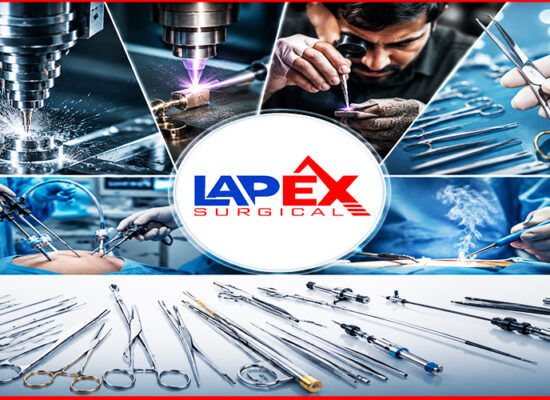
Precision Forging & Machining: Our instruments begin as precisely forged blanks, shaped using advanced drop forging and CNC machining. This ensures accurate patterns and dimensions, laying the groundwork for superior function.
Artisanal Hand Finishing: This is where the Sialkot difference truly shines. Our highly skilled artisans perform meticulous hand-grinding, filing, and polishing to achieve the perfect balance, ergonomic feel, and mirror-smooth finish characteristic of Lapex Surgical instruments. This critical step ensures flawlessly operating joints, perfectly aligned tips, and supreme cutting edges.
Heat Treatment & Hardness Testing: Instruments undergo sophisticated heat treatment processes to achieve optimal hardness and elasticity. Each batch is rigorously tested (e.g., Rockwell hardness test) to guarantee durability without brittleness.
Rigorous Quality Control: Every single instrument undergoes multiple stages of stringent quality inspection. From visual checks for imperfections to functional tests for sharpness, grip, and articulation, nothing is overlooked. We adhere to ISO 13485 (Medical Devices), CE Marking (MDR 2017/745), ISO 9001, ISO 14001, ISO 45001, and GMP/FDA compliance, ensuring complete traceability and consistent excellence.
Passivation & Polishing: A final passivation process enhances corrosion resistance, while various polishing techniques (mirror, satin, sand finish) ensure hygienic surfaces that resist staining and facilitate easy cleaning.
Why Choose Lapex Surgical Instruments?
Choosing Lapex Surgical means choosing instruments crafted with a blend of time-honored tradition and cutting-edge technology. It means choosing:
Unwavering Reliability: Instruments that perform flawlessly, every time.
Exceptional Durability: Tools built to withstand the rigors of repeated sterilization and demanding surgical environments.
Optimal Precision: Designs that facilitate intricate maneuvers and reduce tissue trauma.
Ergonomic Comfort: Instruments that feel balanced and intuitive in the surgeon’s hand, reducing fatigue.
Global Compliance: Products that meet the strictest international safety and quality standards.
Conclusion: The Enduring Power of Foundational Tools
While the operating room will continue to evolve with smart technologies and robotic assistance, the core functions performed by instruments like scalpels, scissors, forceps, retractors, needle holders, loupes, and specula will remain timeless. They are the bedrock upon which all surgical innovation is built.
At Lapex Surgical, we are honored to be the manufacturers of these best surgical instruments, committed to empowering surgeons worldwide with tools that are not just effective but are truly extensions of their skill and precision. From the bustling workshops of Sialkot, we continue our mission to set the global standard for surgical instrument quality, ensuring that every incision, every grasp, and every stitch contributes to better patient outcomes, reinforcing our position at the forefront of surgical excellence.
Frequently Asked Questions (FAQ)
Q1: What are the primary functions of surgical instruments?
A1: Surgical instruments serve various primary functions, including cutting and dissecting (scalpels, scissors), grasping and holding (forceps, clamps), retracting and exposing (retractors, specula), and suturing (needle holders).
Q2: Why are scalpels considered essential surgical instruments?
A2: Scalpels are essential because they are the primary tools for making precise initial incisions through skin and various tissue layers. Their sharpness and variety of blade shapes allow for accurate dissection, crucial at the outset of almost any surgical procedure.
Q3: What's the difference between locking and non-locking forceps?
A3: Non-locking forceps (or thumb forceps) are held by finger pressure and release when pressure is removed, used for grasping delicate tissues. Locking forceps (or clamps/hemostats) have a ratchet mechanism that allows them to remain closed on tissue or a blood vessel without continuous manual pressure, primarily used for hemostasis.
Q4: How do retractors help during surgery?
A4: Retractors are vital for holding back skin, tissue, muscle, or organs to expose the surgical site clearly. They free up a surgeon’s hands or assistant’s hands, protect surrounding structures, and maintain an optimal view throughout the procedure.
Q5: Why are surgical loupes important for surgeons?
A5: Surgical loupes provide magnification of the surgical field, allowing surgeons to see fine details with greater clarity and precision. This enhances accuracy, reduces eye strain, and promotes better ergonomics by allowing the surgeon to maintain a more comfortable working posture.
Q6: What role does Lapex Surgical play in providing these essential instruments?
A6: Lapex Surgical, based in Sialkot, Pakistan, manufactures a comprehensive range of these essential surgical instruments. We ensure unparalleled quality through premium materials, precision forging, artisanal hand-finishing, and rigorous quality control (ISO, CE, FDA compliant), providing surgeons with reliable, durable, and ergonomically superior tools.
Q7: How do you ensure the quality of your surgical instruments?
A7: Our commitment to quality is upheld through multiple stages: selection of high-grade surgical stainless steel, advanced manufacturing processes like CNC machining, meticulous hand-finishing by skilled artisans, precise heat treatment, and multi-stage quality control checks. We adhere strictly to international standards such as ISO 13485 and CE Marking (MDR).