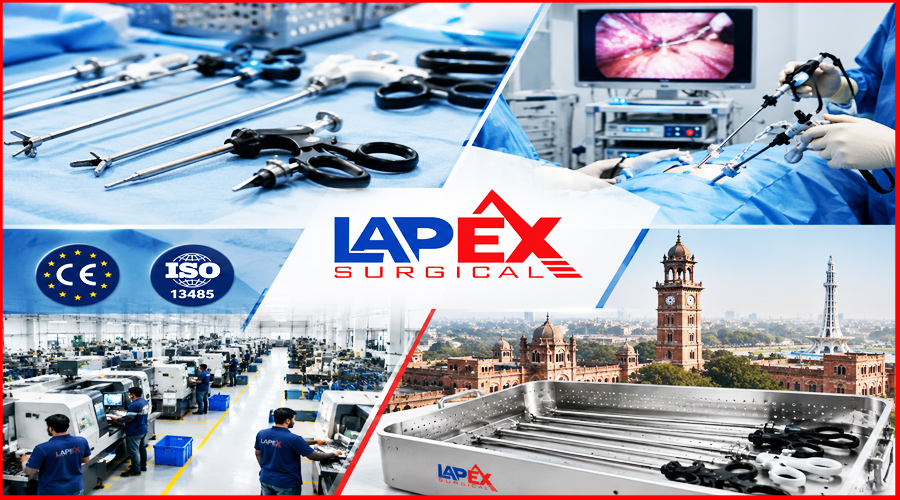
Laparoscopic Instruments from Sialkot: A Buyer’s Guide to Certified Manufacturing, OEM Sourcing & Global Export Standards
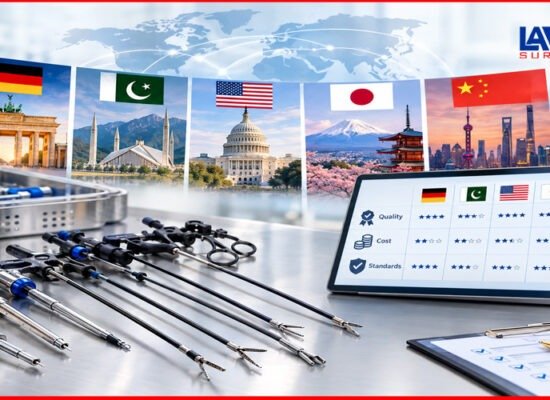
Sialkot, Pakistan, manufactures the majority of the world’s handheld surgical instruments, and laparoscopic tools are now one of its fastest-growing specialties. The best Sialkot manufacturers meet the same certifications as European brands — ISO 13485, CE under MDR, EUDAMED registration, and GMP/FDA compliance — while pricing well below German or US-made equivalents.
The risk in this market isn’t quality; it’s inconsistency, since thousands of small workshops sell alongside a smaller group of genuinely certified, audited manufacturers. Lapex Surgical is built to be in that second group: a Sialkot-based manufacturer specializing in laparoscopic, electrosurgical, and plastic surgery instruments, engineered to match European clinical performance at a fraction of the cost. This guide explains how the industry works, what to check before you order, and where Lapex Surgical fits into that picture.
Why Sialkot Dominates the Global Surgical Instrument Trade
Sialkot’s surgical instrument industry is not a recent development. It traces back over a century, to a period when British colonial doctors had their surgical equipment repaired by local metalworkers. That repair skill evolved, generation by generation, into full-scale manufacturing.
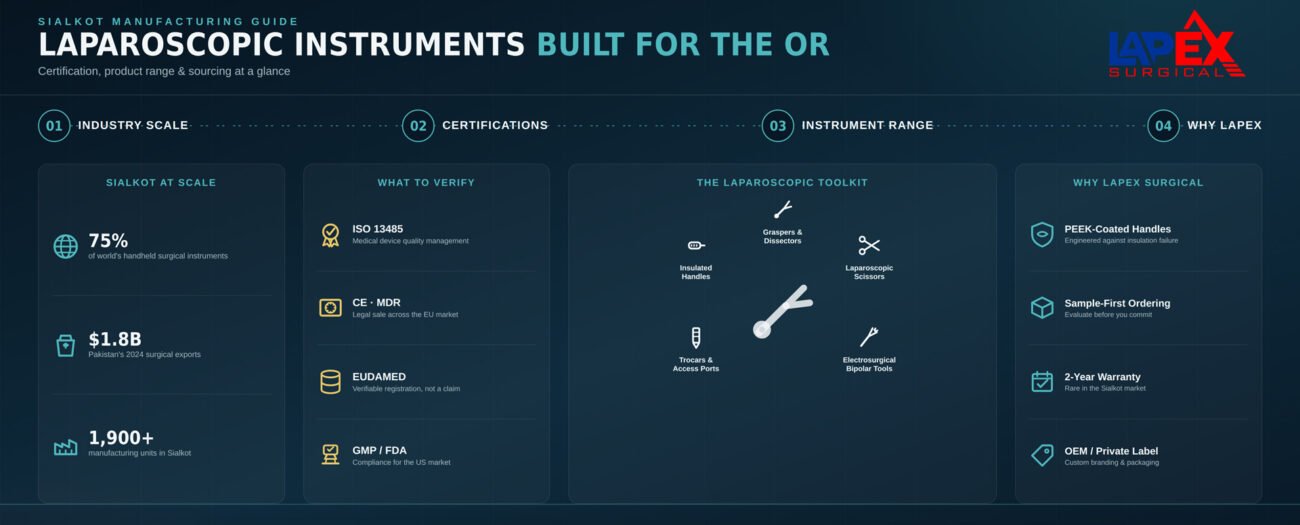
Today, Sialkot is home to roughly 1,900 surgical instrument manufacturing units, employing close to 100,000 skilled workers. An estimated 75% of the world’s handheld surgical instruments originate from this single industrial city.
A few numbers put the scale in perspective:
| Metric | Figure |
|---|---|
| Pakistan’s annual surgical instrument exports (2024) | ~$1.8 billion |
| Growth from 2023 to 2024 | Up from ~$1.5 billion |
| Share of Sialkot production sold internationally | ~95% |
| Pakistan’s global surgical instrument market share | ~2.5% |
| Top export markets | USA, UK, Germany, Italy, Saudi Arabia, UAE |
| Instrument variety produced | Up to 10,000+ distinct types |
Why buyers keep coming back to Sialkot:
- Skilled, generational craftsmanship in metalwork and instrument finishing
- Access to German-grade stainless steel (AISI 316/420 series)
- Lower labor and overhead costs than Western manufacturing hubs
- OEM flexibility — private labeling, custom sets, and logo laser-marking
- A manufacturing base large enough to support both small distributors and container-scale orders
One detail surprises most first-time buyers: several well-known German and European surgical brands already subcontract production to Sialkot factories. The instrument in a premium European catalog and the instrument sold directly from a certified Sialkot manufacturer are often closer in origin than buyers assume.
The Rise of Laparoscopic Instruments as Sialkot’s Growth Category
General surgical tools — forceps, scissors, retractors — built Sialkot’s reputation. Laparoscopic instruments are now driving its next phase of growth, for a simple reason: minimally invasive surgery (MIS) has become the default approach for a growing share of procedures worldwide, and demand for the instruments that make it possible has grown alongside it.
Laparoscopic instrumentation is mechanically less forgiving than open-surgery tools. A grasper or dissector has to work through a 5–10mm port, transmit tactile feedback accurately along its shaft, and maintain insulation integrity if it carries electrosurgical current. This raises the manufacturing bar — and it’s exactly where Sialkot’s best manufacturers, including Lapex Surgical, have chosen to specialize rather than compete purely on general instrument volume.
What “Laparoscopic Instruments” Actually Covers
| Category | Examples | Primary Use |
|---|---|---|
| Graspers & Dissectors | Maryland dissector, atraumatic grasper | Tissue handling and manipulation |
| Scissors | Curved, hook, Metzenbaum-style laparoscopic scissors | Cutting tissue or suture |
| Electrosurgical Instruments | Bipolar forceps, monopolar hooks | Cutting with simultaneous coagulation |
| Access Instruments | Trocars, cannulas | Creating and maintaining the surgical port |
| Retrieval & Suturing Tools | Specimen retrieval bags, needle drivers | Tissue removal and closure |
| Handles & Insulation Systems | Reusable insulated handles, modular click-line systems | Reusable instrument platforms |
Certifications That Actually Matter — And How to Verify Them
Anyone can print “ISO Certified” on a website. What separates a genuinely compliant manufacturer from a marketing claim is whether that certification is verifiable and current.
Core Certifications to Ask For
- ISO 13485 — the international quality management standard specific to medical devices, covering design, production, and post-market surveillance.
- CE Marking under MDR (Medical Device Regulation) — required for legal sale in the European Economic Area; confirms the instrument meets EU safety and performance requirements.
- EUDAMED Registration — the EU’s database for medical devices; a registered entry is a strong signal of MDR compliance, not just a claimed one.
- ISO 9001 — general quality management, often held alongside 13485.
- ISO 14001 & ISO 45001 — environmental and occupational health/safety management, increasingly requested by hospital procurement teams doing ESG due diligence.
- GMP / FDA Compliance — relevant for buyers supplying the US market.
How to Verify a Certificate Instead of Trusting It
- Ask for the certificate number and the issuing Notified Body name.
- Search that Notified Body’s number in the EU’s NANDO database or the manufacturer’s EUDAMED entry.
- Confirm the certificate scope actually covers “laparoscopic instruments” — some certificates are scoped narrowly to general surgical tools only.
- Check the certificate’s expiry date; medical device certifications are time-bound and require periodic re-audit.
Lapex Surgical maintains ISO 13485, ISO 9001, ISO 14001, ISO 45001, CE certification under MDR, a registered European Representative, EUDAMED registration, and GMP/FDA compliance — documentation available on request for every product line, not just a general company certificate.
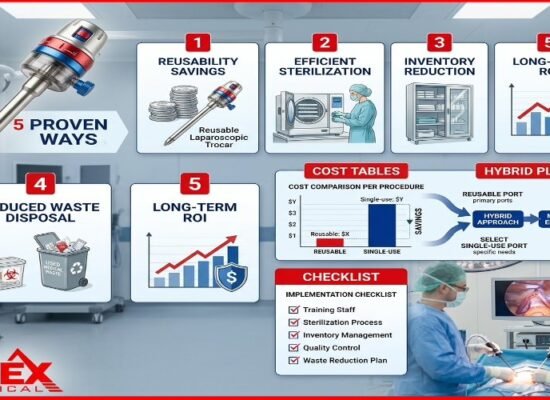
Reusable vs. Single-Use Laparoscopic Instruments: A Real Buying Decision
This is one of the most common questions procurement teams ask, and the right answer depends on volume, sterilization capacity, and total cost of ownership — not just upfront price.
| Factor | Reusable Instruments | Single-Use Instruments |
|---|---|---|
| Upfront cost per unit | Higher | Lower |
| Cost over 50+ procedures | Typically lower | Higher (repeated purchase) |
| Sterilization requirement | Yes — autoclave cycle needed | None |
| Consistency of performance | Depends on maintenance & reprocessing quality | Consistent, factory-fresh every time |
| Environmental impact | Lower waste | Higher disposable waste |
| Best fit | High-volume hospitals with sterilization infrastructure | Ambulatory surgical centers, lower-volume clinics, and infection-control-sensitive procedures |
A frequent failure point in the reusable category is insulation failure on electrosurgical handles, where the outer coating degrades after repeated sterilization cycles, creating a stray-current risk during procedures. This is a known weak spot across cheaper Sialkot exports. Manufacturers who use PEEK-coated, steel-insulated handles and test insulation integrity as part of batch QC solve this problem at the source rather than leaving it to the hospital’s sterile processing department to catch.
Inside the Manufacturing Process: What Separates a Premium Sialkot Instrument
A laparoscopic instrument that looks identical to a competitor’s on a spec sheet can perform very differently in a surgeon’s hand. The difference comes down to process, not just materials.
1. Raw Material Selection
Premium manufacturers use certified AISI 316 or 420-series stainless steel, sourced with traceable mill certificates — not generic scrap-grade steel, which is more common among lower-cost, uncertified exporters.
2. Precision Machining & Hand-Finishing
Shafts, jaws, and ratchets are machined to tight tolerances, then hand-finished by craftsmen — many with 20+ years of experience — to achieve the tactile “feel” surgeons rely on for fine tissue handling.
3. Insulation & Electrosurgical Safety Testing
For bipolar and monopolar tools, insulation is tested under simulated repeated-use conditions, not just checked once at the factory before shipping.
4. Batch-Level Quality Control
Every batch undergoes:
- Optical dimensional checks using calibrated measuring equipment
- Performance matrix evaluation (grip force, jaw alignment, cutting action)
- 100% visual inspection before packing
5. Documentation & Traceability
Each batch is tied to a lot number, material certificate, and QC record — critical for hospitals and distributors who need traceability for regulatory audits or recalls.
Lapex Surgical: Where We Fit Into This Industry
Lapex Surgical is a Sialkot-based manufacturer built specifically around the categories that demand the most precision: laparoscopic instruments, electrosurgical tools, and plastic surgery instruments, alongside broader surgical instrument manufacturing.
What We Manufacture
- Laparoscopic Instruments — Maryland dissectors, atraumatic graspers, trocar systems, laparoscopic scissors, in both modular (Click-Line) and monolithic designs
- Electrosurgical Tools — bipolar forceps and monopolar hooks engineered for safe, efficient cutting and coagulation
- Plastic Surgery Instruments — fine-tolerance tools for procedures where finish and precision are non-negotiable
- General & Specialty Surgical Sets — customized hospital sets (appendectomy, hysterectomy, and other procedure-specific trays)
Why Surgeons and Distributors Choose Lapex Surgical
- Reusable insulated handles with PEEK coating — engineered specifically to prevent the insulation-failure problem common in lower-cost instruments
- Full certification stack — ISO 13485, ISO 9001, ISO 14001, ISO 45001, CE (MDR), EUDAMED registration, GMP/FDA compliance
- Sample-first ordering — we provide samples before any bulk commitment, so your surgical team can evaluate feel and performance firsthand
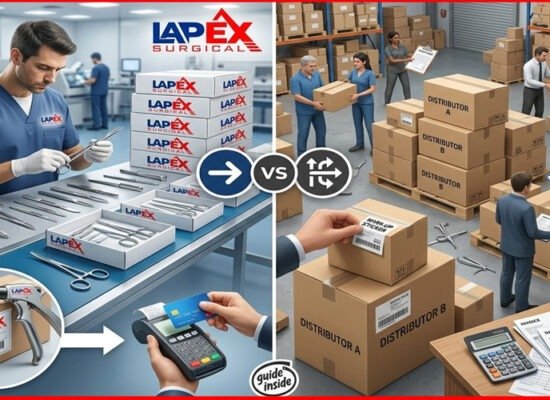
- OEM & private-label services — laser-marked branding, custom packaging, and tailored specifications for distributors building their own product lines
- 2-year manufacturing defect warranty — uncommon in the Sialkot market, where most exporters offer no warranty at all
- 24/7 international support — built around the time-zone gap our global partners deal with daily
- Flexible order volumes — from low-MOQ orders for smaller distributors to full container shipments for large-scale buyers
A Practical Sourcing Checklist for International Buyers
Before placing an order with any Sialkot manufacturer — Lapex Surgical included — run through this checklist:
- Request the certificate and Notified Body number, and verify it independently rather than taking it at face value.
- Ask for a sample batch before committing to bulk. No credible manufacturer should discourage this step.
- Confirm steel grade and traceability documentation for the specific instrument line you’re ordering, not just a general company brochure.
- Clarify warranty terms in writing — manufacturing defect coverage varies widely across the market.
- Ask about insulation testing protocols if ordering electrosurgical or reusable laparoscopic tools.
- Understand shipping logistics — most exporters use DHL or FedEx for small orders and air/sea freight for container-level shipments; confirm customs clearance support is included.
- Check MOQ flexibility if you’re a smaller distributor building initial market presence before scaling up.
Use Cases: Matching the Right Instrument Category to Your Business
| Buyer Type | Priority | Recommended Approach |
|---|---|---|
| Hospital procurement teams | Sterilization compatibility, long-term cost control | Reusable insulated laparoscopic instruments with documented warranty |
| Ambulatory surgical centers | Infection control, consistent quality without in-house reprocessing | Single-use laparoscopic instruments |
| Distributors building a private label | OEM flexibility, branding, and competitive landed cost | Custom-branded laparoscopic and electrosurgical sets with sample evaluation first |
| Surgeons directly evaluating new suppliers | Tactile feel, precision, safety | Small sample order of Maryland dissectors, graspers, or bipolar forceps before switching suppliers |
Frequently Asked Questions
Are laparoscopic instruments from Sialkot as good as German or US-made equivalents?
When manufactured with the same AISI steel grades and ISO 13485-compliant processes, clinical performance is comparable to European-made instruments. The primary difference is labor and overhead cost, not material quality or engineering standard — provided you’re sourcing from a properly certified manufacturer rather than an uncertified low-cost exporter.
How do I know if a manufacturer’s CE certificate is genuine?
Ask for the certificate number and the issuing Notified Body, then verify that number independently through the EU’s NANDO database or the manufacturer’s EUDAMED registration. A manufacturer confident in its compliance will provide this without hesitation.
Is it true that major medical brands manufacture in Sialkot?
Yes. Several well-known German and European surgical brands subcontract production, or source OEM components, from established Sialkot manufacturers — a strong third-party validation of the region’s manufacturing capability.
What’s the biggest quality risk when sourcing laparoscopic instruments from Pakistan?
Insulation failure on reusable electrosurgical handles is a recurring issue with lower-cost exporters, since repeated sterilization cycles can degrade cheaper insulation coatings over time. Manufacturers using PEEK-coated insulated handles and batch-level insulation testing address this directly.
Should I order a sample before placing a bulk order?
Always. Any manufacturer that discourages sampling before bulk commitment is a red flag. A sample lets your surgical team confirm tactile feel, jaw alignment, and cutting performance before you commit to a container-level order.
Does Lapex Surgical offer OEM and private-label manufacturing?
Yes. Lapex Surgical supports custom branding, laser-marked logos, tailored packaging, and instrument specifications built around a distributor’s own product line, alongside standard catalog ordering.
What warranty coverage is typical in this market?
Warranty coverage varies significantly, and many Sialkot exporters offer none. Lapex Surgical provides a standard 2-year warranty against manufacturing defects, which is uncommon in this market and worth confirming in writing with any supplier you evaluate.
The Bottom Line for Buyers
Sialkot’s surgical instrument industry is large, mature, and genuinely capable of matching European clinical standards — but the market rewards buyers who verify credentials rather than buy on price alone. Certification numbers, sample evaluation, insulation testing, and written warranty terms are the difference between a supplier relationship that scales safely and one that creates risk in the operating room.
Lapex Surgical was built around that distinction: full certification (ISO 13485, ISO 9001, ISO 14001, ISO 45001, CE under MDR, EUDAMED registration, GMP/FDA compliance), PEEK-coated insulated handles engineered against insulation failure, sample-first ordering, OEM and private-label flexibility, and a 2-year manufacturing defect warranty most competitors don’t offer.
Ready to evaluate Lapex Surgical for your laparoscopic instrument sourcing?
- Request a sample of our Maryland dissectors, bipolar forceps, or trocar systems before any bulk commitment
- Download our full product catalog to review our complete laparoscopic, electrosurgical, and plastic surgery instrument range
- Ask our team for certificate verification details, including Notified Body numbers, for full transparency
- Get a custom quote for OEM/private-label branding or a procedure-specific instrument set
Contact Lapex Surgical, Industrial Estate, Sialkot, Pakistan — Precision. Safety. Excellence.