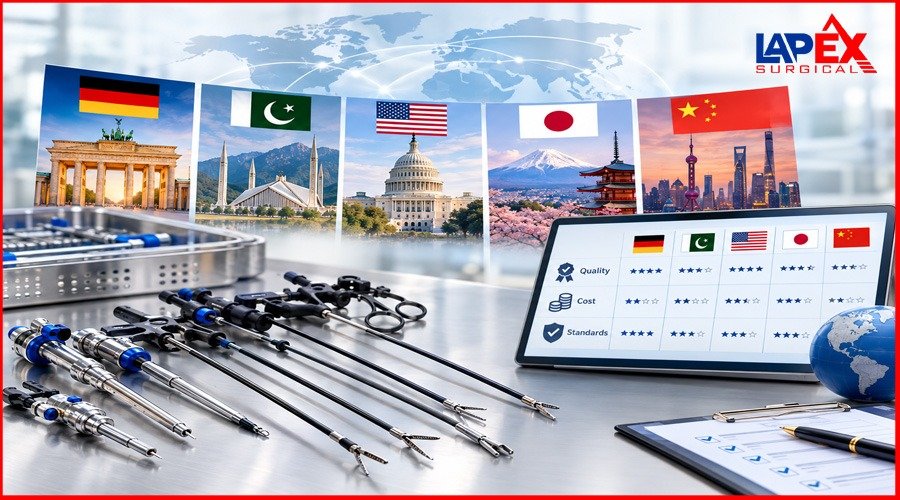
The Ultimate Buyer’s Guide: Which Country Makes the Best Laparoscopic Instruments?
No single country wins in every category. Germany leads in premium precision and brand trust. Pakistan leads in value for money, especially from Sialkot. The United States leads in advanced technology and robotics. Japan leads in optics and fine detail. China leads in low prices and large volume.
The “best” country depends on what you need:
- Best for top-tier precision and reputation: Germany
- Best for quality at a fair price (reusable instruments): Pakistan
- Best for new technology and powered devices: United States
- Best for optics and delicate work: Japan
- Best for the lowest cost and single-use items: China
Below, you’ll see how each country compares, and how to pick the right supplier for your hospital or brand.
Quick Comparison Table
| Factor | Germany | Pakistan | United States | Japan | China |
|---|---|---|---|---|---|
| Quality reputation | Very high | Good to high (varies by maker) | Very high | Very high | Mixed |
| Price level | Highest | Low to mid | High | High | Lowest |
| Main strength | Precision steel work | Value and OEM flexibility | Innovation, robotics | Optics, fine tools | Scale, single-use |
| Main hub | Tuttlingen | Sialkot | Minnesota, Massachusetts, California | Tokyo, Osaka regions | Shanghai, Jiangsu, Guangdong |
| Best for | Premium hospitals | Distributors, OEM brands, mid-budget hospitals | Advanced surgery centers | Specialty optics | High-volume buyers |
| Customization | Limited, costly | Strong | Limited | Limited | Strong |
Note: These are general trends. Quality depends on the individual factory, not just the country.
Why “Country of Origin” Matters (And Why It Doesn’t Tell the Whole Story)
A country’s name on a box gives you a clue. It does not give you a guarantee.
Some countries have a long history of making surgical tools. They have trained workers, strong supply chains, and local rules that push makers to do better. That is why many buyers start their search by country.
But a poor factory in a great country can still make poor tools. A great factory in a lower-cost country can make excellent ones.
So use country as a starting filter. Then check the factory itself. We will show you how later in this guide.
What Makes a Laparoscopic Instrument “Good”?
Laparoscopic instruments are long, thin tools. Surgeons use them through tiny cuts in the body. Because they are so thin and so long, small flaws cause big problems.
Here is what to judge:
1. Material Quality
Most reusable instruments use stainless steel. The grade matters. Common grades include:
- AISI 304: Used for non-cutting parts. Resists rust well.
- AISI 316L: Used where extra rust resistance is needed.
- AISI 410 and 420: Harder steels. Used for jaws, scissors, and cutting parts.
- AISI 440: Very hard. Holds an edge well.
Steel that is too soft bends and dulls. Steel that is too hard can snap. Good makers balance both.
2. Precision Engineering
Jaws must close evenly. Shafts must be straight. Ratchets must lock and release smoothly. Even a tiny gap can cause tissue slipping or poor grip.
3. Insulation Quality
Many laparoscopic tools carry electric current. The coating on the shaft must have no cracks. A damaged coating can burn tissue outside the surgeon’s view. This is a major patient safety risk.
4. Finish and Corrosion Resistance
A good finish makes cleaning easier. A weak finish traps dirt and blood. That raises infection risk and shortens tool life.
5. Compliance and Paperwork
Look for documents that prove quality. We cover these in the standards section below.
Germany: The Premium Standard
The Tuttlingen Story
Germany’s surgical tool industry centers on Tuttlingen, a small city in southern Germany. People often call it the “world capital of medical technology.” Hundreds of medical device firms work in and around the city. Many are small, family-owned workshops that have passed skills down for generations.
Strengths
- Material control: German makers often use high-grade steel from trusted mills.
- Precision: Tight tolerances and careful hand finishing.
- Brand trust: Surgeons around the world know and request German brands.
- Long tool life: Well-made reusable tools can last for years with correct care.
Weaknesses
- High price: Labor and material costs are high.
- Long lead times: Smaller workshops may not scale quickly.
- Limited custom work: OEM and private-label options exist, but cost more and often need large orders.
A Note on “German Surgical Steel”
You will see the phrase “German surgical steel grade” on many websites. Be careful. It is not a legal grade. It is a marketing phrase. Some tools called “German steel” are not made in Germany at all.
Always ask for the exact steel grade (like 420 or 440) and the mill certificate. A real supplier will share them.
Best For
University hospitals, high-end private clinics, and buyers who want a well-known premium brand and have a larger budget.
Pakistan: The Value Leader from Sialkot
The Sialkot Story
Pakistan’s surgical tool industry sits mainly in Sialkot, a city in Punjab. The trade has been active here for well over a century. Today, the city has hundreds of surgical instrument makers. Many export to Europe, North America, the Middle East, and Africa.
Sialkot makers often supply tools that are later sold under European or American brand names. That is called OEM or private-label work.
Strengths
- Strong value: Prices are lower than in Germany, Japan, or the U.S.
- Skilled workforce: Generations of craftspeople work in this region.
- OEM flexibility: Makers accept custom designs, private labels, and smaller order sizes.
- Wide range: Surgical, electrosurgical, plastic surgery, dental, and laparoscopic instruments are all made here.
- Reusable tool focus: The region is especially strong in reusable stainless steel instruments.
Weaknesses
- Uneven quality: Sialkot has top-tier factories and weak ones. Checking the maker matters a lot.
- Branding gap: Some buyers still link the region with low prices only.
- Infrastructure issues: Power cuts and shipping delays can happen. Good factories plan for this.
How to Spot a Strong Sialkot Supplier
- Holds ISO 13485 certification
- Holds CE marking for products sold in Europe
- Shares steel certificates
- Allows factory audits or video tours
- Offers sample kits before big orders
- Has clear cleaning and sterilization guidance
Example: Choosing a Sialkot Partner
Lapex Surgical (the manufacturer of Surgical, Electrosurgical, Plastic Surgery Instruments, and Laparoscopic instruments from Sialkot) is one example of a producer in this region that serves hospitals, distributors, and brand owners. When you compare suppliers like this, ask for documents first, then samples, then a small trial order.
Best For
Distributors, OEM brand managers, and hospitals that want solid quality at a fair price.
United States: The Innovation Engine
Where It Shines
The U.S. leads in new designs. Many powered devices, energy tools, stapling systems, and robotic surgery platforms start here. Large firms spend heavily on research and testing. Clinical trials and surgeon feedback shape the products.
Strengths
- Advanced tech: Robotics, smart energy devices, and advanced staplers.
- Strong testing: Heavy research and clinical data.
- Strict oversight: The FDA reviews medical devices before many can be sold.
- Good support: Training, service contracts, and surgeon education.
Weaknesses
- High cost: Devices and service plans are expensive.
- Single-use focus: Many products are disposable, which adds ongoing cost and waste.
- Locked systems: Some tools only work with one brand’s platform.
Note on Where Parts Are Made
Large U.S. brands often make some parts or whole products in other countries. The company is American, but the factory may not be. Check the “Made in” label.
Best For
Advanced surgery centers, hospitals using robotic systems, and teams that need the newest technology.
Japan: The Optics and Detail Expert
Where It Shines
Japan is famous for fine optics and careful engineering. Many of the world’s top endoscope cameras and scopes come from Japanese firms. Japanese makers also produce very fine, delicate tools used in precise work.
Strengths
- Excellent optics: Sharp images, good color, and strong durability.
- Fine detail work: Very small, delicate parts made with care.
- Reliability: Low failure rates and consistent output.
Weaknesses
- High price: Costs are close to German or U.S. levels.
- Less OEM flexibility: Custom work is limited.
- Smaller range of basic tools: Japan is stronger in scopes and specialty items than in low-cost standard hand instruments.
Best For
Hospitals that need top-tier cameras, scopes, and fine specialty tools.
China: The Volume and Price Leader
Where It Shines
China is the world’s biggest producer of many medical products. Huge factories can make large amounts quickly. This is especially true for single-use (disposable) laparoscopic tools, such as trocars and some graspers.
Strengths
- Lowest prices: Large scale cuts costs.
- Fast output: Big factories fill large orders quickly.
- Strong supply chain: Plastics, electronics, and metal parts are easy to source locally.
- Rising quality at top firms: Several leading Chinese makers now meet high international standards.
Weaknesses
- Wide quality gap: The best factories are excellent. The worst are risky.
- Reusable tool durability: Some low-cost reusable tools wear out faster.
- Trade and tariff changes: Import rules and duties can shift costs.
- Intellectual property worries: Some buyers worry about design protection.
Best For
High-volume buyers who need disposable items at the lowest price, as long as they audit the supplier carefully.
Reusable vs. Single-Use Laparoscopic Instruments
This choice matters as much as the country.
| Factor | Reusable | Single-Use |
|---|---|---|
| Upfront cost | Higher | Lower |
| Long-term cost | Lower (spread over many uses) | Higher (you buy each time again) |
| Waste | Less | More |
| Cleaning needs | Strict cleaning and sterilizing | None |
| Risk of poor cleaning | Possible if staff skip steps | None |
| Consistency | Can wear down over time | Fresh and sharp each time |
| Best for | Busy hospitals with a good sterilization unit | Low-volume use or limited sterilization capacity |
A Simple Example
Say a hospital does 500 laparoscopic surgeries a year. A single-use grasper costs a few dollars each time. A good reusable grasper costs more at first but can be used many times. Over a year or two, the reusable one often costs less per surgery.
But this only works if your sterilization team is well trained. If cleaning is weak, reusable tools can become a risk.
Many hospitals use a mix: reusable for common tools and single-use for special cases.
Standards and Certifications to Check
Whatever the country, ask for proof. Here are the main documents.
ISO 13485
This is the global quality management standard for medical device makers. It shows the factory follows set steps for design, production, testing, and record-keeping. If a supplier does not hold it, think twice.
CE Marking
Needed to sell medical devices in the European Union. Under the EU’s Medical Device Regulation (MDR), rules are strict. Ask for the certificate and check the issuing body.
FDA Registration or Clearance
Needed for sale in the United States. Registration alone is not the same as approval. Ask what the product’s status is.
Other Useful Proofs
- Mill test certificates for steel
- Biocompatibility reports for parts that touch tissue
- Sterilization validation data for reusable tools
- Batch tracking so each product can be traced
- Insulation test results for electrosurgical shafts
Quick Tip
Ask to see the certificate numbers. Then check them with the issuing body. This takes a few minutes and can save you from fake papers.
Cost Comparison: What You Might Expect to Pay
Prices change by product, order size, and grade. This table shows relative levels only.
| Country | Relative Price (Reusable Instruments) | Typical Minimum Order |
|---|---|---|
| Germany | Highest ($$$$) | Medium to high |
| United States | High ($$$$) | High |
| Japan | High ($$$) | Medium to high |
| Pakistan | Low to mid ($$) | Low to medium |
| China | Lowest ($) | Medium to high |
Look Beyond the Price Tag
The cheapest tool is not always the cheapest choice. Think about:
- Lifespan: How many uses before it wears out?
- Repair costs: Can the maker fix or replace parts?
- Shipping and duties: Do they add much?
- Downtime: What if a tool fails during surgery?
Total cost of ownership tells the real story.
How to Choose the Right Supplier: A 7-Step Checklist
- Define your need. Reusable or single-use? Which tools? What volume?
- Set your budget. Think in total cost, not just unit price.
- Shortlist by region. Pick two or three countries that fit your needs.
- Request documents. Ask for ISO 13485, CE, FDA papers, and steel certificates.
- Order samples. Test grip, jaw alignment, ratchet feel, and insulation.
- Audit the factory. Visit in person or ask for a live video tour.
- Start small. Place a trial order before a full contract.
What to Test in Samples
- Do the jaws close evenly?
- Does the shaft stay straight?
- Is the insulation smooth and unbroken?
- Do the handles feel comfortable?
- Does the tool disassemble easily for cleaning?
- Does it hold up after repeated sterilization cycles?
Let your surgeons try them. Their feedback matters most.
Which Country Makes the Best Laparoscopic Instruments?
Quality, cost, and innovation at a glanceFive Hubs Compared
Price Level (Reusable Tools)
Reusable or Single-Use?
Ask for These Papers
How to Pick a Supplier
Avoid These Mistakes
Common Mistakes Buyers Make
- Trusting the label. “German steel” or “Premium grade” means little without papers.
- Picking on price alone. Cheap tools can cost more in the long run.
- Skipping samples. Photos do not show feel or finish.
- Ignoring after-sales support. Ask who handles repairs and replacements.
- Forgetting sterilization needs. Make sure your team can clean the tools you buy.
- Not checking compatibility. Confirm shaft diameter (like 5 mm or 10 mm) matches your trocars and equipment.
Final Verdict: Which Country Is Best?
Here is the simple answer again.
- Pick Germany if you want a premium name and have the budget.
- Pick Pakistan (Sialkot) if you want strong value, custom branding, and reusable instruments at a fair price.
- Pick the United States if you need the latest technology and powered systems.
- Pick Japan if optics and fine detail are your top needs.
- Pick China if you need low-cost, high-volume disposable products.
For many distributors and mid-sized hospitals, Sialkot-based manufacturers offer the best balance of cost and quality, as long as the factory is certified and transparent. Lapex Surgical (the manufacturer of Surgical, Electrosurgical, Plastic Surgery Instruments, and Laparoscopic instruments from Sialkot) fits this profile for buyers who want a certified partner with a broad product range.
The smartest move is to compare two or three suppliers, test samples, and judge them on facts.
Frequently Asked Questions
Which country makes the best laparoscopic instruments?
Germany is known for top precision. The U.S. leads in new technology. Pakistan offers the best value for reusable tools. The best choice depends on your budget and needs.
Is German surgical steel really better?
It can be, but “German surgical steel” is not a legal grade. Always check the exact steel type and the mill certificate.
Are Pakistani surgical instruments good quality?
Many are. Sialkot has a long history of making surgical tools. Quality varies by factory, so check for ISO 13485, CE marking, and samples before ordering.
What is Tuttlingen known for?
Tuttlingen is a city in Germany with a very high number of medical device makers. It is often called the world center of surgical technology.
Should I buy reusable or single-use laparoscopic instruments?
If you have a strong sterilization process and high surgery volume, reusable tools often cost less over time. If sterilization is limited, single-use may be safer and simpler.
What does ISO 13485 mean?
It is an international standard for medical device quality systems. It shows a factory follows strict rules for design, production, and records.
Can I get private-label or OEM laparoscopic instruments?
Yes. Many Sialkot and Chinese manufacturers offer OEM and private-label options. Germany and the U.S. do too, but often at higher cost and larger minimum orders.
How do I verify a supplier’s certificates?
Ask for the certificate number and contact the issuing body. You can also request audit reports and third-party test results.
How long do reusable laparoscopic instruments last?
It depends on the build, steel grade, and care. With proper cleaning and handling, good-quality tools can last for years. Regular inspection is key.
What is the biggest risk when buying surgical instruments online?
Fake or missing certificates, and tools that do not match the photos. Always request samples first.
Ready to Source with Confidence?
Looking for certified, high-precision laparoscopic instruments tailored to your healthcare facility or distribution brand? Contact our medical procurement specialists today to request a custom quote and material sample kit.
👉 Visit https://lapexsurgical.com