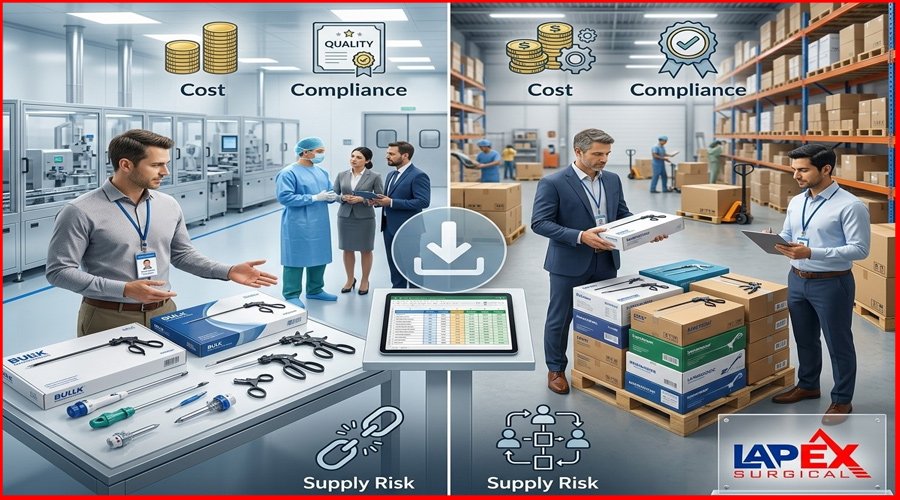
Bulk Laparoscopic Tools: Direct Maker vs. Medical Distributor, Cost, Compliance, and Supply Chain Optimization Guide for Procurement Officers
Buying bulk laparoscopic tools straight from an OEM usually lowers your unit cost. It also gives you more control over specs and repairs. But it puts more work and risk on your team: import rules, longer lead times, and quality checks.
Distributors cost more per item. In return, they hold stock, ship fast, and handle much of the paperwork.
For most hospitals and surgical centers, the best answer is a hybrid model. Buy high-volume, steady-demand reusable instruments direct. Keep a distributor or GPO contract for urgent, low-volume, and disposable items.
This guide shows you how to decide, item by item.
Quick Comparison: OEM Direct vs. Distributor
| Factor | OEM Direct | Distributor / GPO |
|---|---|---|
| Unit price | Lower | Higher (includes margin) |
| Total landed cost | Needs careful math | Simple, often one price |
| Lead time | Longer (weeks) | Short (days) |
| Minimum order | Often higher | Often flexible |
| Compliance paperwork | More on your side | More on the distributor’s side |
| Customization | Strong (specs, branding, sizes) | Limited |
| Repair and warranty | Direct with maker | Goes through a middleman |
| Emergency stock | You must build it | Distributor holds it |
| Best for | High-volume, steady items | Urgent, mixed, or low-volume items |
What Each Buying Model Means
OEM Direct Sourcing
An OEM (original equipment manufacturer) makes the instrument. You buy from the factory with no middle layer. You deal with the maker on price, specs, shipping, and after-sales support.
Some OEMs also make instruments under your own brand or private label. That is called OEM or ODM work.
Medical Distributors
A distributor buys from many makers and sells to many hospitals. It stocks products, ships locally, and often bundles orders. You pay for that convenience through a markup.
GPOs (Group Purchasing Organizations)
A GPO is a buying group. It negotiates contracts for many hospitals at once. Your hospital may get set prices and a list of approved vendors. GPO contracts often come with volume commitments. Breaking those can cost you price tiers or rebates.
Cost Breakdown: Look Past the Unit Price
A low factory price can fool you. What matters is landed cost. That is the full price of getting the instrument to your OR shelf.
What goes into landed cost
- Unit price
- Freight and insurance
- Import duties and taxes
- Customs broker fees
- Incoming inspection or lab testing
- Cost of holding extra stock
- Currency swings
- Staff time to manage the process
A simple example (made-up numbers)
Say you buy 500 reusable 5 mm laparoscopic graspers.
| Cost item | Distributor (per unit) | OEM Direct (per unit) |
|---|---|---|
| Instrument price | $95 | $62 |
| Freight and insurance | Included | $4 |
| Duties and broker | Included | $5 |
| Inspection and testing | Included | $3 |
| Extra stock and currency risk | Included | $4 |
| Landed cost | $95 | $78 |
Savings: $17 per unit, or about 18%. On 500 units, that is $8,500.
These numbers are only for showing the math. Your real figures will differ. Ask for quotes from both sides and fill in your own table.
Where direct sourcing saves the most
Direct buying pays off when you:
- Order the same items again and again
- Order large volumes
- Can forecast demand for 6 to 12 months
- Have staff who can manage imports (or a good freight partner)
Where distributors win
Distributors often win when you:
- Need small quantities
- Need items this week
- Buy many different brands
- Have a GPO contract with strong tier pricing
Reusable vs. Disposable Laparoscopic Instruments: Cost
This choice changes your cost more than the supplier does.
Reusable instruments cost more up front. You spread that cost over many uses. But you also pay for cleaning, sterilizing, inspection, and repair.
Disposable instruments cost less per unit to buy. You use them once and throw them away. You avoid reprocessing, but you pay again for every case, and you create more waste.
A simple per-use example (made-up numbers)
| Reusable grasper | Disposable grasper | |
|---|---|---|
| Purchase price | $80 | $35 |
| Expected uses | 50 | 1 |
| Purchase cost per use | $1.60 | $35.00 |
| Reprocessing cost per use | $8.00 | $0 |
| Cost per use | $9.60 | $35.00 |
Reprocessing cost differs a lot from hospital to hospital. Count labor, water, sterilant, and repairs. Use your own sterile processing department’s numbers.
Some surgeons prefer disposables for sharpness or feel. Some sterile processing teams prefer them because they remove cleaning risk. Ask both groups before you switch.
Also check how each item is used. High-use, standard tools like graspers, scissors, and dissectors often suit reusable models. Specialty or single-patient items may suit disposables.
Compliance and Quality: Who Carries the Risk?
This is where many direct-buy plans go wrong. A low price means nothing if the product cannot legally enter your country or fails in the OR.
What to check on any supplier
ISO 13485 is the quality management standard for medical device makers. Ask for the certificate. Then check three things:
- Is it current (not expired)?
- Does the scope cover the products you want?
- Was it issued by a recognized certification body?
An ISO 13485 certificate shows the maker runs a proper quality system. It does not, by itself, approve a product for sale in your market.
2. Market approval
- European Union: Look for CE marking under the EU MDR (Regulation 2017/745). A maker outside the EU needs an EU authorized representative. Depending on the device class, a notified body certificate may also be needed. If you’re seeking MDR-compliant minimally invasive tools, ask for the Declaration of Conformity and the certificate details.
- United States: Many laparoscopic instruments are Class II devices. Many need FDA 510(k) clearance. Some simple manual instruments are exempt. Check the FDA’s device databases and confirm the maker’s registration and listing.
- Other countries: Rules differ. Ask your regulatory team what your country requires.
3. Traceability and labels
You need clear lot numbers, unique device identifiers (UDI) where required, and instructions for use. These help you track instruments and run recalls.
4. Material and reprocessing data
For reusable tools, ask for:
- Stainless steel grade and material certificates
- Validated cleaning and sterilization instructions
- Expected number of reprocessing cycles
How the risk shifts
When you buy from a distributor, the distributor has legal duties too. Under EU MDR, for example, distributors must check CE marking, labels, and instructions before selling.
When you buy direct, you may become the importer of record. That adds duties and paperwork. Talk to your regulatory and legal teams before your first order.
Supply Chain and Lead Times
The direct route
Direct orders mean production time plus shipping time. Air freight is fast but costly. Sea freight is cheaper but slower and can face delays at ports.
Plan for:
- Production lead time
- Shipping time
- Customs clearance
- Inspection before release to the OR
How to lower the risk
- Keep safety stock. Hold enough to cover the longest likely delay.
- Use blanket orders. Agree on a yearly volume with scheduled shipments.
- Split shipments. Don’t put everything on one boat.
- Use a backup source. Keep one distributor on file.
- Set clear Incoterms. Terms like FOB, CIF, or DDP decide who pays for and carries risk at each stage.
The distributor route
Distributors carry local stock. Delivery may take a day or two. That is a big help for emergencies and last-minute case changes. But distributors also face shortages. If a maker is late, the distributor is late too.
Warranty, Repairs, and Support
Reusable instruments wear out. Jaws loosen. Insulation cracks. Ratchets slip. Good after-sales support matters as much as the purchase price.
With OEM direct:
- You talk to the people who built the tool
- Repair and replacement can be faster and cheaper
- Design changes are easier to request
- You may need to ship items overseas for repair
With a distributor:
- One contact handles returns
- Local service may be easier
- You may wait longer for answers from the maker
- Some distributors do not repair at all
Ask every supplier these questions:
- What does the warranty cover, and for how long?
- Who pays for shipping on a defective item?
- How long does a repair or replacement take?
- Do you offer a loaner or replacement stock?
GPO vs. OEM Direct
If you’re in the US, this may be your biggest question.
GPO contracts often bring:
- Pre-negotiated prices
- Vetted vendors
- Less contracting work for your team
But they may also bring:
- Volume commitments
- Rebates tied to staying on contract
- Limits on off-contract buying
Before you go direct, read your GPO agreement. Find out:
- How much can you buy off-contract?
- Will you lose rebates or tier pricing?
- Are some product categories carved out?
Sometimes a GPO price is already close to the direct price. Compare them line by line. Don’t guess.
The Hybrid Model: A Practical Plan
Most procurement teams do best by splitting their spend.
Step 1: Sort your items
Pull 12 months of purchase data. Sort items into three groups:
| Group | Description | Best channel |
|---|---|---|
| A | High volume, steady use, standard specs | OEM direct |
| B | Medium volume, some variation | Distributor or GPO, with direct quotes for comparison |
| C | Low volume, urgent, or specialty | Distributor |
Step 2: Start small
Pick five to ten Group A items. Order direct as a pilot. Compare cost, quality, and delivery against your current supplier.
Step 3: Test before you scale
- Inspect the first shipment closely
- Get feedback from surgeons and sterile processing staff
- Track defects and repair rates
Step 4: Keep a safety net
Keep your distributor as a backup. Keep a small emergency stock on site.
Step 5: Review every quarter
Look at cost per case, on-time delivery, defect rate, and repair time. Adjust the split as you learn.
One example of a maker that supports this kind of plan is Lapex Surgical (a manufacturer of Surgical, Electrosurgical, Plastic Surgery, and Laparoscopic instruments from Sialkot). Sialkot, Pakistan, is a well-known hub for surgical instrument production, and makers there often serve both direct buyers and distributors. Whichever maker you consider, hold them to the checklist below.
Bulk Laparoscopic Tools: OEM Direct vs Distributor
Quick compare
Compare landed cost, not unit price
Reusable vs disposable: cost per use
Reusable grasper
Disposable grasper
Check every supplier
ISO 13485
Market approval
Traceability
Reprocessing data
Plan for supply delays
A direct order has four stages
Five ways to cut the risk
Read your GPO deal first
The hybrid plan
Five steps to start
Ready to audit your OR instrument spending?
Manufacturer Vetting Checklist
Before placing a bulk order, confirm the following:
- Valid ISO 13485 certificate with the right scope
- CE marking, FDA registration, or other approvals your market needs
- Material certificates for each lot
- Sample instruments tested by your OR and sterile processing team
- Clear reprocessing instructions
- Written warranty terms
- Lead times and minimum order quantities in writing
- Packaging and labeling that meet your rules
- References from other hospitals or distributors
- A named contact for quality issues
If a supplier can’t provide these, walk away. Price does not make up for missing paperwork.
Which Option Fits Your Team?
| Your situation | Likely best fit |
|---|---|
| Large hospital with steady OR volume and a strong supply chain team | Hybrid, leaning direct for Group A items |
| Small ASC with limited storage and staff | Distributor, with occasional direct quotes for top-volume items |
| Distributor expanding its product line | OEM direct partnership, with clear compliance roles |
| Hospital in a GPO with tight commitments | GPO first, direct only where allowed |
| Buyer needing custom specs or private label | OEM direct |
Frequently Asked Questions
Is buying laparoscopic instruments direct from the manufacturer always cheaper?
No. The unit price is usually lower. But freight, duties, testing, and stock costs can shrink the savings. Compare landed cost, not just the price on the quote.
Do I need ISO 13485 from every supplier?
You should ask for it. It shows the maker follows a medical device quality system. Also confirm the regulatory approvals your market requires, since ISO 13485 alone isn’t product approval.
Can I buy direct and stay in my GPO?
Often yes, but it depends on your contract. Read the terms on off-contract purchases and rebates first. Ask your GPO representative in writing.
How long does an OEM direct order take?
It depends on the maker, the order size, and shipping method. Plan for production time plus transit and customs. Ask for lead times in writing, and add a buffer.
Are reusable laparoscopic instruments cheaper than disposable ones?
Often, yes, on a cost-per-use basis. But you must count cleaning, sterilizing, and repair. Run the math with your own department’s numbers.
What is the biggest risk of going direct?
Compliance gaps and supply delays. Check approvals early, keep safety stock, and keep a backup supplier.
Ready to Audit Your Instrument Spending?
Ready to audit your operating room’s instrument spending? Download our OEM Sourcing vs. Distributor Cost Evaluation Matrix or contact our procurement specialists today for a custom quote on certified bulk laparoscopic instruments.