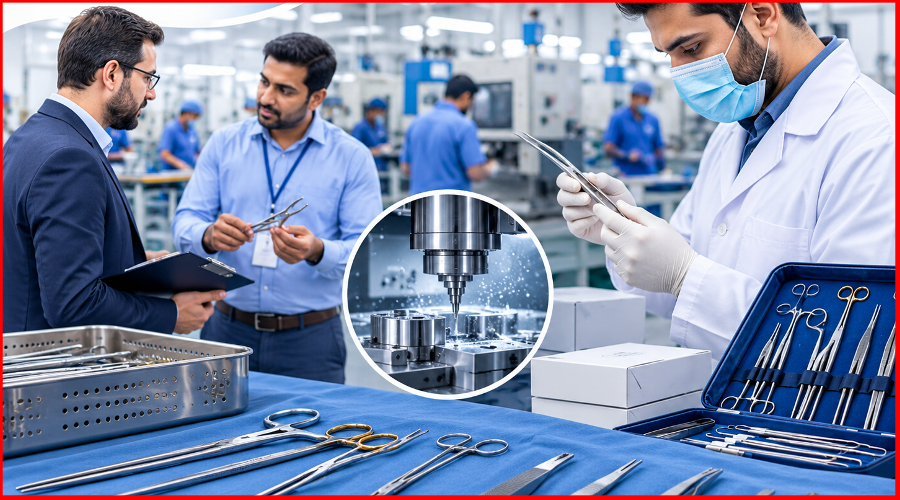
Partnering with Lapex Surgical: Flexible OEM & Private-Label Manufacturing for Global Retailers
If you want your own brand of surgical instruments, work directly with a factory. A direct factory partner gives you better prices, steadier quality, and more control than a trader or middleman.
Lapex Surgical (the manufacturer of Surgical, Electrosurgical, plastic surgery, and Laparoscopic instruments from Sialkot) builds instruments under your name or to your drawings. The offer is simple:
- Low minimum order quantities, so you can start small.
- Strict quality checks on every batch.
- Good steel grades, including German stainless steel.
- Priority scheduling, bulk discounts, and one account manager for your orders.
Ready to start? Request a quote here. The rest of this guide explains how the model works, how it compares to other buying options, and what to check before you sign.
Who This Guide Is For
This guide is for people who sell or plan to sell surgical instruments under their own label. That includes:
- Medical device brands that want a contract manufacturer.
- Online and offline retailers who want a white-label line.
- Distributors who want to stop reselling other people’s brands.
- Start-ups testing a new product range.
You do not need a factory of your own. You need a clear idea of what you want to sell, and a partner who can build it the same way every time.
OEM vs. Private Label vs. Buying from a Trader
There are three common ways to get branded instruments. Each one has a different level of control and cost. Here is a plain comparison.
| Feature | OEM (Made to Your Design) | Private Label (Made to Our Design, Your Brand) | Trader or Distributor |
|---|---|---|---|
| Who owns the design | You | The factory | The factory or another brand |
| Your brand on the product | Yes | Yes | Often no |
| Setup time | Longer | Short | Shortest |
| Control over steel and finish | High | Medium | Low |
| Price per piece | Low at volume | Low to medium | Higher |
| Minimum order | Medium | Low | Very low |
| Best for | Brands with their own specs | Retailers who want to launch fast | One-time buyers |
What OEM Means
OEM stands for original equipment manufacturer. You bring the drawing, the size, and the rules. The factory builds it. Your design stays yours.
This suits brands that already have a product idea. For example, a surgeon-led company may want a forceps with a special tip shape.
What Private Label Means
Private label is easier. The factory already makes the instrument. You pick it from the catalog, add your logo and packaging, and sell it as your own.
This suits retailers who want a full range fast, without design costs.
Why Not Just Buy from a Trader?
Traders are fine for a single order. But they add a layer between you and the factory. That layer adds cost. It also hides who really made your product.
If a batch fails, a trader may not know why. A factory can check its records and fix the cause. That is a big reason many brands move to direct supply after their first few orders.
Why Sialkot Is a Smart Place to Source
Sialkot, in Pakistan, has made surgical instruments for well over a hundred years. Many workshops and factories sit in one city. That means skilled workers, nearby suppliers, and a deep pool of experience.
Here is why that matters to you:
- Skilled handwork. Many steps, like filing and finishing, need trained hands.
- Nearby suppliers. Plating, packaging, and tooling shops are close by.
- Export know-how. Local makers ship to hospitals and brands around the world.
- Competitive cost. Labor and overhead costs are lower than in many other manufacturing hubs.
A good location does not guarantee good quality. You still need to check the factory. But Sialkot gives you a strong starting point.
What a Direct-to-Factory Partner Can Do
A broad range lets you buy many products from one source. That saves time on shipping, paperwork, and talking to many suppliers.
Lapex Surgical (the manufacturer of Surgical, Electrosurgical, Plastic Surgery Instruments, and Laparoscopic instruments from Sialkot) covers four main groups.
Surgical Instruments
These are the everyday tools of an operating room:
- Scissors (Mayo, Metzenbaum, iris)
- Forceps (tissue, dressing, artery)
- Needle holders
- Retractors
- Scalpel handles
- Clamps
Electrosurgical Instruments
These tools carry electric current to cut or seal tissue. Common examples are bipolar forceps and cables. They need good insulation and a clean finish, so testing matters even more here.
Plastic Surgery Instruments
These are small and fine. They work on delicate tissue. Think of skin hooks, fine scissors, and small forceps. Tip shape and tip alignment must be exact.
Laparoscopic Instruments
These are long, thin tools for keyhole surgery. They have moving parts inside a narrow shaft. Small errors show up fast, so these items need tight checks.
Materials: What the Steel Grade Really Means
Steel is the base of any instrument. Different jobs need different steel. Here is a simple guide.
| Material | Common Use | Key Strength | Watch Out For |
|---|---|---|---|
| German stainless steel (martensitic, such as 420-type grades) | Scissors, forceps, clamps, needle holders | Hard, holds an edge, resists rust after proper finishing | Needs correct heat treatment |
| Austenitic stainless steel (304 or 316-type) | Retractors, basins, non-cutting parts | Very good rust resistance | Softer, so not for sharp edges |
| Titanium | Light instruments, microsurgery | Light and strong | Higher price |
| Tungsten carbide inserts | Needle holder jaws, fine scissors | Very long wear | Higher price |
What Does German Stainless Steel Mean?
The phrase usually points to the quality level of the steel. It often means steel made to strict European standards. Many buyers ask for it because it is known for steady quality.
Do not take the label alone as proof. Ask for a mill certificate. This paper shows the steel’s make-up, such as its carbon and chromium levels. It tells you what you are really buying.
Why Heat Treatment Matters
Steel needs to be heated and cooled in a set way. This step gives the instrument its hardness. Too soft, and the edge dulls. Too hard, and the part may crack.
Ask your factory how it checks hardness. A common method is a Rockwell hardness test on sample pieces.
Finishes
The finish changes how the tool looks and how it handles light.
- Mirror polish: Shiny. Easy to clean.
- Satin or matte: Less glare under bright lamps.
- Black or colored coatings: Used on some laparoscopic and special tools.
Quality Testing: What Strict Control Looks Like
Quality is the main reason buyers move to a trusted factory. A good factory tests at several steps, not only at the end. Below are the key tests for a surgical instrument line.
1. Autoclave Resistance
Hospitals clean instruments in an autoclave. This is a steam machine that runs at high heat and pressure. An instrument that cannot handle it will rust, stain, or warp.
A factory can test this by running samples through repeated steam cycles. After each round, staff look for rust, pitting, and loose joints. An international standard, ISO 13402, covers how to test hand instruments for resistance to autoclaving, corrosion, and heat.
What to ask for:
- How many cycles do you test?
- What temperature do you use?
- Do you keep photos or records?
2. Sharpness Testing
A cutting tool must cut cleanly. Dull scissors tear tissue. That hurts patients and surgeons.
Common checks include:
- Cutting test on gauze or a test membrane.
- Edge check under magnification.
- Blade alignment check, so the blades meet along the full length.
Good scissors cut right to the tip. They do not fold the material or leave a ragged edge.
3. Tension Testing
Tension means the spring force and joint feel of an instrument. It covers box locks, ratchets, and hinges.
Here is what staff look for:
- Does the ratchet lock firmly and release with ease?
- Do the jaws close evenly, with no gap?
- Does the joint move smoothly, without a wobble?
- Do the tips meet exactly?
A tool with weak tension may slip during surgery. One with too much tension tires the hand.
4. Other Checks Worth Asking About
| Test | What It Finds |
|---|---|
| Visual check | Scratches, burrs, rough spots |
| Dimension check | Wrong length, width, or tip size |
| Passivation check | Weak rust protection on the surface |
| Hardness test | Steel that is too soft or too brittle |
| Insulation check (electrosurgical) | Gaps in the coating that could leak current |
| Cleanliness check | Leftover polish or oil |
Batch Records Are Your Safety Net
A good factory marks each batch with a code. If a problem appears later, the code points to the date, the steel, and the workers involved. Ask if your partner gives you this. It is how you handle a complaint with facts instead of guesses.
B2B Benefits of Working Directly with the Factory
Low prices are only part of the story. The real gain is how the working relationship feels over time.
Priority Scheduling
Factories have limited machine time. A repeat partner who plans orders often gets a set slot in the production calendar.
This helps you in three ways:
- You know your delivery window early.
- Busy seasons hurt less.
- You can plan your own sales around real dates.
Bulk Volume Discounts
The more you order at one time, the lower the cost per piece. Setup time, tooling, and packing are spread across more units.
Here is a simple example. These numbers are for illustration only and are not a real price list.
| Order Size | Example Price per Piece | Why the Price Drops |
|---|---|---|
| 100 pieces | $10.00 | Setup cost is shared by few units |
| 500 pieces | $8.50 | Better use of machine time |
| 1,000 pieces | $7.80 | Steel bought in larger lots |
| 5,000 pieces | $7.00 | Smooth, repeat production |
For real numbers, request a quote with your item list.
Dedicated Account Management
One person knows your account. You do not have to explain your needs again each time.
That person can:
- Answer questions on order status.
- Pass your changes to the factory floor.
- Share test records and photos.
- Help with packing lists and shipping papers.
This cuts down on mix-ups. It also saves you hours each month.
Low Minimums: How to Start Small
Many factories ask for very large first orders. That is risky for a new brand. A low minimum lets you test the market before you commit big money.
A Simple Example
Imagine a small online store in Canada. It wants to sell its own line of dressing forceps and scissors.
- Step 1: The owner picks six items from the catalog.
- Step 2: They order a small first batch of each, with their logo laser-marked.
- Step 3: They sell the stock and read customer reviews.
- Step 4: They re-order the best sellers in bigger lots and get a lower price.
The owner risked a small amount at the start. Growth came from real sales, not guesses.
Tips for a Smart First Order
- Start with items you already know sell well.
- Order fewer styles, but in enough quantity to test.
- Ask for samples first.
- Plan the second order before the first one ends.
Minimums can change by product type, so ask the factory for its current terms.
How the Process Works, Step by Step
A clear process keeps both sides on the same page. Here is a common flow for OEM and private-label work.
- Send your request. Share the item list, quantities, and any drawings.
- Get a quote. The factory sends prices, lead times, and terms.
- Review a sample. Check the fit, finish, and feel in your own hands.
- Approve the details. Confirm steel, finish, logo, and packaging.
- Start production. The factory builds and tests your batch.
- Final inspection. Staff checks the batch against your approved sample.
- Pack and ship. Items are packed with your labels and sent by air or sea.
- Review and re-order. You share feedback, and the next order is smoother.
Branding Options
You can usually brand your products in several ways:
- Laser marking on the instrument.
- Printed or custom boxes.
- Pouches and sterile-pack labels.
- Instrument sets and trays.
- Instruction sheets in your language.
Check the label rules in your market before you finalize a design.
Paperwork and Rules You Should Know
Selling medical devices comes with rules. The rules differ by country. Your factory should help with documents, but the legal duty often falls on the brand that sells the product.
Common Documents to Ask For
- A quality management certificate, such as ISO 13485.
- A CE mark file, if you sell in Europe.
- Material certificates for the steel.
- Test records for each batch.
- A packing list and commercial invoice.
Key Points on Responsibility
When you put your name on a device, regulators often treat you as the legal maker. This is true in many regions, including the EU and the US. That means you may need your own registration, labeling, and complaint process.
Rules change over time. Speak with a regulatory expert in your target market before you launch. This guide is general information and not legal advice.
How to Pick the Right Manufacturing Partner
Use this checklist when you compare factories. It works for any supplier, including the ones you meet online.
Green Flags
- Shows real photos and videos of its own factory.
- Shares test records without a fuss.
- Gives clear answers on steel grades.
- Offers samples before big orders.
- Names one contact person for your account.
- Quotes clear lead times.
Red Flags
- Refuses to share any certificates.
- Gives vague answers on materials.
- Has no sample policy.
- Promises very low prices that are far below the market.
- Cannot tell you who actually makes the product.
Quick Comparison: Direct Factory vs. Trading Company
| Question | Direct Factory | Trading Company |
|---|---|---|
| Who makes the product? | The factory itself | Often unknown |
| Can you visit the production line? | Usually yes | Often no |
| Price | Lower, with no middle fee | Higher, with a margin added |
| Fixing a defect | Faster, since staff trace the cause | Slower, with more hand-offs |
| Custom changes | Easier | Harder |
| Long-term supply deals | Strong | Weak |
Why Retailers Choose to Work with Lapex
Here is a quick recap of what a direct partnership with Lapex Surgical (the manufacturer of Surgical, Electrosurgical, plastic surgery, and Laparoscopic instruments from Sialkot) offers:
- One source for four instrument families.
- OEM and private-label options under one roof.
- Quality checks for autoclave resistance, sharpness, and tension.
- Good steel grades with paperwork to match.
- Low minimums for new brands.
- Priority scheduling, bulk pricing, and a dedicated account manager for long-term partners.
The goal is a supply deal that grows with your business. You get steady product. You also get one person who knows your account.
OEM & Private-Label Surgical Instruments
Your brand. Built direct at the Lapex Surgical factory in Sialkot.
Three Ways to Buy
OEM
- You own the design
- Most control
- Best price at volume
Private Label
- Pick from the catalog
- Your logo and box
- Fast to launch
Trader
- Maker often unknown
- Extra fee added
- Slow defect fixes
Four Instrument Families
Surgical
Scissors, forceps, clamps
Electrosurgical
Bipolar forceps, cables
Plastic Surgery
Fine hooks and tips
Laparoscopic
Long keyhole tools
Steel Grades
Quality Checks on Every Batch
Repeated steam cycles. No rust.
Clean cut to the tip.
Firm lock. Smooth joint.
Not too soft. Not brittle.
What You Get as a B2B Partner
Low Minimums
Start small. Test first.
Priority Slots
Fixed production dates.
Bulk Discounts
Bigger lot, lower price.
One Manager
One contact for orders.
How It Works
Send List
Get Quote
Approve Sample
Build & Test
Ship
Frequently Asked Questions
What is the difference between OEM and private label?
With OEM, you provide the design and the factory builds it. With private label, you pick an existing product and add your brand. OEM gives more control. Private label is faster.
Can I order a small first batch?
Yes. Low minimums are meant for new brands that want to test the market. Share your item list and ask for current minimums.
Can I get samples before a bulk order?
Samples are a standard step in OEM and private-label work. They let you check the steel, the finish, and the feel before you commit.
What does German stainless steel mean?
It usually points to high-grade stainless steel made to strict European quality levels. Always ask for a mill certificate to confirm the exact grade.
How are instruments tested for autoclave use?
Samples go through repeated steam cycles. Staff then check for rust, stains, loose joints, and warping. ISO 13402 gives a common test method for hand instruments.
How do you check if scissors are sharp?
Staff cut test material, such as gauze or a test membrane. They also check the edge under magnification and make sure the blades meet along their full length.
What is tension testing?
It checks the spring force and joint action. This includes ratchets, box locks, and hinges. The tool should close evenly and lock firmly.
Will you put my logo on the products and boxes?
Branding is a core part of private-label work. Common options are laser marking, custom boxes, pouches, and labels. Confirm details when you request your quote.
Who is responsible for regulatory approval?
Often the brand owner who sells the product. Rules vary by country, so speak with a regulatory expert in your market.
How do bulk discounts work?
Price per piece drops as your order grows. Larger lots spread setup and packing costs across more units. Steel is also bought in larger amounts.
How long does production take?
Lead times depend on the product, quantity, and current factory load. Priority scheduling helps repeat partners lock in dates. Ask for a clear timeline in your quote.
How do I get started?
Send your item list, target quantities, and any drawings. Then request a quote.
Next Step: Get Your Quote
A good supply partner saves you money, time, and stress. Start with a small, clear request. Share what you want to make, how many you need, and your target market.
Request a Quote from Lapex Surgical
👉 Ready to upgrade your surgical inventory? For more information, contact the Lapex Surgical support team.