Why Choose Lapex Surgical Laparoscopic Instruments? A Comprehensive Buyer & Surgeon Guide
Lapex Surgical laparoscopic instruments are a strong fit if you want reusable, certified, well-priced tools made in Sialkot, Pakistan’s surgical instrument hub. They suit hospitals, day-care surgical centers, and distributors who need steady quality without paying brand-name premiums.
Here is the short version:
- You get reusable laparoscopic tools that can be cleaned, sterilized, and used again.
- You can ask for CE and ISO 13485 documents before you buy.
- You can order standard items or request a custom quote.
- You should still test samples before a large order. That is true for any supplier.
The rest of this guide explains how to judge laparoscopic instruments, what to check, and where Lapex Surgical fits.
Who Is This Guide For?
This guide is written for people who buy, use, or maintain laparoscopic tools:
- Hospital procurement officers
- Surgical operations managers
- Laparoscopic surgeons
- Biomedical engineers
- Medical device distributors
Each group cares about something different. Buyers think about cost and paperwork. Surgeons think about feel and control. Engineers think about repair and sterilization. This guide covers all three.
What Are Laparoscopic Instruments?
Laparoscopic instruments are long, thin tools used in minimally invasive surgery. The surgeon makes small cuts, usually 5 to 12 mm wide. Tools pass through tubes called trocars. A camera shows the inside of the body on a screen.
Compared with open surgery, this approach usually means:
- Smaller scars
- Less pain after surgery
- Shorter hospital stays
- Faster return to normal life
Common procedures include gallbladder removal, appendix removal, hernia repair, and many gynecologic and urologic operations.
The Main Instrument Types
| Instrument Group | What It Does | Common Examples |
|---|---|---|
| Grasping tools | Hold and move tissue | Atraumatic graspers, Babcock, Allis-type forceps |
| Dissecting tools | Separate tissue layers | Maryland dissectors, curved dissectors |
| Cutting tools | Cut tissue or sutures | Metzenbaum-type scissors, hook scissors |
| Needle holders | Hold needles for suturing | Straight and curved needle drivers |
| Electrosurgical tools | Cut or seal with energy | Monopolar hooks, spatulas, bipolar forceps |
| Access tools | Create and keep the entry path | Trocars, cannulas, Veress needles |
| Support tools | Help with fluid, retraction, and extraction | Suction-irrigation sets, retractors, clip appliers |
About the Maker
Lapex Surgical (the manufacturer of Surgical, Electrosurgical, Plastic Surgery Instruments, and Laparoscopic instruments from Sialkot) works in a city known worldwide for surgical instrument making. Sialkot has a long craft tradition. Many local workshops and factories export to hospitals and distributors across the world.
That location matters for buyers. Skilled metalworkers, grinders, polishers, and assemblers work close together. This often means faster production and flexible order sizes.
Location alone does not prove quality. Papers, tests, and samples do. The next sections show how to check.
Why Choose Lapex Surgical Laparoscopic Instruments?
1. A Wide Range Under One Supplier
Lapex Surgical laparoscopic instruments sit alongside general surgical, electrosurgical, and plastic surgery lines. That helps procurement teams. One supplier can cover several departments. You get fewer purchase orders, fewer vendor files, and simpler follow-up.
2. Reusable Design
Reusable laparoscopic tools are built from stainless steel and other durable materials. They are made to go through many cycles of cleaning and sterilization. When cared for properly, they can lower your cost per surgery.
3. Paperwork You Can Verify
Good suppliers share documents without a fight. Ask for:
- ISO 13485 certificate
- CE certificate or Declaration of Conformity
- Material certificates
- Instructions for use (IFU) with cleaning and sterilization steps
- Batch or lot traceability records
4. Custom Quotes and Flexible Orders
Not all hospitals need the same thing. A small surgical center may want a starter set. A distributor may want large volumes with private labeling. Lapex Surgical offers custom quotes so that you can match the order to your real needs.
5. Price-to-Value Balance
Big Western brands often cost much more. Sialkot-made instruments can offer a lower price with solid performance. The savings can pay for extra spare instruments, which helps your operating room run on schedule.
What Certifications Really Mean
Buyers often see “CE certified” and “ISO 13485” and stop reading. Here is what these terms mean.
ISO 13485
ISO 13485 is a quality management standard for medical device makers. It shows that a factory has controlled processes for design, production, record-keeping, complaints, and corrections. It does not guarantee that every single instrument is perfect. It shows that the maker has a system to catch and fix problems.
CE Marking
CE marking shows that a device meets the rules of the European Union. For medical devices, the rules are in the EU Medical Device Regulation (MDR 2017/745). The route to CE marking depends on the device class. Many reusable surgical hand instruments are in a lower class (Class I reusable). Some products need a review by a notified body.
How to Check
- Ask for the certificate copy.
- Check that the name and address match the supplier.
- Check the issue date and expiry date.
- Check which products the certificate covers.
- If a notified body is named, confirm it with that body or in public databases.
A certificate that covers “surgical instruments” in general may not cover your exact product. Ask for clarity.
How to Judge Laparoscopic Instrument Quality
Whatever supplier you pick, use the same checklist. It protects your patients and your budget.
Material and Finish
- Stainless steel grade: Medical-grade stainless steel resists rust and wear. Ask which grade is used for each part.
- Surface finish: A smooth, matte or satin finish reduces glare under bright lights.
- Welds and joints: Look for clean joins with no gaps where dirt could hide.
Shaft and Insulation (for Electrosurgical Tools)
Insulation is a safety issue. A crack in the coating can send current where it should not go, and that can burn tissue outside the camera view.
Check that:
- The coating is even from end to end
- There are no cuts, bubbles, or peeling
- The supplier tests insulation (ask how)
- The tool is rated for the energy type you use
Test insulation before every use and replace damaged tools right away. Hospitals often use insulation testers for this.
Tip Design and Jaw Alignment
Jaws should meet cleanly. For grasping forceps, teeth should match with no gaps. For scissors, blades should cut paper-thin material cleanly near the tips.
Handle Feel and Action
Surgeons spend hours holding these tools. Look for:
- Smooth opening and closing
- No sticking or grinding
- A comfortable grip
- A ratchet (if present) that locks and releases cleanly
Disassembly for Cleaning
Many modern reusable laparoscopic tools come apart so that the inner channel can be cleaned. Tools that flush well are easier to keep safe. Ask whether the design includes a flush port and clear disassembly steps.
Laparoscopic Grasping Forceps: A Closer Look
Grasping forceps are among the most used laparoscopic tools, so they deserve a closer look.
Types of Jaws
| Jaw Type | Best For | Notes |
|---|---|---|
| Atraumatic (smooth or fine-ridged) | Bowel, delicate tissue | Gentle on tissue |
| Toothed (traumatic) | Tissue to be removed, tough tissue | Strong hold, more damage |
| Fenestrated (with openings) | Wide tissue grip | Spreads grip force |
| Babcock-style | Bowel and tubular structures | Rounded, gentle hold |
| Maryland-style | Dissection and light grasping | Curved, fine tip |
Common Sizes
Most grasping forceps are 5 mm wide. Some are 3 mm for pediatric or fine work. Some are 10 mm for heavier work. Length is often around 330 mm for adult work, though lengths vary by design and use.
Features Worth Asking About
- Rotating shaft (360 degrees) for better angle control
- Insulated or non-insulated shaft
- Monopolar connection post (if you want to add energy)
- Ratchet or non-ratchet handle
- Detachable parts for cleaning
Pick the jaw and handle style that matches your surgeon team’s habits. It is smart to let surgeons hold samples before you finalize an order.
Electrosurgical Instruments Procurement: What to Know
Electrosurgical tools use high-frequency electric current to cut tissue and stop bleeding. They need extra care when buying.
Monopolar vs. Bipolar
| Feature | Monopolar | Bipolar |
|---|---|---|
| Current path | Through the body to a return pad | Between two jaw tips only |
| Common uses | Cutting, dissecting, coagulating | Sealing vessels, careful coagulation |
| Spread of heat | Wider | More focused |
| Needs return pad | Yes | No |
Procurement Checklist
- Generator match. Confirm the plug type, cable, and power range work with your generator.
- Insulation proof. Ask for test details.
- Cable length and type. Check that cables are reusable and built for repeated sterilization.
- Spare parts. Confirm that tips, cables, and insulators can be bought separately.
- Repair policy. Ask whether damaged tools can be fixed, and how long it takes.
- Training. Ask whether the supplier offers basic guides or video support.
A cheap electrosurgical tool that fails early costs more than a fair-priced one that lasts. Compare the cost per use, not only the unit price.
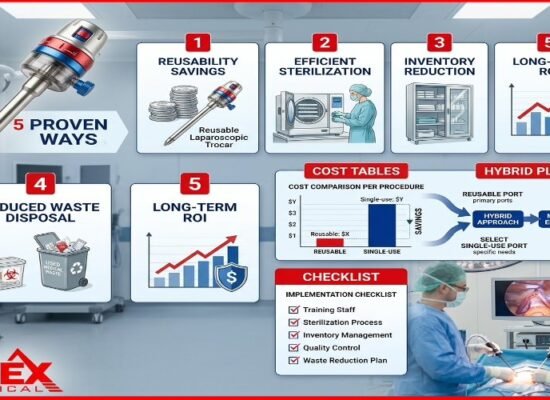
Reusable vs. Disposable Laparoscopic Tools
This is one of the biggest choices a hospital makes.
| Factor | Reusable | Disposable |
|---|---|---|
| Upfront cost | Higher | Lower per piece |
| Long-term cost | Lower per use | Higher over time |
| Waste | Less | More |
| Cleaning workload | High (needs a sterile processing department) | None |
| Consistent sharpness | Needs checks and sharpening | Always new |
| Infection control risk if poorly cleaned | Higher | Lower |
| Best for | High-volume centers with strong sterilization | Low-volume centers, special cases |
A Simple Cost Example
This is a made-up example to show the idea, not a price quote.
Say a reusable grasper costs 10 times what a disposable one costs. If the reusable one safely handles 100 cases, the cost per case is a tenth of the cost of the disposable one, plus cleaning costs. If your team cleans and tracks tools well, reusable wins on cost. If your sterilization process is weak, disposable may be safer.
Many hospitals use both. They keep reusable tools for routine work and disposable tools for special cases.
Cleaning, Sterilization, and Care
Even the best tool fails if it is cleaned badly. Poor cleaning can also put patients at risk.
Basic Care Steps
- Wipe at the point of use. Remove blood and tissue right after surgery.
- Keep tools moist until cleaning, so dried material does not harden.
- Take apart any tool built to be disassembled.
- Flush the channels with a brush or syringe.
- Clean by hand or in an ultrasonic cleaner or washer-disinfector, as the IFU says.
- Rinse with clean water.
- Dry fully.
- Check under light for dirt, cracks, loose parts, and insulation damage.
- Lubricate moving parts with an instrument-safe lubricant if the IFU says so.
- Sterilize, most often by steam (autoclave), using the settings in the IFU.
Things to Avoid
- Saline soaking for long periods (it can cause rust)
- Harsh cleaners with chlorine
- Metal brushes on fine surfaces
- Stacking heavy tools on delicate ones
- Skipping the visual check
Always follow the maker’s IFU. Steam temperature and time rules can differ between products.
Lapex Surgical vs. Other Supplier Types
There is no single “best” supplier for everyone. Here is how common supplier types compare.
| Factor | Premium Western Brands | Sialkot Manufacturers (like Lapex Surgical) | Unknown Trading Companies |
|---|---|---|---|
| Price | High | Medium to low | Low, often unclear |
| Range of products | Very wide | Wide | Varies |
| Customization | Limited | Often flexible | Rare |
| Paperwork | Usually complete | Ask and verify | Often weak |
| Direct factory contact | Sometimes | Yes | Often no |
| Lead time | Varies | Often flexible | Unclear |
| Best for | Large systems with big budgets | Value-focused hospitals, distributors | Not advised for critical tools |
Takeaway: A direct maker gives you someone to call when there is a problem. A middle trader may not know the factory details.
A Practical Buying Process
Use these steps to buy with less risk.
Step 1: List Your Needs
Write down the procedures, instrument types, sizes, and quantities. Ask surgeons for input.
Step 2: Request Documents
Ask for certificates, IFUs, material details, and product lists.
Step 3: Order Samples
Test a small set. Let surgeons, nurses, and sterile processing staff all try them.
Step 4: Run a Trial
Check:
- Grip and feel
- Jaw alignment
- Insulation (for electrosurgical tools)
- Cleaning ease
- How tools handle several sterilization cycles
Step 5: Compare Total Cost
Add up unit price, shipping, spare parts, repair costs, and expected life.
Step 6: Place a Staged Order
Start with a moderate order. Increase once you are happy with the results.
Step 7: Track Performance
Log failures, repairs, and surgeon feedback. Share the data with your supplier.
Red Flags When Choosing Any Supplier
Walk away or slow down if you see:
- No willingness to share certificates
- Certificates that do not match the company name
- Vague answers about materials
- No IFU
- No sample policy
- Very low prices that seem too good to be true
- No after-sales contact
Tips for Surgeons
If you will use the tools, speak up early. Here is what to test:
- Weight and balance. Long cases need a tool that does not tire your hand.
- Tip precision. Try picking up a small object in a training box.
- Rotation. The shaft should turn smoothly.
- Ratchet feel. It should lock and release without effort.
- Visibility. The finish should not shine too much under the light.
Your feedback helps procurement pick tools that people will want to use.
Tips for Biomedical Engineers
You see what breaks. Share these checks with your team:
- Test insulation before every case where possible
- Inspect jaw alignment weekly
- Keep a log with serial or batch numbers
- Set a retirement point for tools with repeated repairs
- Keep a small stock of spare tips and cables
Ask your supplier whether they offer repair or replacement parts, and at what cost.
Tips for Distributors
If you resell, you carry your own reputation on every box. Look for:
- Stable quality from batch to batch
- Clear labeling and packaging
- Supplier support for registration paperwork in your country
- Private label options, if you want them
- Reliable lead times
Ask whether the supplier can support the documents your local health authority requires.
Lapex Surgical Laparoscopic Instruments at a Glance
Reusable. Certified. Made in Sialkot.
What are they?
Long, thin tools for keyhole surgery. Cuts are only 5 to 12 mm wide.
7 instrument groups
Why choose Lapex Surgical?
Ask for these papers
Check quality on arrival
Reusable or disposable?
Care in 6 steps
How to buy with less risk
Red flags
Ready to compare?
Explore the catalog or request a quoteLapex Surgical, Sialkot: surgical, electrosurgical, plastic surgery and laparoscopic instruments.
Frequently Asked Questions
Are reusable laparoscopic tools safe?
Yes, when they are cleaned, checked, and sterilized according to the IFU. Safety depends on both the tool and the process.
How many times can a reusable laparoscopic instrument be used?
It depends on the design, the material, and how it is cared for. Makers rarely give one fixed number. Inspect each tool before each case and retire damaged ones.
What does ISO 13485 mean for a buyer?
It means the maker follows a documented quality system for medical devices. It adds trust but does not replace your own testing.
Does CE marking mean the product is approved everywhere?
No. CE marking relates to EU rules. Other countries have their own approval or registration steps.
Can I get custom instruments?
Many Sialkot makers can adjust sizes, finishes, or packaging. Ask for a custom quote and share your drawings or needs.
What sizes do laparoscopic instruments come in?
Common shaft widths are 3 mm, 5 mm, and 10 mm. Some systems use 12 mm. Match the instrument to your trocars.
How do I check insulation on electrosurgical tools?
Use a visual check and an insulation tester if your hospital has one. Replace any tool with cracks, bubbles, or worn spots.
Should I buy a full set or single pieces?
A full set suits new operating rooms. Single pieces suit refills and special needs. A mix is common.
What should I ask before placing a bulk order?
Ask for samples, certificates, lead times, warranty terms, repair policy, and payment terms.
How do I compare prices fairly?
Compare cost per use. Include shipping, spare parts, repair, and cleaning time. A lower sticker price is not always cheaper over time.
Final Thoughts
Choosing laparoscopic instruments is about trust. Surgeons need tools that feel right and work every time. Procurement teams need clear paperwork and fair prices. Engineers need tools that can be cleaned, tested, and repaired.
Lapex Surgical laparoscopic instruments offer a practical option for teams that want reusable, certified tools from a direct maker in Sialkot. Check the documents, test the samples, and compare cost per use. Then decide with facts.
Ready to compare? Explore Lapex Surgical’s full catalog of certified laparoscopic instruments today or request a custom quote for your facility.