
Table of Contents
ToggleBuilding a Medical-Grade Home Sim Lab: The Best Affordable Laparoscopic Instruments for Independent Practice
In the high-stakes world of Minimally Invasive Surgery (MIS), the difference between a competent surgeon and an exceptional one often boils down to one factor: deliberate practice. However, the reality for many surgical residents and medical students today is that “theatre time” is a precious and limited commodity. Simulation labs in hospitals are often booked weeks in advance, and the pressure to perform during live cases leaves little room for the trial-and-error required to master complex motor skills.
The solution? The rise of the Home Simulation Lab (Home Sim Lab).
By bringing the training environment into your own living space, you can bridge the “skills gap” on your own terms. This guide explores how to build a medical-grade home setup using affordable, high-quality laparoscopic instruments that provide the tactile feedback necessary for real-world surgical excellence.
1. The Paradigm Shift: Why Training at Home is No Longer Optional
Historically, surgical training followed the “see one, do one, teach one” model. With the advent of laparoscopy, this transitioned to “simulate many, do one.” Modern research consistently shows that proficiency in tasks such as intracorporeal suturing and depth perception is acquired faster when practice is distributed over time rather than crammed into infrequent hospital sessions.
Key Benefits of Independent Practice:
Reduced Cognitive Load: Mastering instrument handling at home allows you to focus on the procedural steps rather than the mechanics when you finally enter the OR.
Muscle Memory Development: Laparoscopy involves a “fulcrum effect” (moving the handle left to push the tip right). Constant repetition at home normalizes this counterintuitive movement.
Stress-Free Failure: The home lab is the only place where dropping a needle or tearing a tissue model has zero clinical consequences.
2. Anatomy of a Medical-Grade Home Sim Lab
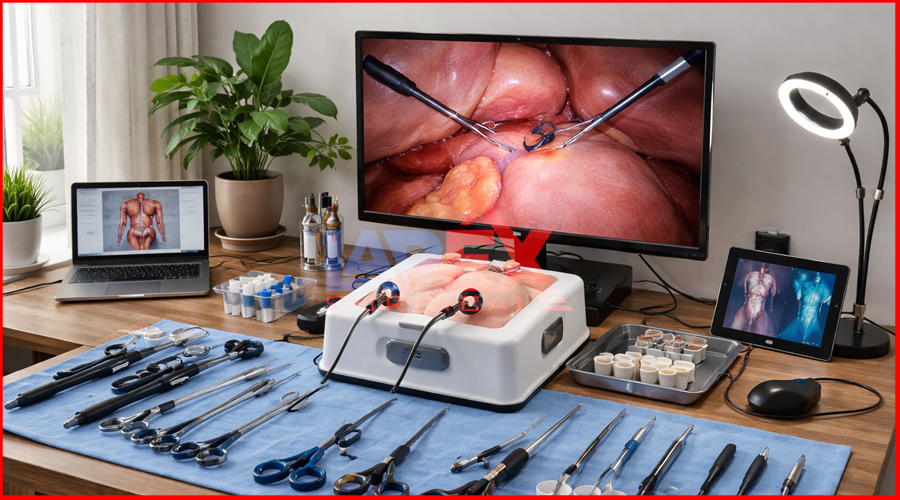
To mimic the operating room, your home setup needs more than just a box. It requires a synergy of hardware and high-fidelity instruments.
The Foundation: The Pelvic Trainer (Trainer Box)
While some DIY enthusiasts use plastic storage bins, a dedicated pelvic trainer is essential for proper ergonomics. Look for trainers that offer:
Multiple trocar ports to simulate different entry angles.
Internal LED lighting to prevent shadows that wouldn’t exist in a real pneumoperitoneum.
A camera mount that holds a tablet, smartphone, or dedicated USB endoscope.
The Engine: Laparoscopic Instruments
This is where most students make a mistake. Using “toy-grade” instruments with loose joints and plastic handles will actually build bad habits. You need instruments that mimic the weight, spring tension, and haptic feedback of surgical-grade tools.
Lapex Surgical understands this balance, providing instruments manufactured in Sialkot—the global hub of surgical instrument craftsmanship—that offer professional durability at a price point accessible to independent trainees.
3. The “Big Three” Essential Instruments for Training
If you are starting your home lab on a budget, you do not need a full 20-piece kit. You need three specific instruments that cover 90% of basic skills training.
Instrument Type | Primary Training Use | Key Feature to Look For |
|---|---|---|
Blunt dissection, fine manipulation, and “stripping” models. | Curved tip with consistent jaw tension. | |
Intracorporeal suturing and knot-tying. | Tungsten carbide inserts for a non-slip grip on needles. | |
Fenestrated Grasper | Bowel handling simulation and object transfer. | Atraumatic teeth and a reliable ratchet mechanism. |
3.1 The Maryland Dissector
Maryland is the “workhorse” of laparoscopy. At home, you will use this for the “Pegboard Transfer” task—moving small objects from one side to another. This builds hand-eye coordination and teaches you how to manage the fulcrum effect.
3.2 The Needle Holder
This is the most critical investment. A poor needle holder will cause the needle to “roll,” leading to frustration and poor suturing technique. When selecting an affordable option, ensure the handle is ergonomic, and the jaws meet perfectly. This is a specialty of Lapex Surgical, where the alignment of the jaws is tested to ensure it meets the rigorous demands of surgical simulation.
3.3 The Fenestrated Grasper
Used for “Tension and Traction” exercises. In a home lab, you can use these to handle latex “organs” or even standard gauze to simulate tissue retraction.
4. Why Sialkot Craftsmanship Matters for Your Home Lab
When searching for “affordable” instruments, the market is often flooded with low-quality imports that break after a few uses. However, instruments sourced from Sialkot, Pakistan, represent a unique intersection of traditional blacksmithing and modern CNC machining.
As a leading manufacturer in this region, Lapex Surgical leverages generations of expertise to ensure that even “training grade” instruments are made from high-tensile stainless steel. This ensures that the instruments don’t just look like the ones in the OR—they feel like them.
5. Setting Up Your Workflow: From Box to Mastery
Having the instruments is only half the battle. You must use them correctly to avoid developing “sim-habits.”
Step 1: Ergonomic Alignment
Place your trainer box at a height where your elbows are at a 90-degree angle. Your monitor or tablet should be at eye level. Practicing with the box on a standard dining table often leads to “shoulder shrugging,” which causes fatigue and is non-anatomical.
Step 2: The FLS Tasks
The Fundamentals of Laparoscopic Surgery (FLS) program is the gold standard for certification. Your home practice should mirror these five tasks:
Peg Transfer: Building depth perception.
Pattern Cutting: Mastering the use of laparoscopic scissors (another essential add-on for your kit).
Ligaloop: Placing a loop around a structure.
Extracorporeal Suturing: Tying knots outside the box.
Intracorporeal Suturing: The “Holy Grail” of MIS training.
Step 3: Recording and Review
One advantage of a home lab is the ability to record your sessions. Use your smartphone to film your internal movements. Reviewing your footage allows you to spot “economy of motion” errors—extra movements that add time and risk to a procedure.
6. Maintenance of Training Instruments
Even though these instruments aren’t used on humans, they still require care to maintain their “medical-grade” feel.
Lubrication: Use a medical-grade lubricant on the joints and handles every few weeks.
Cleaning: If using suture materials with coatings, wipe the jaws of your needle holder to prevent buildup.
Storage: Store instruments in a roll or case. Throwing them into a drawer can misalign the delicate tips of dissectors and scissors.
7. Cost-Benefit Analysis: The ROI of a Home Sim Lab
A high-quality set of three to four training instruments from a reputable manufacturer like Lapex Surgical is a one-time investment that typically costs less than a single weekend surgical workshop.
The Return on Investment (ROI):
Time: Save hours of travel to and from the hospital lab.
Career: Residents who demonstrate superior manual dexterity are often given more autonomy in the OR by attending surgeons.
Confidence: The psychological benefit of “knowing” you can tie a knot in under 60 seconds cannot be overstated.
9. Taking the Next Step in Your Surgical Journey
Building a medical-grade home sim lab is a statement of intent. It shows a commitment to the craft that goes beyond the minimum requirements of a residency program. By selecting affordable, high-quality instruments that mirror the tools used in the operating room, you are not just practicing; you are performing.
When you choose instruments from established manufacturers like Lapex Surgical, you are benefiting from a legacy of precision engineering. Whether you are practicing your first peg transfer or refining your 500th intracorporeal knot, the quality of your tools will dictate the quality of your skills.
Don’t wait for your next rotation to get better. Start building your home lab today, master the mechanics in the comfort of your own space, and step into the OR with the confidence of a seasoned professional.
8. Frequently Asked Questions (FAQ)
Q: Can I use real surgical instruments for home training?
A: Yes, but it is often cost-prohibitive. Training-specific instruments are designed to provide the same tactile feedback but are not “certified sterile,” which significantly lowers the cost while maintaining the mechanical quality.
Q: How many hours should I practice at home?
A: Research suggests that “short and frequent” is better than “long and rare.” 20 minutes a day, four times a week, is more effective for muscle memory than a single four-hour block.
Q: Are disposable instruments better for training?
A: Generally, no. Disposable instruments often have a different “flex” and weight. For long-term home practice, reusable stainless steel instruments are more cost-effective and provide a more realistic feel.
Q: What is the most difficult skill to learn at home?
A: Intracorporeal suturing. It requires a high degree of “ambidexterity.” This is why having a high-quality needle holder and a reliable grasper in your home lab is non-negotiable.