Table of Contents
ToggleEssential Disposable Alligator Grasper – 5 Powerful Reasons Surgeons Choose It
In the highly specialized field of Minimally Invasive Surgery (MIS), every millimeter of an instrument matters. Laparoscopy transforms major abdominal or pelvic operations into precision procedures performed through “keyhole” incisions. But this feat of surgery is impossible without tools capable of translating the surgeon’s minute, highly controlled movements from the operating table to the deep, confined surgical field.
Among the indispensable tools in the laparoscopic toolkit, the Alligator Grasper holds a foundational position. Named for its long, slender jaw structure and powerful, secure grip, it is the workhorse for tissue manipulation, retraction, and removal of foreign bodies.
At Lapex Surgical, based in the legendary instrument manufacturing hub of Sialkot, we have taken this essential tool and perfected it in its Disposable form. We combine the strength of German-grade metals at the working tip with sophisticated, single-use material science throughout the shaft and handle. The result is the Lapex Disposable Alligator Grasper: sterile, flawlessly functional, and ready to enhance surgical outcomes.
This comprehensive guide details the technical and operational advantages of the disposable model, providing five powerful, evidence-based reasons why leading surgeons worldwide are choosing single-use precision over the compromises of reusable instruments.
The Anatomy of a Laparoscopic Workhorse
Before diving into the advantages of disposability, it is essential to understand the technical complexity of the Alligator Grasper and why its flawless function is non-negotiable in the operating theater.
1.1. Defining the Alligator Grasper
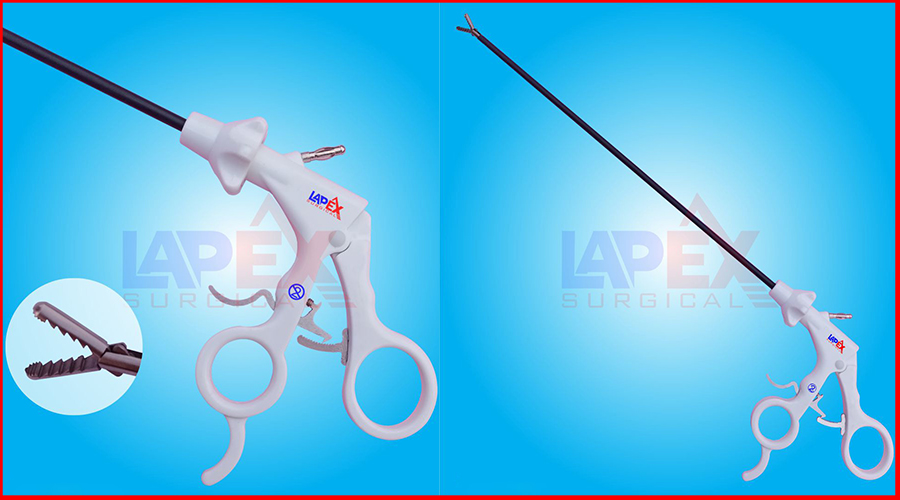
The Alligator Grasper is a type of laparoscopic forceps designed for general grasping and manipulation of tough or dense tissues. Its defining characteristic is the pattern of its jaws: short, strong, and highly serrated, often resembling the bite of an alligator—hence the name.
Component | Material Science (Lapex Disposable) | Purpose and Function |
|---|---|---|
Jaws (Working Tip) | German-grade Stainless Steel (AISI 420 Series) | Provides robust, non-slip tissue grip; maintains integrity during high-tension retraction. |
Shaft | Medical-grade Polymer with internal insulation liner | Transmits rotation and force; provides guaranteed electrical insulation. |
Cannula/Insulation Sheath | Single-use, non-conductive polymer | Protects surrounding tissue from electrical current and mechanical friction. |
Handle (Finger Rings) | Ergonomic Polymer/ABS Plastic | Provides a comfortable, fatigue-reducing grip; translates the surgeon’s force via a lever mechanism. |
Pivot Mechanism | Stainless Steel with controlled friction points | Ensures smooth, precise opening and closing motion; critical for tactile feedback. |
1.2. Why the Alligator Jaw Pattern is Critical
In laparoscopic surgery, surgeons handle delicate organs, dense fascia, and tough connective tissue. The choice of jaw pattern—such as the traumatic Alligator, the atraumatic Dolphin, or the gentle Babcock—is determined by the tissue type.
The Alligator Grasper is chosen for its positive mechanical lock on tissue that needs secure, prolonged retraction (e.g., pulling back the gallbladder, securing the cystic duct, or retrieving dense tissue specimens). Its deep, crossing serrations prevent slippage, which is a key requirement for maintaining a steady surgical field under high-pressure pneumoperitoneum.
5 Powerful Reasons Surgeons Choose the Disposable Alligator Grasper
The decision to choose a single-use laparoscopic instrument is not merely a preference; it is a clinical and economic calculation based on minimizing risk and maximizing performance. The Lapex Disposable Alligator Grasper offers undeniable advantages in five core areas.
Reason 1: Guaranteed Zero-Defect Performance (Precision)
The reusable surgical instrument is a product of compromise. Every cycle of sterilization, cleaning, and heavy use subjects the delicate mechanical components to stress, leading to inevitable degradation.
A. Flawless Jaw Alignment
For grasping and cutting, the two jaws of the instrument must meet perfectly, edge-to-edge. In reusable instruments, minor bending, torque applied during surgery, or microscopic stress from the ultrasonic cleaner can lead to jaw misalignment, known as “tip skip” or “jaw hang.”
The Disposable Advantage: The Lapex Disposable Alligator Grasper leaves the Sialkot manufacturing line with guaranteed, optically verified jaw alignment. Since it is never reprocessed, the surgeon receives a mechanically pristine instrument, ensuring a secure grip on the first attempt, every time. This translates directly to reduced operating time and decreased risk of tissue slippage.
B. Consistent Tactile Feedback
The smoothness of the instrument’s pivot mechanism dictates the tactile feedback the surgeon receives. A rough or sticky pivot, caused by residual bioburden or corrosion on a reused instrument, dampens the surgeon’s sense of the tissue they are manipulating.
Lapex Solution: We use internal, lubricated, medical-grade components in our disposable line that are optimized for a single, perfect use. This ensures the surgeon experiences maximum tactile sensitivity, allowing them to differentiate between tough fascia and delicate neurovascular bundles, which is critical for preventing inadvertent injury.
C. Zero Wear on German-Grade Tips
While the shaft and handle are optimized for cost-effective disposal, the working jaws are still crafted from robust German-grade stainless steel to ensure sufficient strength. Because they are never dulled, chipped, or bent by manual cleaning or handling errors outside the operating room, the tips offer maximum performance right out of the sterile package.
Reason 2: Ultimate Infection Control & Safety (Sterility)
Infection control is paramount. While sterilization is effective, the complex geometries of laparoscopic instruments pose unique challenges that disposability completely bypasses.
A. Eliminating Bioburden Traps
The pivot joints, ratchet locks, and flush ports of any laparoscopic instrument create microscopic crevices and lumens where blood, tissue, and protein (bioburden) can become trapped. Even advanced cleaning techniques may fail to reach 100% eradication. Over time, this cumulative bioburden can compromise the sterility of the instrument.
Single-Use Safety: The disposable grasper eliminates the risk of retained bioburden, ensuring that the only contaminants introduced during the procedure come from the patient’s own body, not from a previous patient’s procedure.
B. Protection Against Prion Transmission
Prions (abnormal, pathogenic agents) are resistant to standard sterilization methods like steam autoclaving. While the risk is low, it is a persistent concern, particularly for neurological procedures.
Risk Mitigation: By choosing an EO-sterilized, single-use instrument, the healthcare facility removes the possibility of prion transmission via surgical instruments, contributing to the highest level of patient safety protocols.
C. Guaranteed EO Sterilization
The Lapex Disposable Grasper is sterilized using Ethylene Oxide (EO) gas, a low-temperature process ideal for heat-sensitive materials like the polymers used in the handle and shaft.
EO Sterilization Protocol: The instrument is sealed in its final packaging before the process. The EO gas permeates the packaging and sterilizes the instrument, and the packaging is only opened immediately before use. This process is validated to achieve a Sterility Assurance Level (SAL) (less than one chance in a million of a non-sterile item), which is the international standard for critical instruments.
Reason 3: Cost and Operational Efficiency (Economics)
At first glance, reusable instruments appear cheaper, but a rigorous analysis of the Total Cost of Ownership (TCO) reveals that disposable instruments often offer superior economic value. This is especially true when factoring in the complex and expensive processes of the Central Sterile Supply Department (CSSD).
A. Elimination of Reprocessing Costs
A reusable laparoscopic instrument requires extensive resources between every case:
Transport and Pre-soak: Staff time and chemical costs.
Manual Cleaning: Detailed scrubbing of jaws and hinges.
Ultrasonic Cleaning: Energy and specialized fluid costs.
Inspection and Maintenance: Trained technicians inspecting insulation, checking jaw alignment, and managing repairs.
Sterilization: Autoclave time, electricity, and water consumption.
Inventory Tracking: Software, labor, and record-keeping for every cycle.
The Disposable Equation: The Lapex Disposable Alligator Grasper incurs none of these reprocessing costs. The single purchase price includes sterilization, packaging, and guaranteed functionality, simplifying the supply chain and allowing CSSD staff to focus on other critical reusable items.
B. Avoiding Costly Instrument Failure
Reusable laparoscopic instruments have fragile parts (e.g., insulation, seals, hinge points) that frequently fail.
Instrument Failure Scenario | Cost Impact |
|---|---|
Insulation Breach | Immediate repair/replacement cost; potential for expensive post-operative complications (stray energy burn) or lawsuits. |
Pneumoperitoneum Seal Failure | Requires immediate replacement of the entire instrument; prolongs operating time and increases anesthesia costs. |
Loss or Damage | Cost of replacing a high-value German-grade steel instrument. |
The disposable model eliminates all repair and replacement costs, offering a fixed, predictable cost per procedure.
Reason 4: Flawless Insulation & Electrosurgical Safety (Electrosurgery)
Laparoscopic surgery frequently uses Monopolar energy (where the current flows from the instrument, through the patient, to a grounding pad) for precise dissection and cutting. In this context, the shaft’s insulation is literally the surgeon’s shield, protecting adjacent tissue from dangerous electrical burns.
A. The Critical Risk of Insulation Failure
Reusable laparoscopic instruments are subject to mechanical stress that can cause microscopic cracks or pinholes in the polymer insulation sheath. This damage, known as a “breach,” allows electrical current to escape the instrument’s intended path, often causing an unseen thermal injury to the bowel or other vital organs adjacent to the breach.
Lapex Safety Guarantee: Our disposable graspers provide guaranteed, factory-fresh insulation integrity. Since they have never been subjected to abrasive cleaning, high heat cycling, or physical wear and tear, the insulation is guaranteed to be 100% intact. This fundamentally eliminates the risk of stray energy injury linked to insulation breakdown.
B. Consistent Monopolar Performance
The Monopolar Alligator Grasper uses the metal tip as the active electrode. Any rust, pitting, or dried bioburden on a reused tip can interfere with the energy flow, leading to inconsistent coagulation or cutting.
The Disposable Advantage: The pristine, clean metal tip of the Lapex disposable instrument ensures maximum, predictable electrical contact and energy delivery, enhancing the surgeon’s control over hemostasis and dissection.
Reason 5: Superior Ergonomics & Reduced Surgeon Fatigue (Comfort)
The prolonged, highly focused nature of laparoscopic surgery can lead to significant physical fatigue for the surgical team, particularly in the hands and wrists. Instrument design plays a crucial role in mitigating this.
A. Optimized Weight and Balance
Reusable instruments are often constructed with heavier, thicker stainless steel handles and components to ensure durability across hundreds of cycles. This added weight contributes to hand fatigue.
Lightweight Design: The Lapex Disposable Alligator Grasper utilizes lightweight, high-strength medical-grade polymers in the handle and shaft, resulting in a perfectly balanced instrument that reduces the strain on the surgeon’s fingers and wrist during long cases.
B. Ready-to-Use Functionality
When a surgeon reaches for an instrument, it must function perfectly. A reusable instrument may be stiff due to improper lubrication after sterilization, or the ratchet may stick. This requires the surgical tech or nurse to waste valuable operating time working the instrument to “loosen” it.
Factory-Condition Smoothness: The disposable instrument is manufactured to optimal friction levels for its single use, guaranteeing smooth, immediate functionality. This seamless operation minimizes intraoperative delays and maintains the surgeon’s focus.
Manufacturing Excellence—The Lapex Surgical Commitment
The quality of a disposable instrument is paramount because there is no opportunity for repair or refurbishment. Our commitment to excellence is forged in the unique blend of Sialkot craftsmanship and modern quality assurance.
3.1. Sialkot Craftsmanship Meets German-Grade Steel
The skill of Sialkot’s surgical instrument makers is internationally renowned. We apply this artisanal expertise to the most critical component: the German-grade stainless steel jaws of the Alligator Grasper.
Metallurgical Integrity: We guarantee the use of certified, medical-grade steel alloys that maintain their strength and resist micro-fractures, even when thinly machined for the laparoscopic tip.
Precision Finishing: The serrations on the alligator jaws are cut using high-precision Computer Numerical Control (CNC) machinery and then finished by hand to remove any burrs, ensuring a smooth profile that passes through the trocar seal without friction.
3.2. The EO Sterilization and Packaging Process
Our instruments are not sterile after a cleaning process; they are sterile upon production.
Validation: Every batch is tested for bioburden levels before sterilization.
Packaging: The grasper is hermetically sealed in specialized medical-grade Tyvek and polymer pouches that maintain sterility while allowing the EO gas to penetrate.
Process Control: Sterilization parameters (gas concentration, temperature, pressure, humidity) are rigorously controlled and documented to ensure a consistent SAL.
Aeration: A critical step is aeration, where residual EO gas is safely removed to protect the patient and staff from chemical exposure.
The result is a reliable, sealed product with a clearly labeled expiry date, guaranteeing sterility and performance the moment it enters the operating room.
Operational and Technical Data
4.1. Total Cost of Ownership (TCO): Disposable vs. Reusable
The following table illustrates a simplified TCO comparison over 12 months for a single surgical grasper used in 200 procedures, demonstrating the hidden costs of reprocessing.
Cost Component | Reusable Alligator Grasper (Average) | Lapex Disposable Alligator Grasper |
|---|---|---|
Initial Purchase Cost | $400.00 | $15.00 per unit x 200$ procedures = $3,000.00 |
Reprocessing Labor | $6.00 x 200 cycles = $1,200.00 | 0.00 |
Sterilization Consumables | $1.50 x 200 cycles = $300.00 | 0.00 |
Annual Repair/Maintenance | $150.00 (Average per instrument) | 0.00 |
Insurance/Liability Fee | $25.00 (Estimated cost tied to cross-contamination risk) | Negligible/Low |
Total 1-Year Cost | approx. $2,075.00 | approx. $3,000.00 |
Cost Per Use (CPU) | approx. $10.38 | approx. $15.00 |
Note: While the CPU for disposable is slightly higher, the table above does not quantify the intangible costs of disposables, which often swing the decision: eliminating OR delays due to defective instruments, avoiding post-op infections, and minimizing litigation costs related to insulation failure.
4.2. Surgical Procedures Highly Dependent on the Alligator Grasper
The Alligator Grasper’s secure hold makes it essential for procedures where tissue retraction and organ manipulation are critical.
Laparoscopic Cholecystectomy (Gallbladder Removal): Used to grasp and retract the gallbladder, providing the necessary traction to expose the cystic duct and artery for dissection and clipping.
Laparoscopic Appendectomy (Appendix Removal): Used to securely grasp the inflamed appendix, guiding it safely out of the abdominal cavity through the port.
Laparoscopic Hysterectomy: Used to grasp and manipulate the uterus, ovaries, and fallopian tubes during ligation and separation from supporting structures.
Foreign Body Retrieval: Its strong, narrow jaws are ideal for retrieving dropped clips, needles, or small gallstones that have spilled into the surgical field.
Adhesiolysis (Breaking up Scar Tissue): Used to apply counter-traction while using energy or sharp dissection to safely free scar tissue.
The Uncompromised Standard of Precision
The evolution of surgical instruments is not just about making cuts; it’s about making control absolute. The Disposable Alligator Grasper from Lapex Surgical is the ultimate realization of this principle in minimally invasive surgery.
By choosing our EO-sterilized, single-use instruments, surgeons eliminate variables: they guarantee perfect jaw alignment (Reason 1), eliminate cross-contamination risk (Reason 2), secure predictable costs (Reason 3), guarantee insulation safety (Reason 4), and benefit from superior ergonomics (Reason 5).
Our legacy, rooted in the German-grade precision of Sialkot, ensures that every Lapex disposable instrument delivers an uncompromised standard of performance. When a surgeon needs to grasp, hold, or manipulate tissue under magnified view, they need absolute confidence.
Lapex Surgical provides that confidence, one precision instrument at a time. Equip your facility with the essential advantage of Lapex Disposable Laparoscopic Instruments.
Technical FAQs and Procurement Considerations
Q1: What is the benefit of the polymer shaft in the Lapex Disposable Grasper compared to a full stainless steel reusable shaft?
A: The polymer shaft is crucial for three reasons: Weight Reduction (reducing surgeon fatigue), Flawless Insulation (guaranteeing against stray energy leaks), and Cost Efficiency (making the instrument disposable and economically viable). The high-strength polymer is rigid enough to transmit force reliably.
Q2: Can the Lapex Disposable Alligator Grasper be used with Monopolar energy?
A: Yes, absolutely. Many disposable Alligator Graspers are designed specifically for use with monopolar energy. The Lapex model features a high-purity electrical contact port on the handle and a fully insulated shaft. In fact, choosing a disposable instrument enhances safety for monopolar procedures because the insulation is factory-verified and guaranteed against wear-and-tear damage.
Q3: How does Lapex ensure the environmental footprint is minimized with disposable instruments?
A: We are committed to minimizing waste by focusing the German-grade stainless steel only on the critical working tips, which are often recoverable, and by using the lightest possible bio-compatible polymers for the shaft and handle. Furthermore, disposable instruments eliminate the massive use of water, chemicals, and energy required for the thousands of reprocessing cycles performed by hospitals annually.
Q4: Is the force required to open and close the jaws different between disposable and reusable instruments?
A: The force profile (the “feel”) is often more consistent and predictable with the disposable grasper. Reusable instruments can vary widely depending on the effectiveness of the last lubrication and sterilization cycle. Lapex engineers our disposable instruments to a narrow tolerance for rotational friction, ensuring a smooth, consistent feel from the first use.
Q5: What are the different lengths available for the Alligator Grasper, and why is length important?
A: Laparoscopic instruments are typically available in lengths of 33 cm and 45 cm. Length is critical because it must match the patient’s body size and the depth of the surgical field. A 45 cm instrument is necessary for bariatric or intense pelvic procedures, while the 33 cm is standard for most abdominal operations. Lapex offers both lengths to ensure optimal surgical access.