
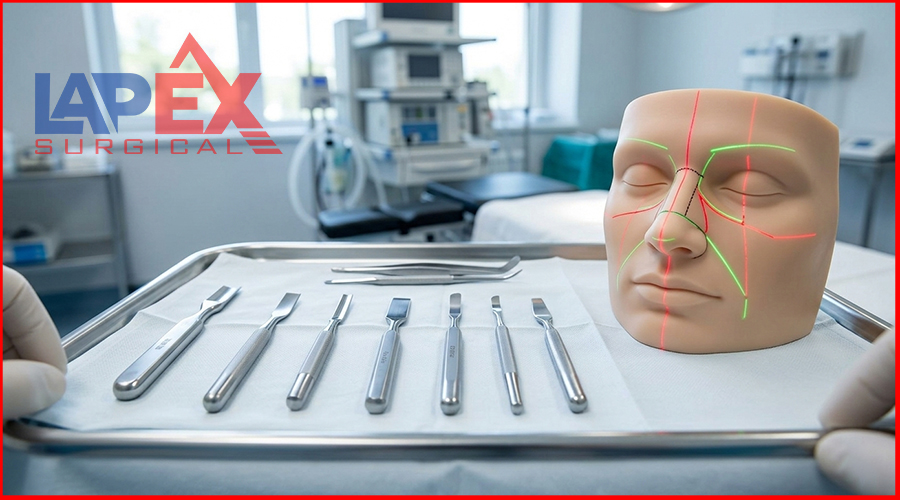
Top 7 Chisels & Osteotomes Every Rhinoplasty Surgeon Needs in Their Kit
In the world of aesthetic and reconstructive surgery, rhinoplasty is widely considered the “game of millimeters.” Unlike abdominal or general surgery, where large incisions and broad maneuvers are common, rhinoplasty requires a level of finesse that borders on the artistic. At the heart of this precision are two fundamental tools: Chisels and Osteotomes.
As a leading manufacturer based in Sialkot, Lapex Surgical understands that the quality of these instruments directly impacts surgical outcomes, patient recovery times, and the surgeon’s hand fatigue. In this definitive guide, we explore the seven essential bone-contouring tools that should be in every modern rhinoplasty kit.
1. The Distinction: Why “The Right Tool” Matters
Before diving into our top seven, we must address a common question: What is the difference between a chisel and an osteotome?
- The Chisel: Beveled only on one side. It is designed to “shave” or “plane” the bone’s surface. It is the tool of choice for removing a small dorsal hump or smoothing an irregular bone surface.
- The Osteotome: Beveled on both sides. It is designed to “cut through” the bone. When a surgeon needs to perform a lateral or medial osteotomy to narrow the nasal bridge, the dual-bevel allows for a straight, clean break.
At Lapex Surgical, we forge both from high-tempered stainless steel to ensure that neither the edge dulls nor the shaft vibrates during the mallet strike.
The “Top 7” Must-Have Instruments
1. The Silver Osteotome (Guarded)
Often considered the “Gold Standard” for lateral osteotomies, the Silver Osteotome features a unique lateral guard.
- The Benefit: The guard protects the delicate nasal mucosa and soft tissue while the blade cuts the bone.
- Lapex Precision: Our Silver Osteotomes are hand-polished to ensure the guard is smooth, preventing any accidental snags on endonasal tissue.
2. The Cottle Chisel (Graduated)
Cottle instruments are staples in Sialkot manufacturing due to their global demand. The Cottle chisel often features centimeter markings on the shaft.
- The Benefit: It allows the surgeon to measure the depth of penetration accurately, ensuring symmetry on both sides of the nose.
- Design Note: Available in various widths (from 2mm to 12mm) to suit different nasal anatomies.
3. The Parkes Osteotome
Known for its slightly curved or “flared” handle, the Parkes Osteotome provides superior grip.
- The Benefit: The ergonomic handle allows for a firm mallet strike without the tool slipping. It is particularly effective for thick nasal bones where more force is required.
4. The Cinelli Osteotome
Specifically designed for the dorsal hump.
- The Benefit: Its wide, flat blade allows for a clean, horizontal cut across the bridge of the nose.
- Lapex Edge: We ensure the Cinelli blade is razor-sharp to prevent “bone crushing,” which leads to excessive post-operative swelling.
5. The Tardy Osteotome (Micro-Osteotome)
For ultra-fine work, the Tardy is indispensable.
- The Benefit: It is much thinner than standard osteotomes, making it perfect for “percutaneous” osteotomies where the surgeon wants to minimize scarring.
6. The Sheehan Osteotome
A versatile, hexagonal-handled tool.
- The Benefit: The hexagonal handle prevents the tool from rolling on the surgical tray and provides multiple pressure points for the surgeon’s thumb, allowing for high control during delicate bone shaving.
7. The Anderson-Neivert Osteotome
Commonly used for medial and lateral osteotomies.
- The Benefit: It features a specialized tip that guides the blade along the natural contour of the maxillary bone.
Technical Comparison Table: Choosing Your Steel
| Instrument | Bevel Type | Primary Use | Handle Style |
|---|---|---|---|
| Silver | Dual (Osteotome) | Lateral Osteotomy | Rounded/Guarded |
| Cottle | Single (Chisel) | Hump Shaving | Graduated/Flat |
| Cinelli | Dual (Osteotome) | Dorsal Reduction | Wide/Flared |
| Tardy | Dual (Micro) | Fine Contouring | Slim/Fiber |
| Sheehan | Dual (Osteotome) | General Cutting | Hexagonal |
The Lapex Manufacturing Advantage: Why Sialkot Steel?
Sialkot is the world’s hub for surgical instrument manufacturing, but not all instruments are created equal. At Lapex Surgical, our manufacturing process involves three critical stages that set us apart:
1. High-Carbon Surgical Steel
We use medical-grade stainless steel that resists corrosion even after hundreds of autoclave cycles. The high carbon content ensures that the cutting edge stays sharp longer than generic alternatives.
2. Tempering and Hardening
A chisel is only as good as its “temper.” If the steel is too soft, it will bend; if it is too brittle, it will chip. Our vacuum-tempering process creates a balance of flexibility and hardness.
3. Hand-Finishing
Machines can forge a shape, but only a master craftsman can feel the balance of an osteotome. Our Sialkot-based artisans hand-grind every bevel to ensure a 100% consistent cutting angle.
Maintenance and Sterilization of Osteotomes
To maintain the “Lapex Edge,” surgeons and clinical staff should follow these protocols:
- Inspect After Every Use: Check for micro-chips in the blade. A chipped osteotome causes bone fragmentation.
- Ultrasonic Cleaning: Before autoclaving, use ultrasonic cleaning to remove bone dust from the handle’s knurling.
- No Metal-on-Metal: Never store sharp chisels in a tray where they can bang against other stainless steel tools. Use silicone mats.
Frequently Asked Questions (FAQ)
Q1: Can I use a Chisel as an Osteotome?
Technically, yes, but it is not recommended. A chisel’s single bevel will cause the tool to “drift” toward the flat side when struck with a mallet. For a straight cut through bone, always use a dual-beveled osteotome.
Q2: What mallet weight is best for these instruments?
For rhinoplasty, a lightweight mallet (200g to 300g) with a nylon or lead head is preferred. This prevents “rebound” and gives the surgeon better tactile feedback.
Q3: Why does Lapex Surgical offer different handle types?
Surgeons have different preferences based on their grip style. Hexagonal handles offer more torque control, while rounded “Fiber-Grip” handles provide better shock absorption for the hand.
Q4: How often should surgical chisels be sharpened?
Depending on the volume of cases, we recommend professional sharpening every 6–12 months. Lapex Surgical offers refurbishment services for all our instruments.
The Lapex Commitment to Excellence
Choosing the right Chisels & Osteotomes for Rhinoplasty is about more than just buying a tool; it’s about investing in the outcome of your patients. As a premier manufacturer, Lapex Surgical is dedicated to providing the global medical community with instruments that combine the heritage of Sialkot craftsmanship with modern engineering precision.
Whether you are performing a complex reconstructive rhinoplasty or a routine aesthetic adjustment, our instruments are designed to be an extension of your hands.
For bulk inquiries or custom instrument modifications, visit our product catalog or contact our technical team at Lapex Surgical.