
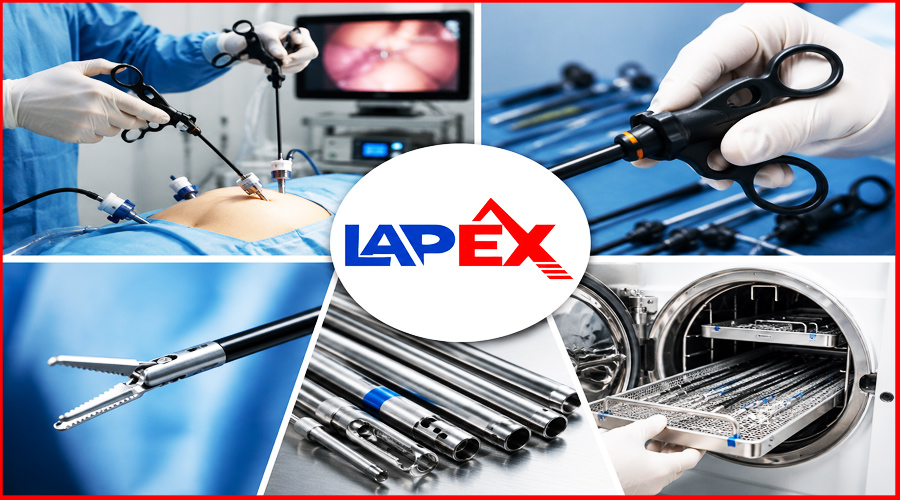
The Procurement Engineer’s Checklist for Laparoscopic Instrument Quality
Investing in a laparoscopic instrument means evaluating three measurable properties before a single rupee or dollar changes hands: jaw alignment tolerance under repeated actuation, the coefficient of friction at the handle-to-shaft interface, and the number of autoclave cycles before insulation or coating failure. A high-quality grasper or dissector typically holds jaw misalignment under 0.05mm through 300+ steam sterilization cycles, transmits tactile feedback through a low-friction rack-and-pinion or cam mechanism, and resists carbon staining on 420-series stainless or German DIN 1.4021 martensitic steel. Anything short of these benchmarks compromises both surgical control and instrument lifecycle cost.
That definition matters because procurement teams in hospitals, ambulatory surgical centers, and group purchasing organizations rarely fail at sourcing instruments — they fail at sourcing instruments that survive their own sterilization protocol. A trocar that performs flawlessly in a vendor demo can develop seal degradation by the fortieth autoclave cycle if the silicone compound wasn’t rated for the facility’s specific steam pressure and dwell time. This is the gap between catalog quality and clinical quality, and it is the gap this article is written to close.
Why Laparoscopic Instrument Quality Is an Engineering Problem, Not a Branding Problem
Minimally invasive surgery compresses a surgeon’s entire sensory and motor input into a five-to-twelve millimeter shaft. Every degree of mechanical play in the jaw, every micron of surface roughness on the handle, and every gram of imbalance in the instrument’s center of mass gets transmitted — amplified, not dampened — to the surgeon’s fingers. In open surgery, a marginally stiff hemostat is an inconvenience. In laparoscopic surgery, the same marginal stiffness, multiplied across a 40-centimeter lever arm, becomes the difference between a clean tissue bite and an inadvertent perforation.
This is why instrument evaluation has to start from mechanical first principles rather than from a sales sheet. A laparoscopic grasper is, functionally, a precision four-bar or cam linkage operating at the distal end of a long, thin tube, actuated by a handle mechanism at the proximal end, and subjected to lateral torque, axial thrust, and repeated high-temperature sterilization stress over its service life. Quality, in this context, is not a subjective adjective. It is a function of metallurgy, tolerance stacking, surface finish, and mechanism design — and each of these can be specified, tested, and verified before a single unit reaches an operating table.
Ergonomic Design: Where Surgeon Fatigue and Patient Outcome Intersect
Surgical literature on instrument-related fatigue has consistently pointed to handle geometry as a leading contributor to surgeon musculoskeletal strain during long laparoscopic procedures. A 2019 ergonomics review published in the Journal of Minimally Invasive Surgery found that surgeons performing procedures exceeding 90 minutes with axial-handle (in-line) instruments reported significantly higher thenar and forearm fatigue scores than those using pistol-grip or ring-handle designs matched to hand anthropometry. The practical implication for procurement teams is that ergonomics cannot be treated as a comfort feature bolted onto an otherwise standard instrument. It is a clinical performance variable with measurable downstream effects on dexterity, tremor amplitude, and procedure duration — particularly in the third and fourth hour of complex bariatric, colorectal, or gynecologic-oncology cases.
Three structural elements determine whether a handle design genuinely reduces fatigue or merely repositions it.
The first is the pivot-point relationship between the handle’s lever arms and the surgeon’s metacarpophalangeal joints. Instruments with a fixed fulcrum that doesn’t track natural finger flexion force the surgeon to compensate with wrist deviation, which is the single largest predictor of repetitive strain in laparoscopic case series. Lapex Surgical’s ring-handle and ratchet-lock grasper lines are built on a floating-pivot geometry that keeps the lever arm aligned with finger curl through the instrument’s full closure range, rather than a single fixed pivot that only feels neutral at 50 percent closure.
The second is grip diameter and surface texture calibrated to gloved-hand friction coefficients. A handle that feels secure in a bare-hand showroom test can become unstable once a size 7.5 latex or nitrile surgical glove is introduced, because glove material changes the effective coefficient of friction by as much as 30 percent depending on glove thickness and powder-free coating. Instruments machined with a uniform knurl pattern, rather than a smooth or partially knurled grip, maintain consistent purchase across glove types and across the moisture buildup that accumulates during multi-hour procedures.
The third is mass distribution along the shaft. An instrument that is heavier at the distal tip than the proximal handle forces the surgeon’s hand to constantly counteract a pendulum effect, which is fatiguing even when the absolute weight of the instrument is low. Lapex’s titanium-shaft variants are weighted to keep the center of mass within 15mm of the surgeon’s grip centerline, which is why surgical teams who switch from generic stainless shafts often describe the change less in terms of “lighter” and more in terms of “steadier” — a meaningfully different and more clinically relevant property.
Tactile Feedback: The Mechanical Property That Cannot Be Faked
Tactile feedback in a laparoscopic instrument is the fidelity with which forces applied at the jaw — tissue resistance, vessel wall tension, the give of a suture passing through fascia — are transmitted back through the shaft to the surgeon’s fingers without distortion or delay. This single property separates a precision instrument from a commodity stamping, and it is the hardest one for a buyer to evaluate from a spec sheet alone, because it depends on the interaction of several manufacturing variables rather than any single dimension.
The dominant variable is mechanism friction. A rack-and-pinion jaw actuation system with tight but properly lubricated tolerances transmits force almost linearly: what the surgeon feels at the handle correlates directly with what the jaw is doing to tissue. Excess internal friction — common in instruments where the shaft tube and the actuation rod inside it are stamped rather than precision-ground — absorbs and masks that force signal. The surgeon compensates by applying more force than necessary, which increases the risk of tissue trauma or instrument slippage, and ironically increases fatigue because the surgeon is now fighting the instrument’s internal resistance in addition to the tissue itself.
The second variable is shaft rigidity versus torsional flex. A shaft with excessive torsional give will twist slightly under lateral load before transmitting rotational input to the jaw, producing a perceptible lag between the surgeon’s wrist movement and the instrument’s response. This lag is measured in surgical engineering as torsional backlash, and instruments with backlash exceeding roughly 3 to 5 degrees are generally perceptible to experienced laparoscopic surgeons as “loose” or “imprecise,” even when the jaw itself is mechanically sound. Lapex’s 5mm and 10mm shaft assemblies are cold-drawn from solid-bar stainless rather than rolled-and-seamed tube stock specifically to minimize this torsional play, because seam-welded tubing — cheaper to produce — introduces a structural weak point that flexes disproportionately under lateral force.
The third variable, often overlooked, is the jaw’s bite geometry itself. Serrated, fenestrated, and atraumatic jaw patterns each transmit a different tactile signature for the same applied force, and matching jaw pattern to procedure type is itself a quality decision. A fenestrated bowel grasper with too aggressive a serration pattern can mask the threshold at which grip pressure crosses from “secure hold” into “tissue trauma,” because the teeth bite before the surgeon perceives resistance. This is why an instrument catalog’s depth — having atraumatic, fine-serration, and coarse-serration variants of the same base grasper — is not catalog padding. It is a direct mechanism for matching tactile feedback to tissue type, which is a patient-safety variable as much as a comfort one.
Durability: Specifying for the Sterilization Cycle, Not the Demo
The single most underestimated cost driver in laparoscopic instrument procurement is premature failure under repeat sterilization, not initial purchase price. An instrument priced 20 percent below market that fails insulation integrity testing at cycle 150 instead of cycle 400 has not saved a hospital money — it has shifted the cost from capital procurement to a recurring replacement and risk-management burden that is harder to track and almost always larger in aggregate.
Three durability variables should anchor any serious evaluation.
Alloy selection determines corrosion resistance and edge retention under the chloride exposure and thermal cycling inherent to steam autoclaving. Lapex Surgical manufactures its core line from German-grade stainless steels — primarily DIN 1.4021 and 1.4034 martensitic grades for cutting and grasping components, where hardness and edge retention matter most, and DIN 1.4301 austenitic grade for housings and non-cutting structural components, where corrosion resistance under repeated moisture exposure is the priority. This dual-alloy approach, standard practice among precision instrument manufacturers in Sialkot’s surgical cluster, reflects a deliberate trade-off: martensitic steels harden well and hold an edge but are more chloride-reactive, so confining them to components that need hardness — jaws, scissor blades — while using austenitic steel elsewhere extends the instrument’s functional life without sacrificing cutting performance.
Surface finish and passivation determine how the alloy behaves over its sterilization lifecycle, not just on day one. Electropolishing followed by a controlled passivation bath removes free iron from the surface layer and builds a stable chromium-oxide layer that resists pitting corrosion — the primary failure mode that causes the dull, mottled surface buyers sometimes mistake for normal wear but which is actually a sign of inadequate post-machining treatment. Instruments that skip a proper passivation cycle to cut production time will often pass initial quality inspection and still develop visible pitting within 100 to 150 autoclave cycles, well inside the instrument’s expected 7-to-10-year service life.
Insulation integrity, for monopolar electrosurgical and electrosurgical-laparoscopic hybrid instruments, is the third and most safety-critical durability variable. Insulation breakdown — invisible to the naked eye in its early stages — allows stray radiofrequency current to arc to adjacent tissue outside the surgeon’s visual field, a documented mechanism behind a meaningful share of laparoscopic electrosurgical injury cases reported in surgical safety literature. Quality manufacturers test insulation integrity at the point of manufacture using high-voltage leak detection, typically at 1,000V to 1,500V DC, and again recommend periodic in-hospital testing using handheld insulation testers as instruments accumulate sterilization cycles. Procurement teams evaluating electrosurgical laparoscopic tools should request documented insulation test data as a baseline requirement, not an optional certificate.
A Worked Comparison: Three Failure Modes from the Field
To make these variables concrete, consider three composite scenarios drawn from patterns commonly reported by surgical-instrument quality assurance teams and consistent with documented failure modes in the sector.
In the first, a mid-sized ambulatory surgical center processing roughly 600 laparoscopic cholecystectomies annually switched to a lower-cost grasper line to reduce per-unit cost by approximately 18 percent. Within fourteen months, the center’s central sterile processing department logged a jaw-misalignment rejection rate climbing from a baseline of under 2 percent to over 11 percent, driven by stamped-tube shafts that developed torsional set after repeated steam exposure. The center’s effective cost per usable instrument-cycle, once replacement frequency was factored in, ended up higher than their original supplier’s pricing — a result that procurement audits increasingly flag as the hidden cost of price-first sourcing in this category.
In the second, a teaching hospital’s bariatric surgery division reported a cluster of longer-than-expected operative times correlated with a specific batch of fenestrated bowel graspers exhibiting elevated mechanism friction — later traced to inconsistent lubrication during assembly rather than a design flaw. The case illustrates that durability and tactile feedback are not purely design properties; they are also manufacturing-process properties, which is why batch-level quality control, not just product-level design specification, belongs in any serious vendor evaluation.
In the third, a regional hospital network standardized its electrosurgical laparoscopic instruments around a single supplier offering documented per-unit insulation testing certificates and a defined maximum-cycle recommendation printed on instrument packaging. The network’s biomedical engineering team reported this single change — moving from generic “reusable, autoclavable” labeling to cycle-rated labeling — as the most operationally useful specification change in their five-year procurement history, because it converted instrument replacement from a reactive, failure-driven process into a scheduled, budgetable one.
Building a Procurement Evaluation Framework
A structural way to evaluate any laparoscopic instrument line, regardless of manufacturer, is to separate the evaluation into mechanism, material, and lifecycle layers rather than treating “quality” as a single undifferentiated judgment.
Evaluation Layer 1 — Mechanism
- Jaw alignment tolerance (target: <0.05mm post-actuation)
- Torsional backlash (target: <3-5 degrees under lateral load)
- Mechanism friction (qualitative: linear force transmission, no perceptible stick-slip)

Evaluation Layer 2 — Material
- Alloy grade documentation (e.g., DIN 1.4021 / 1.4034 / 1.4301 or ASTM equivalents)
- Surface finish and passivation certification
- Insulation leak-test voltage and pass threshold (electrosurgical instruments only)

Evaluation Layer 3 — Lifecycle
- Rated autoclave cycle count
- Warranty terms tied to cycle count, not calendar time
- Batch-level QC documentation, not just product-level design specs
This three-layer framework is deliberately structured to be vendor-agnostic. A hospital sourcing team or surgical center procurement officer can apply it to any catalog, and a manufacturer confident in its own production discipline should be able to answer every line item with documentation rather than marketing language. That is, in practice, the test that separates a precision instrument manufacturer from a commodity stamping operation: not whether they claim quality, but whether they can produce the underlying mechanical and material data on request.
Why Catalog Depth Is a Quality Signal, Not Just a Convenience
It’s tempting to treat a manufacturer’s catalog breadth as a secondary, purely logistical consideration — fewer purchase orders, one vendor relationship, simpler inventory management. But catalog depth is also a direct proxy for design discipline, because a manufacturer that has engineered 82 or more distinct instrument variants across general surgical, electrosurgical, plastic surgery, and laparoscopic categories has necessarily built the tooling, the alloy-sourcing relationships, and the quality-control infrastructure to support variation without sacrificing consistency across the line.
Lapex Surgical’s catalog spans laparoscopic graspers, dissectors, scissors, needle holders, and trocar systems alongside electrosurgical forceps and generators-compatible instruments, and plastic surgery sets that share the same precision-machining standards. The clinical value of this breadth is matching, not maximizing — a colorectal team needs a different jaw serration and shaft length than a gynecologic-oncology team, and a plastic surgery unit needs a different handle ergonomics profile than a general laparoscopic cholecystectomy set. A manufacturer with genuine catalog depth lets a surgical team standardize on a single quality tier — the same alloy, the same passivation process, the same mechanism tolerances — while still selecting the jaw geometry, handle type, and shaft length specific to each procedure. That consistency of underlying quality, expressed across a wide range of clinically specific tools, is precisely what separates a manufacturing partner from a parts supplier.
Sialkot’s Manufacturing Context and Why It Matters for Quality Sourcing
Sialkot’s surgical instrument manufacturing cluster has, over several decades, developed a dense ecosystem of precision forging, CNC machining, and electropolishing capability concentrated within a relatively small geographic radius — a structural advantage that allows tighter coordination between forging, machining, and finishing stages than is typical in more geographically dispersed supply chains. For procurement teams unfamiliar with the region, this density translates into a practical sourcing advantage: manufacturers based in Sialkot’s established cluster, including Lapex Surgical, typically maintain in-house or tightly integrated control over the full production sequence — from bar-stock forging through CNC profiling, heat treatment, polishing, passivation, and final assembly — rather than outsourcing individual stages to disconnected subcontractors. That vertical coordination is directly relevant to the mechanism and material quality variables discussed above, because tolerance stacking errors most commonly enter an instrument’s production at the handoff points between disconnected manufacturing stages.
For international buyers, this also means that meaningful quality differentiation among Sialkot-based manufacturers comes down to exactly the variables outlined in this article — alloy grade discipline, passivation rigor, mechanism tolerance control, and batch-level QC documentation — rather than to the region itself. Origin is not a quality proxy; process discipline is.
Practical Recommendations for Surgical Teams and Procurement Officers
Surgical teams evaluating a new instrument line should request a clinical trial period under real operating conditions, not just a vendor demonstration, because mechanism friction and tactile feedback differences often only become apparent after a glove has been worn for two hours and the instrument has been through several full closure-and-release cycles under actual tissue load. Procurement officers should request documented alloy specifications and insulation test certificates as standard intake requirements, the same way these are requested for implantable devices, rather than treating reusable instruments as a lower-scrutiny category. And both groups benefit from tracking instrument-specific rejection and replacement rates through central sterile processing data, because that operational data — more than any spec sheet — reveals whether an instrument line is delivering on its durability claims in the specific sterilization environment of that facility.
Lapex Surgical structures its laparoscopic, electrosurgical, and plastic surgery instrument lines around this same evaluation logic: documented alloy grades, batch-level passivation and insulation testing, and a catalog built wide enough — 82-plus instruments and growing — to let surgical teams match jaw geometry, handle ergonomics, and shaft specification to procedure type without compromising on the underlying mechanical and material standards that determine whether an instrument performs consistently through its full service life rather than just through its first dozen cases.
Quality in laparoscopic instrumentation is, in the end, not a marketing claim to be taken on trust. It is a set of measurable engineering properties — tolerance, alloy, friction, insulation integrity, cycle life — that any serious manufacturer should be willing and able to document, and that any serious procurement process should be structured to verify before, not after, the instrument reaches the operating table.
👉 Ready to upgrade your surgical inventory to corrosion-resistant excellence? Explore the Lapex Surgical Catalog | For more information contact the Lapex Surgical support team.