
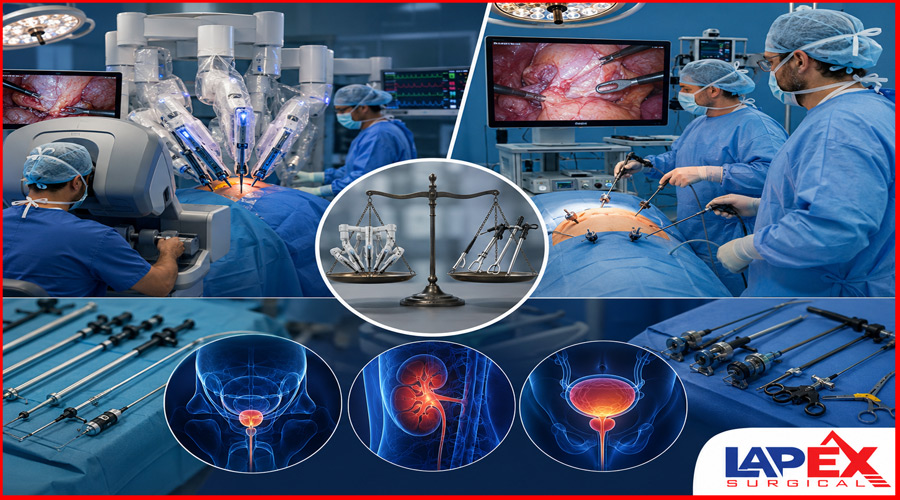
Laparoscopic vs. Robotic Instruments for Urological Oncology: A Complete Comparison
Robotic instruments beat laparoscopic tools for most complex cancer surgeries. They bend like a human wrist, filter out hand shakes, and show the surgeon a 3D view. This helps with tricky work like nerve-sparing prostate removal or fixing blood vessels during kidney surgery.
But laparoscopic instruments still matter. They cost less, set up faster, and work fine for simpler procedures. Many hospitals use both, picking the right tool for each patient and each surgery.
This guide breaks down the real differences between the two, backed by clinical use cases, so you can make a smart choice for your OR or your career.
Why This Comparison Matters
Cancer surgery inside the body has changed a lot over the past 20 years. Doctors used to cut large openings to remove tumors. Now they work through tiny ports, using long, thin tools and cameras.
Two main tool systems dominate this space today:
- Conventional laparoscopic instruments: straight, rigid tools controlled by hand.
- Robotic-assisted instruments: wristed tools controlled through a console.
Picking between them isn’t just about preference. It affects surgery time, patient recovery, hospital costs, and even how well a surgeon can protect nerves and organs during cancer removal.
Let’s look at how these tools actually work, where they differ, and which one fits which job.
What Are Laparoscopic Instruments?
Laparoscopic instruments are long, thin, rigid tools. A surgeon holds them by hand and pushes them through small cuts in the belly. A camera called a laparoscope lets the team see inside on a screen.
These tools move in a straight line, like a stick. Think of using chopsticks through a small hole; you can grab and cut, but you can’t easily turn the tip sideways.
Key Traits of Laparoscopic Tools
- 4 degrees of freedom. The tool can move up, down, left, right, and rotate, but the tip itself doesn’t bend.
- No wrist joint. The surgeon relies on body position and angle, not tool flexibility.
- Fulcrum effect. Moving the handle one way moves the tip the opposite way, since the port acts like a pivot point. Surgeons train for years to get used to this.
- Manual control. No motors, no filters. Every shake in the surgeon’s hand can show up at the tip.
- Lower cost. Instruments are often reusable and don’t need an expensive robotic system to run.
Laparoscopy is still a workhorse in many operating rooms. It’s fast to set up, doesn’t need a robot console, and works well for procedures that don’t require tight, angled stitching.
What Are Robotic-Assisted Instruments?
Robotic instruments are also inserted through small ports, but a robotic system controls them. The surgeon sits at a console a few feet away and moves hand controls. The robot translates those movements into precise motion at the tool tip, inside the patient.
Two well-known platforms in this space are the da Vinci system with EndoWrist technology and the Medtronic Hugo RAS system.
Key Traits of Robotic Tools
- 7 degrees of freedom. The tip has a wrist joint, so it moves almost like a human hand, twisting, bending, and rotating inside the body.
- Tremor filtering. The system smooths out small shakes from the surgeon’s hand, so the tool tip stays steady.
- Motion scaling. Large hand movements at the console can be scaled down to small, precise movements at the tip, sometimes at a 5:1 ratio.
- 3D high-definition view. The surgeon sees a magnified, three-dimensional image instead of a flat 2D screen.
- Seated console work. The surgeon operates while sitting, which reduces physical strain during long procedures.
This extra dexterity matters most in tight spaces, like deep inside the pelvis, where laparoscopic tools struggle to angle correctly.
Side-by-Side Comparison Table
| Feature | Conventional Laparoscopic Instruments | Robotic-Assisted Instruments |
|---|---|---|
| Degrees of Freedom | 4 (rigid, straight-line movement) | 7 (full wrist articulation) |
| Motion Scaling & Tremor Filter | None (manual control) | Active tremor filtering, up to 5:1 scaling |
| Ergonomics | Standing; higher physical fatigue | Seated console; reduced physical strain |
| Primary Surgical Strengths | Cost-effective; rapid setup | Complex suturing, tight-space dissection |
| Consumable Cost | Low (reusable/durable options) | High (per-procedure instrument life limit) |
| Visualization | 2D, standard camera | 3D, high-definition, magnified |
| Best Fit | Simple, high-volume procedures | Complex reconstruction and cancer removal |
Core Technological Differences Explained
Degrees of Freedom: Why Wrist Movement Matters
A human wrist can bend, twist, and rotate in almost any direction. Laparoscopic tools can’t do that; they only move in and out, side to side, and rotate around their own shaft. That’s 4 degrees of freedom.
Robotic tools add a wrist joint at the tip. That gives surgeons 7 degrees of freedom, almost matching a real hand. This matters most when stitching in a small, curved space, like deep in the pelvis during a prostate removal.
Tremor Filtering and Motion Scaling
Every human hand shakes a little, especially during long surgeries. Laparoscopic tools show every bit of that shake at the tip, since there’s no computer in between.
Robotic systems filter this out. They also let surgeons scale down their movements, so a big hand motion becomes a tiny, controlled motion inside the body. This reduces the risk of accidental damage to nearby nerves or blood vessels.
Ergonomics and Surgeon Fatigue
Laparoscopic surgery often means standing for hours, holding tools at odd angles. This causes fatigue, and over time, it can lead to shoulder, neck, or back strain for surgeons.
Robotic surgery lets the surgeon sit at a console. Their arms rest in a natural position while the robot handles the fine motion. This can help surgeons stay sharp during long, complex cancer surgeries.
Cost Differences
Laparoscopic tools are usually cheaper. Many are reusable, and they don’t need a multi-million-dollar robotic system to operate.
Robotic tools cost more. The robotic arms themselves have a limited number of uses before they need replacing, which adds to the cost per surgery. Hospitals also need to invest in the robotic system itself, plus staff training.
This cost gap is a real factor for procurement teams comparing platforms. Companies like Lapex Surgical, a manufacturer of surgical, electrosurgical, plastic surgery, and laparoscopic instruments based in Sialkot, continue to supply cost-effective conventional instruments that remain essential for many procedures, even as robotic adoption grows.
Clinical Impact in Urological Cancer Surgery
Radical Prostatectomy
Removing a cancerous prostate is delicate work. Surgeons need to spare the nerves that control urinary and sexual function while fully removing the tumor.
Robotic-assisted radical prostatectomy (RARP) is now the standard approach in many hospitals. The wristed needle drivers and graspers help with:
- Precise nerve-sparing dissection
- Continuous bladder-to-urethra stitching (anastomosis)
- Reduced blood loss during the procedure
Doing this same nerve-sparing work with straight laparoscopic tools is possible, but it takes much longer to master. The learning curve is steep, and even skilled surgeons find the wrist-free movement limiting in this tight space.
Partial Nephrectomy
A partial nephrectomy removes a tumor from the kidney while keeping the healthy part intact. Speed matters here, because the kidney’s blood supply is often clamped during the tumor removal. This clamped time is called warm ischemia time (WIT).
The longer the WIT, the more risk there is to long-term kidney function. Robotic suturing helps surgeons close the kidney faster after removing the tumor, which shortens WIT compared to conventional laparoscopic methods.
For patients, this can mean better preserved kidney function after surgery, a real, measurable clinical benefit.
Radical Cystectomy
Removing the bladder due to cancer is one of the more complex urological surgeries. After removal, surgeons must rebuild a way for urine to leave the body, called urinary diversion.
This reconstruction needs fine, accurate micro-suturing inside the body. Robotic instrument articulation makes this easier, and it’s linked to:
- Lower rates of converting to open surgery mid-procedure
- Shorter hospital stays for patients
Conventional laparoscopy can still perform cystectomy, but the reconstruction step is where robotic wrist movement offers a clear edge.
When Laparoscopic Instruments Still Make Sense
Robotic tools aren’t always the better pick. Laparoscopic instruments remain a smart choice when:
- The procedure is simple. Straightforward tumor removal without complex reconstruction doesn’t always need a wrist joint.
- Budget is limited. Not every hospital can afford a robotic system and its ongoing costs.
- Speed of setup matters. Laparoscopic rooms can be ready faster than robotic ones.
- Surgeon training favors laparoscopy. A surgeon skilled in traditional laparoscopic technique may achieve excellent results without switching platforms.
Manufacturers like Lapex Surgical continue producing durable, reusable laparoscopic instruments that serve hospitals where robotic systems aren’t practical or necessary for every case.
Making the Decision: A Quick Framework
Hospital procurement teams and surgical directors often ask the same question: robotic, laparoscopic, or both?
Here’s a simple way to think about it:
- High case volume of complex reconstructive cancer surgery → Robotic platform investment likely pays off.
- Mixed caseload with many straightforward procedures → Keep a strong laparoscopic instrument set on hand.
- Tight capital budget → Laparoscopic tools deliver strong outcomes at a lower cost.
- Surgeon team already trained on robotics → Lean into robotic-assisted cases for complex reconstructions.
Most hospitals don’t need to pick one system forever. Many run both, using robotic tools for nerve-sparing prostatectomy or intracorporeal cystectomy, and laparoscopic tools for simpler nephrectomy or diagnostic procedures.
Laparoscopic vs. Robotic Instruments
A quick-look comparison for surgeons, directors, and procurement teams choosing minimally invasive tools for cancer surgery.
Robotic tools win on precision for complex reconstruction. Laparoscopic tools win on cost for simpler, high-volume cases.
Instrument Specs, Side by Side
Laparoscopic
Robotic-Assisted
Where Robotic Precision Changes Outcomes
Three cancer procedures where wrist articulation makes a measurable difference.
Radical Prostatectomy
Wristed tools help spare nerves and stitch the bladder-urethra join.
Partial Nephrectomy
Faster robotic suturing cuts warm ischemia time, protecting kidney function.
Radical Cystectomy
Better micro-suturing means fewer conversions and shorter hospital stays.
Which One Should You Pick?
Frequently Asked Questions
Is robotic surgery always better than laparoscopic surgery for cancer removal?
Not always. Robotic tools offer more precision in tight spaces, which helps with complex reconstruction. But for simpler procedures, laparoscopic tools can achieve similar results at a lower cost.
What does “degrees of freedom” mean in surgical instruments?
It refers to how many directions a tool can move. Laparoscopic tools have 4 (in/out, side to side, and rotation). Robotic tools add wrist bending and twisting, giving 7 total.
Why does warm ischemia time matter in kidney surgery?
Warm ischemia time is how long the kidney’s blood supply is clamped during surgery. Shorter times protect kidney function better. Robotic suturing tends to shorten this time compared to laparoscopic methods.
Do robotic instruments cost more than laparoscopic ones?
Yes. Robotic instruments have a limited number of uses per instrument, and the robotic system itself is a major investment. Laparoscopic tools are often reusable and cheaper overall.
Can a hospital use both laparoscopic and robotic instruments?
Yes, and many do. Hospitals often keep both instrument sets, choosing the right tool based on the complexity of each case.
What is EndoWrist technology?
EndoWrist is the wristed instrument technology used in da Vinci robotic systems. It gives the tool tip a joint that mimics human wrist movement, allowing more precise dissection and suturing.
Final Takeaway
Robotic instruments offer clear advantages for complex urological cancer surgery, better dexterity, steadier hands, and improved outcomes in tight anatomical spaces like the pelvis. Laparoscopic instruments remain a reliable, cost-effective choice for simpler procedures and hospitals with tighter budgets.
The right answer isn’t robotic or laparoscopic. It’s knowing which tool fits which surgery. Suppliers like Lapex Surgical continue to support both approaches, manufacturing laparoscopic instrumentation that keeps traditional minimally invasive surgery accessible and dependable for hospitals worldwide.
Explore our comparative catalog of next-generation robotic and laparoscopic urological instrumentation.
👉 For expert guidance on this topic, contact our support team now!