CE Mark vs. “China Export” Mark: How to Verify Authentic Certification on Surgical Instruments
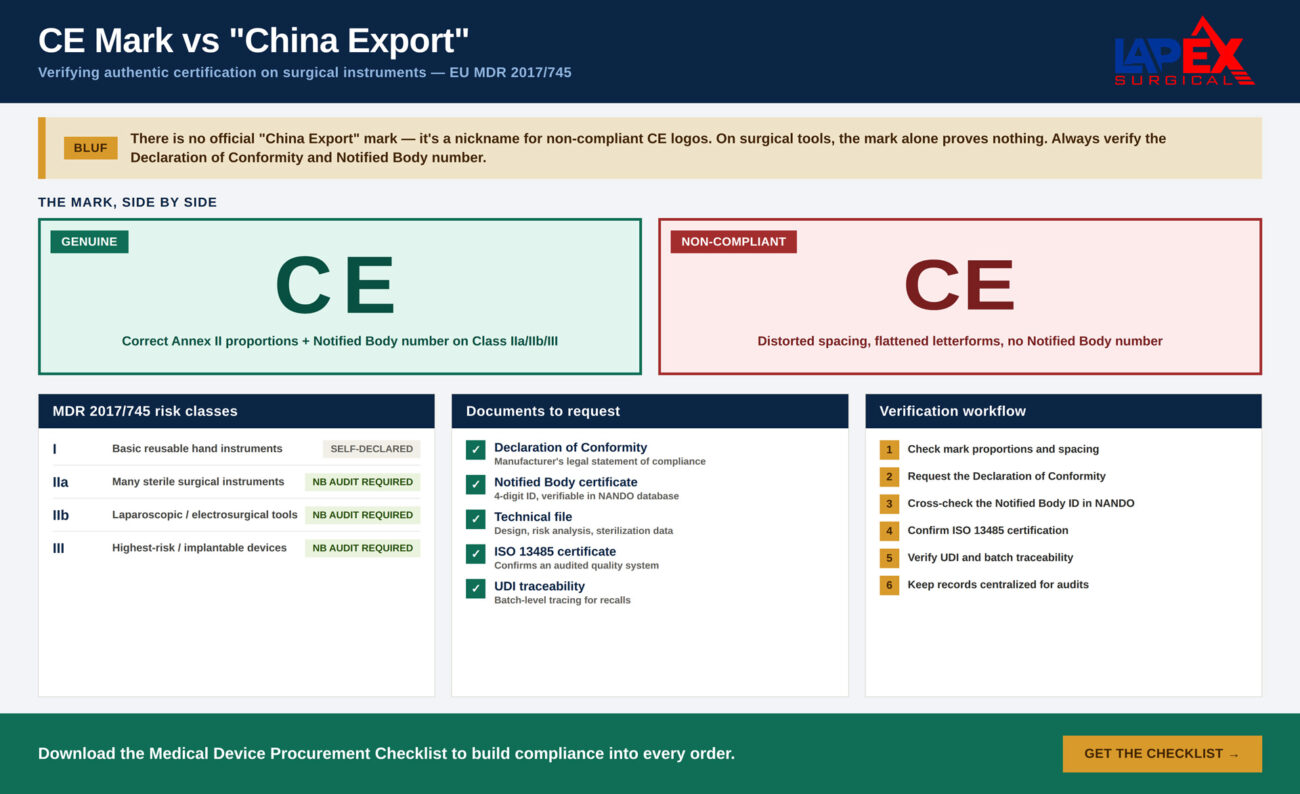
There is no such thing as an official “China Export” logo. It is a nickname procurement professionals invented for CE marks that are poorly reproduced, geometrically wrong, or outright counterfeit. The real risk isn’t a secret second logo hiding on your instrument tray; it’s a non-compliant or fraudulent CE mark that hasn’t been backed by a legitimate conformity assessment.
For surgical, electrosurgical, plastic surgery, and laparoscopic instruments sold into the EU in 2026, three things matter more than the shape of the letters on the tool:
- The mark’s proportions must follow the exact geometric template set out in EU law, not “eyeballed” spacing.
- A four-digit Notified Body number must sit next to the CE mark for Class IIa, IIb, and III devices, proving an independent auditor reviewed the manufacturer’s quality system.
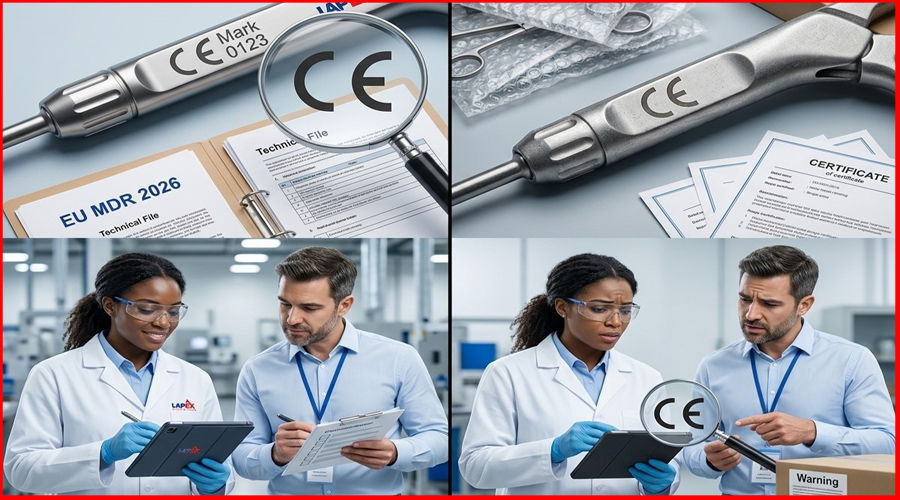
- A Declaration of Conformity (DoC) and Technical File must exist behind that mark, because a logo, real or fake, is decoration without paperwork to support it.
If your procurement checklist stops at “does the logo look right,” you are one shipment away from a compliance failure, a customs seizure, or, worse, an instrument that fails in an operating theatre. This guide walks quality assurance managers, distributors, and hospital procurement officers through exactly what to check, in what order, and why it matters more than ever under EU MDR 2017/745.
Why This Topic Matters Right Now
Surgical instrument sourcing has become a global business. Sialkot, Pakistan, home to manufacturers like Lapex Surgical, supplies a significant share of the world’s hand-held surgical, electrosurgical, and laparoscopic instruments. So do manufacturers across China, India, and Eastern Europe. With that global supply chain comes an uncomfortable truth: not every CE mark on the market was earned.
Counterfeit and non-compliant marks matter because:
- Patient safety is on the line. A forceps or trocar that hasn’t passed real conformity testing may fail under load, corrode faster than expected, or carry biocompatibility risks.
- Hospitals face legal exposure. Using uncertified devices can void insurance coverage and expose procurement teams to liability if something goes wrong in surgery.
- Customs and market surveillance authorities are tightening enforcement. EU customs routinely detain shipments over suspect CE marks, and market surveillance authorities can force product recalls.
- EU MDR 2017/745 raised the bar substantially compared to the old Medical Device Directive (MDD), meaning older assumptions about “CE = compliant” no longer hold without deeper verification.
The “China Export” Myth, Explained Properly
Ask ten people in procurement what “China Export” means, and you’ll likely get ten different, and mostly incorrect, answers. Let’s clear this up definitively.
There is no official “China Export” mark
No regulatory body, in China or anywhere else, has ever registered or sanctioned a logo called “China Export.” The term is internet folklore that grew out of a real observation: some counterfeit or careless manufacturers produce CE-style marks with incorrect spacing between the “C” and the “E,” making the mark look visually distinct from a properly proportioned CE mark.
This gave rise to a popular (but technically imprecise) claim that the “C” and “E” are drawn closer together in a “China Export” mark. In reality:
- There is no second, formally defined mark.
- What people are calling “China Export” is simply a badly drawn, non-compliant, or counterfeit CE mark.
- The letter-spacing observation is a useful visual shorthand for spotting a problem, but it is not a legal definition, and relying on it alone will miss many fraudulent marks that are otherwise well-drawn.
Why the myth persists
The myth is sticky because it’s a simple, memorable story: “close letters = fake, wide letters = real.” It gives buyers a false sense that visual inspection alone is sufficient due diligence. That is precisely the problem this article exists to correct: visual inspection is a first filter, not a compliance program.
The Power of Proportions: What a Genuine CE Mark Actually Looks Like
The European Commission does specify exact geometric requirements for the CE mark, and this is where real due diligence begins.
Official design rules
| Requirement | Detail |
|---|---|
| Shape | The mark consists of the initials “CE” in the specific stylized form set out in EU legislation, not a generic typed “CE.” |
| Proportions | If the mark is enlarged or reduced, the vertical and horizontal proportions must be preserved exactly as in the graduated drawing published in EU law. |
| Minimum height | The mark must generally be no smaller than 5 mm in height, unless another minimum dimension is specified for that product category. |
| Visibility | It must be visible, legible, and indelible, not something that wipes off during cleaning or autoclaving. |
| Placement | It must be affixed to the product itself where possible, or to its packaging and accompanying documents if the product is too small. |
| Sole use | Only the manufacturer (or their authorized representative) may affix the CE mark, and only after the applicable conformity assessment has been completed. |
Common visual red flags (informal indicators, not legal tests)
- Uneven spacing between the “C” and “E” characters
- A distorted or overly rounded “C” that doesn’t match the standard EU template
- A mark that is stamped, printed, or engraved with visibly poor resolution
- Absence of any accompanying Notified Body number where one is legally required
- A mark placed only on packaging when the instrument itself is large enough to bear it directly
None of these, on their own, proves fraud. But they should trigger the next step: asking for documentation.
Focus on EU MDR 2017/745: The Mark Alone Is Not Enough
This is the section that many articles about “spotting fake CE marks” skip entirely, and it’s the most important one for surgical instruments specifically.
Classification drives what you should expect to see
Under EU MDR 2017/745, medical devices, including most surgical, electrosurgical, and laparoscopic instruments, are classified by risk:
| Class | Typical Examples | Conformity Assessment Route | Notified Body Involved? |
|---|---|---|---|
| Class I | Simple reusable non-invasive instruments (e.g., basic non-sterile hand tools) | Self-declaration by manufacturer in most cases | Generally, no, unless sterile, measuring, or reusable-surgical-instrument provisions apply |
| Class IIa | Many reusable surgical instruments, certain laparoscopic tools | Manufacturer + Notified Body audit of quality system and/or technical documentation | Yes |
| Class IIb | Electrosurgical generators, certain energy-delivery devices, and more invasive laparoscopic instruments | Full quality system audit plus technical file review | Yes |
| Class III | Highest-risk implantable or life-sustaining devices | Full technical documentation review, unit-by-unit scrutiny for certain products | Yes |
The critical rule: for Class IIa, IIb, and III devices, the CE mark must be accompanied by a four-digit Notified Body identification number. That number identifies the independent, government-designated body that audited the manufacturer’s quality management system and reviewed the technical file. A CE mark on one of these instrument classes without a Notified Body number sitting next to it is an immediate compliance red flag, not a matter of interpretation.
Where transition timelines stand in 2026
EU MDR fully replaced the old Medical Device Directive (MDD) in May 2021, but the Commission has extended transition deadlines for certain legacy devices multiple times since, most recently under Regulation (EU) 2023/607 and subsequent amendments. As of 2026, the relevant checkpoints procurement teams should be aware of are:
- Class III custom-made implantable devices: transition period extended to May 26, 2026.
- Higher-risk legacy devices (Class III and implantable Class IIb): transition period extended to December 31, 2027.
- Medium- and lower-risk legacy devices (other Class IIb, Class IIa, and Class I requiring Notified Body involvement): transition period extended to December 31, 2028.
- EUDAMED registration (the EU’s central medical device database) became mandatory from May 28, 2026, regardless of device class, adding a new verification layer that procurement teams can check against.
These extensions apply specifically to legacy devices already certified under the old MDD that are transitioning to full MDR certification, not to brand-new devices, which have been required to meet full MDR requirements since 2021. If a supplier tells you their instrument is “still under the old directive,” ask precisely which transition provision applies and request the paperwork proving eligibility.
Why does this matter for surgical tools specifically
Surgical, electrosurgical, and laparoscopic instruments frequently sit in Class IIa or IIb because they are invasive, reusable, and used in sterile environments. That means:
- A missing Notified Body number is not a minor omission; it likely means the device has not completed the legally required assessment route.
- Reusable instrument manufacturers must also demonstrate validated reprocessing (cleaning, disinfection, sterilization) instructions as part of their technical file, something a logo can never communicate.
- Electrosurgical generators, being active devices with electrical safety and EMC considerations, typically carry additional technical standards (such as IEC 60601 series compliance) that should be referenced in the Declaration of Conformity.
Documentation Over Decoration: What to Actually Ask For
Here is the core mindset shift procurement and QA teams need: the CE mark is a claim, not proof. The proof lives in two documents.
1. The Declaration of Conformity (DoC)
This is a legally binding document, signed by the manufacturer, stating that the product meets all applicable EU requirements. A genuine DoC should include:
- Manufacturer name and address (and authorized EU representative, if applicable)
- A unique identifier for the device (model, batch, or UDI reference)
- The device’s risk classification
- Reference to the specific EU regulation and the relevant harmonized standards applied
- The Notified Body name and identification number, where applicable
- Date and place of issue, with an authorized signature
2. The Technical File (Technical Documentation)
This is the deeper evidence base behind the DoC, generally including:
- Device description and intended purpose
- Design and manufacturing information
- Risk management documentation (per ISO 14971)
- Biocompatibility and material safety data
- Clinical evaluation or performance data
- Labeling and instructions for use
- Post-market surveillance plan
You do not necessarily need the entire Technical File handed over (much of it is commercially sensitive). Still, a legitimate manufacturer or distributor should never hesitate to provide the DoC and a summary of the technical file on request. Reluctance, delay, or a document that looks freshly generated with no traceable history is itself a warning sign.
Quick-reference verification table
| What You’re Checking | Where to Look | Red Flag |
|---|---|---|
| CE mark proportions | Directly on the instrument | Distorted, uneven, or inconsistent lettering |
| Notified Body number | Next to the CE mark (Class IIa/IIb/III only) | Missing, blurry, or not verifiable |
| Declaration of Conformity | Supplier documentation package | Not provided, vague, or missing signature/date |
| Notified Body validity | EU NANDO database (public) | The number doesn’t match any registered Notified Body |
| EUDAMED registration | EUDAMED public database | Device or manufacturer not listed |
| Technical File summary | Requested from manufacturer/distributor | Refusal, excessive delay, inconsistent details |
| Labeling & IFU | Product packaging | Missing manufacturer address, batch/lot, or sterilization method (if applicable) |
What Genuine Manufacturers Do Differently
It’s worth separating the conversation about fraudulent marks from an unfair, and inaccurate, assumption that sometimes creeps into procurement discussions: that instruments manufactured in Sialkot, Pakistan, or other established surgical-instrument hubs are inherently higher-risk. Origin is not the variable that determines compliance. Process is.
A manufacturer serious about the EU market typically demonstrates the following, regardless of where its factory is located:
- An ISO 13485-certified quality management system, independently audited and kept current, covering design controls, supplier management, and post-market surveillance.
- A documented conformity assessment history for each device family, including which route was used (self-declaration for Class I, or Notified Body assessment for Class IIa and above) and when it was last renewed.
- Traceable batch and lot records, so that if a quality issue emerges, the exact production run can be identified and, if necessary, recalled.
- Validated reprocessing instructions for reusable surgical instruments, cleaning, disinfection, and sterilization parameters that have actually been tested, not just copied from a template.
- A named Person Responsible for Regulatory Compliance (PRRC) or equivalent regulatory contact who can answer specific questions about classification and technical documentation without deflecting.
- Willingness to share verifiable third-party audit certificates, not just internally generated compliance statements.
When you’re evaluating a new supplier relationship, these operational signals are far more predictive of long-term reliability than the appearance of the mark on any single sample instrument you’re handed at a trade show.
A note on private-label and OEM sourcing
Many hospitals and distributors buy surgical instruments through private-label or OEM arrangements, where the brand on the packaging differs from the factory that produced the device. This is common and entirely legitimate, but it adds a documentation layer that procurement teams sometimes miss. In these arrangements, confirm:
- Whose name appears as “manufacturer” on the Declaration of Conformity, it should be the legal entity actually responsible for conformity, not just the brand printed on the box.
- Whether the private-label distributor holds its own EU Authorized Representative arrangement, if the manufacturer is based outside the EU.
- The Notified Body number referenced applies to the actual production facility and device family you are purchasing, not a different product line under the same brand umbrella.
A Practical Verification Workflow for Procurement Teams
- Visual check. Inspect the mark for proportion and print quality. Treat oddities as a prompt to dig further, not a final verdict.
- Classify the device. Confirm whether it’s Class I, IIa, IIb, or III. This tells you exactly what documentation should exist.
- Request the DoC. Ask for it before placing an order, not after the shipment arrives.
- Cross-check the Notified Body. Use the EU’s public NANDO (New Approach Notified and Designated Organisations) database to confirm the four-digit number is real and currently active.
- Check EUDAMED. Confirm the manufacturer and device are registered, particularly important given the May 2026 registration milestone.
- Ask for a Technical File summary. A reputable manufacturer will provide risk management and clinical evaluation summaries without resistance.
- Document everything. Keep copies of the DoC, Notified Body confirmation, and correspondence as part of your own audit trail; you may need them during a hospital accreditation review or customs inquiry.
Frequently Asked Questions
Is “China Export” an official mark used by Chinese manufacturers?
No. It is an informal nickname for CE marks that are poorly reproduced or fraudulent. No government or standards body has ever registered a mark under that name.
Does a well-proportioned CE mark guarantee the instrument is genuinely certified?
No. A well-drawn mark can still be applied to a product that never underwent conformity assessment. Proportion checks are a first filter; documentation is the real proof.
What’s the difference between Class I and Class II surgical instruments under EU MDR?
Class I generally covers lower-risk, non-invasive, or simple reusable instruments that, in most cases, can be self-declared by the manufacturer. Class IIa and above typically require an independent Notified Body assessment, evidenced by a four-digit ID number next to the CE mark.
Why does the Notified Body number matter so much?
It identifies the specific independent organization that audited the manufacturer’s quality system and technical documentation. Without it, there is no way to verify that any third-party scrutiny occurred for devices where that scrutiny is legally required.
Can a distributor legally add their own CE mark to a product?
No. Only the original manufacturer or their authorized EU representative may affix the CE mark, and only after satisfying the applicable conformity assessment procedure.
What should I do if I already have inventory with a suspicious mark?
Quarantine the stock, request the Declaration of Conformity and Notified Body confirmation from your supplier immediately, and consult your regulatory affairs team or a qualified regulatory expert before distributing or using the devices further.
Does EUDAMED registration replace the need for a Declaration of Conformity?
No. EUDAMED is a registration and traceability database; it complements the DoC and Technical File rather than replacing them. Both should exist and be checkable.
Are Sialkot-manufactured instruments held to a lower certification standard?
No. Any manufacturer, regardless of country, placing surgical instruments on the EU market must meet the same EU MDR requirements, including Notified Body assessment where applicable. Origin is not a shortcut around compliance; documentation is.
Why This Matters for Your Procurement Standards Going Forward
The “China Export” story is a useful entry point into a much bigger conversation: compliance verification has to move past logo-spotting. With EU MDR transition deadlines actively closing between 2026 and 2028, and EUDAMED registration now mandatory, procurement and QA teams have more public tools than ever to verify legitimacy, but only if they know to use them.
A trustworthy surgical instrument manufacturer will never make you choose between a good price and a verifiable Declaration of Conformity. If a supplier’s response to a documentation request is hesitation, vague reassurance, or “just trust the mark,” that is the clearest signal of all.
Take the Next Step
Don’t leave regulatory compliance to a visual guess. Download our Medical Device Procurement Checklist to build a documentation-first verification process for every surgical, electrosurgical, or laparoscopic instrument shipment you receive, or contact a regulatory expert to review your current supplier documentation before your next order.