Best Laparoscopic Tools for Hernia Repair and Mesh Fixation: A Comprehensive Clinical Guide
Selecting the right laparoscopic tools for hernia repair directly determines operative time, recurrence rates, and postoperative pain, three metrics that hospital procurement committees and operating surgeons care about equally. The instruments that matter most fall into four categories: precision trocars for safe port access, atraumatic graspers and dissectors for tissue handling, mesh fixation devices (tackers, staplers, and glue applicators) for secure prosthetic placement, and specialized TAPP/TEP-specific instrument sets for peritoneal and preperitoneal dissection.
Absorbable tackers are increasingly preferred over permanent titanium staplers to reduce chronic pain, while fibrin-based glue fixation is gaining traction for inguinal repairs where nerve entrapment is a concern. For ventral and incisional hernias, biologic mesh fixation instruments with wider tissue purchase are essential when working with biosynthetic or biologic grafts in contaminated fields. The rest of this guide breaks down every instrument category, compares device types side by side, and gives you a clinical selection framework you can apply before your next procurement cycle or OR list.
Why Instrument Selection Is a Clinical Decision, Not Just a Procurement One
Hernia repair volume has grown steadily worldwide as laparoscopic and robotic-assisted techniques have replaced open mesh repair for inguinal, ventral, and incisional defects. But the shift to minimally invasive hernia surgery has placed enormous pressure on instrument design. A 5mm trocar with poor grip stability, a tacker that fires inconsistently, or a grasper with excessive jaw force can turn a routine TEP repair into a prolonged, complication-prone case.
For surgeons, the instrument in hand is inseparable from the outcome on the table. For procurement managers, instrument choice affects cost-per-case, sterilization turnaround, and reorder frequency. For surgical technologists, ergonomics and tray organization determine how smoothly a case runs. This guide is written to serve all three audiences with a single, comprehensive reference.
Core Laparoscopic Tools for Hernia Repair
Every laparoscopic hernia repair, whether TAPP (Transabdominal Preperitoneal), TEP (Totally Extraperitoneal), or laparoscopic ventral hernia repair, relies on a common instrument foundation before mesh fixation even begins.
1. Laparoscopic Trocars for Hernia Surgery
Trocars are the entry point for every other instrument, and their design affects insufflation stability, tissue trauma at the port site, and the risk of incisional hernia at the trocar site itself, an ironic but real complication if trocar selection is poor.
Key features to evaluate:
- Bladeless vs. bladed tips: Bladeless (dilating) trocars reduce port-site bleeding and lower the risk of trocar-site hernia formation.
- Balloon or structural retention: Especially relevant in TEP, where a balloon dissector trocar creates the preperitoneal working space before standard trocars are introduced.
- Diameter range: 5mm and 10- 12 mm trocars are standard; the 10- 12 mm port typically accommodates the mesh introducer and tacker.
- Threaded vs. smooth shaft: Threaded trocars resist slippage during instrument exchange, which matters in longer TAPP cases with more triangulation.
2. Atraumatic Graspers and Dissectors
Tissue handling in hernia repair, particularly around the spermatic cord, epigastric vessels, and Cooper’s ligament, demands graspers that hold tissue securely without crushing it.
- Fenestrated graspers for peritoneal flap handling in TAPP
- Maryland dissectors for fine dissection around the pubic tubercle and cord structures
- Babcock-style graspers for atraumatic bowel or sac retraction
3. Laparoscopic Scissors
Curved, monopolar-compatible scissors are used for peritoneal incision in TAPP and for releasing adhesions in incisional hernia repair. Insulated shafts are non-negotiable to prevent stray energy injury near bowel.
4. Needle Holders
Even in a predominantly mesh-fixation-driven procedure, needle holders remain essential for peritoneal closure in TAPP and for transfascial suture placement in ventral hernia repair.
| Instrument | Primary Use | Critical Design Feature |
|---|---|---|
| Bladeless optical trocar | Primary port entry | Reduces port-site trauma and hernia risk |
| Balloon dissector trocar | TEP space creation | Controlled preperitoneal expansion |
| Fenestrated grasper | Peritoneal flap handling | Non-slip, low-crush jaw design |
| Maryland dissector | Cord structure dissection | Fine tip, precise angulation |
| Insulated laparoscopic scissors | Peritoneal incision, adhesiolysis | Full-shaft insulation |
| Needle holder | Peritoneal closure, transfascial sutures | Secure ratcheting, tactile feedback |
Mesh Fixation Devices in Laparoscopy: The Core of the Repair
Mesh fixation is arguably the single most scrutinized step in laparoscopic hernia repair because it directly correlates with two competing risks: recurrence (under-fixation) and chronic postoperative pain (over-fixation or nerve entrapment). Modern mesh fixation devices in laparoscopy fall into three broad categories.
A. Surgical Tackers and Staplers
Tackers remain the most widely used fixation method for both inguinal and ventral hernia mesh placement.
- Titanium (permanent) tackers: Historically the gold standard for secure, long-term fixation, particularly in larger ventral defects with higher tension. Concerns include chronic pain from nerve or periosteal penetration, particularly near the “triangle of pain” and “triangle of doom” in inguinal repair.
- Absorbable tackers: (polydioxanone or similar co-polymers), Increasingly preferred for inguinal TAPP/TEP repair because they degrade over months, reducing long-term foreign-body reaction and chronic groin pain, while still providing adequate fixation during the critical early tissue in-growth period.
- Helical vs. straight tack design: Helical tacks distribute tissue purchase over a wider footprint, reducing point-load trauma compared to straight tacks.
B. Fibrin Glue and Synthetic Sealant Applicators
Glue-based fixation has grown significantly in inguinal hernia repair, largely driven by evidence associating mechanical fixation with higher rates of chronic pain compared to atraumatic fibrin sealant fixation.
- Fibrin sealant applicators: Deliver a thin, even layer of fibrin glue across the mesh-tissue interface without any point penetration, effectively eliminating nerve entrapment risk from fixation itself.
- Synthetic cyanoacrylate applicators: An alternative to fibrin glue, offering faster polymerization and lower cost, though with less physiologic tissue integration than fibrin-based products.
C. Suture-Based and Transfascial Fixation Instruments
For larger ventral and incisional hernias, particularly with biologic or biosynthetic mesh, suture-based fixation through a dedicated suture-passer device is often combined with tacker fixation for a “double-crown” technique.
- Transfascial suture passers: Allow full-thickness suture placement from inside the peritoneal cavity out through the abdominal wall, critical for large ventral defects under tension.
- Endoscopic suturing devices: Increasingly used in robotic-assisted ventral hernia repair for intracorporeal mesh fixation with reduced instrument exchange.
TAPP and TEP Repair Tools: What’s Different?
While both TAPP and TEP use overlapping instrument sets, the sequence and specific tools differ meaningfully enough to warrant separate procurement planning.
| Feature | TAPP (Transabdominal Preperitoneal) | TEP (Totally Extraperitoneal) |
|---|---|---|
| Initial access | Standard laparoscopic trocars into peritoneal cavity | Balloon dissector trocar into preperitoneal space |
| Working space creation | Direct visualization, peritoneal incision required | Balloon or telescope dissection, no peritoneal entry |
| Closure requirement | Peritoneal flap closure with needle holder/tacker | No peritoneal closure typically needed |
| Mesh fixation approach | Tacker, glue, or suture, full visualization of Cooper’s ligament | Tacker or glue, narrower working space demands finer instrument articulation |
| Ideal instrument trait | Broader triangulation tools | Slim-profile, angled instruments for tight space |
| Common indication | Bilateral hernias, prior lower abdominal surgery | Primary unilateral inguinal hernia |
Because TEP works in a more confined preperitoneal space, procurement teams should prioritize slim-shaft graspers and low-profile tacker applicators. TAPP, by contrast, benefits from a broader instrument set since the surgeon has full intraperitoneal visualization and more room to maneuver.
Biologic Mesh Fixation Instruments
Biologic and biosynthetic meshes are used in contaminated or clean-contaminated fields, recurrent hernias, infected surgical sites, or patients with compromised wound-healing capacity. These grafts behave differently from synthetic polypropylene mesh and require fixation instruments capable of handling thicker, less rigid material.
Key considerations for biologic mesh fixation instruments:
- Wider tack or suture purchase: Biologic mesh has different tensile properties and benefits from a broader fixation footprint to prevent tearing at the fixation point.
- Slower absorbable fixation systems: Since biologic mesh incorporates over a longer remodeling period (often 6-12 months), fixation devices with matched or extended absorption profiles are preferred over rapid-absorbing tackers.
- Combination fixation: Many surgeons combine transfascial sutures at the mesh periphery with circumferential tacking for biologic grafts to compensate for the material’s lower initial tensile strength compared to synthetic mesh.
Comparative Analysis: Choosing the Right Fixation Method
| Fixation Method | Best For | Advantages | Limitations |
|---|---|---|---|
| Titanium tackers | Large ventral/incisional hernias, high-tension repairs | Strong, immediate fixation strength | Higher chronic pain risk, permanent foreign body |
| Absorbable tackers | Inguinal TAPP/TEP repair | Reduced long-term foreign-body reaction | Slightly lower initial pull-out strength |
| Fibrin glue | Inguinal repair, nerve-sensitive zones | Minimal chronic pain risk, no point penetration | Higher material cost, requires dry field |
| Cyanoacrylate glue | Cost-sensitive inguinal repair | Fast polymerization, lower cost than fibrin | Less physiologic integration |
| Transfascial sutures | Large ventral defects, biologic mesh | High mechanical strength at fixation points | Longer OR time, potential for suture-site pain |
| Double-crown (suture + tack) | Complex/recurrent ventral hernia | Combines strength with distributed load | Increased instrument and material cost |
Clinical Selection Criteria: A Practical Framework
Before finalizing an instrument set, whether for a single case or a hospital-wide procurement standard, run through this checklist:
- Hernia type and location: Inguinal repairs favor absorbable tackers or glue; large ventral/incisional defects often require combination fixation.
- Field contamination status: Contaminated fields typically call for biologic mesh and matched absorbable fixation systems rather than permanent synthetic hardware.
- Approach (TAPP vs. TEP vs. robotic): Determines trocar configuration, instrument shaft length, and articulation needs.
- Chronic pain risk profile: Younger, physically active patients undergoing inguinal repair may benefit more from glue-based or absorbable fixation to minimize neuropathic complications.
- Surgeon experience and case volume: Higher-volume MIS surgeons may justify more specialized (and costly) instrument sets given better cost-per-case amortization.
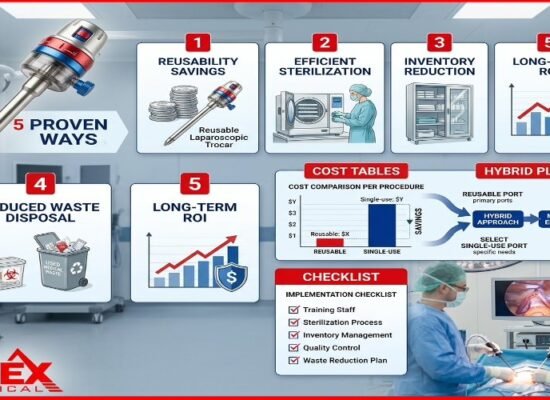
- Sterilization and reusability: Reusable trocars and graspers reduce per-case cost but require robust sterile processing infrastructure; single-use tackers reduce cross-contamination risk but add recurring cost.
- Ergonomics and tactile feedback: Instruments with better in-hand feedback reduce surgeon fatigue in longer bilateral or complex cases.
Ergonomics and Safety: Often Overlooked, Always Critical
Instrument ergonomics directly affects surgeon fatigue, tremor, and precision, particularly in cases lasting over 90 minutes, common in bilateral inguinal or large incisional hernia repair.
- Handle design: Pistol-grip and axial-handle designs distribute grip force differently; surgeons with smaller hand sizes often prefer axial handles for reduced strain.
- Shaft length and diameter matching: Mismatched shaft lengths across a tray create inconsistent triangulation and slow instrument exchange.
- Tactile feedback in tacker firing: A tacker that provides clear, confirmable firing feedback reduces the risk of missed or double-fired tacks, both of which have downstream implications for fixation integrity and cost.
- Insulation integrity checks: For any energy-enabled dissector or scissors, insulation failure is a leading cause of unintended thermal injury; procurement and sterile processing teams should incorporate insulation testing into routine maintenance.
Emerging Trends in Laparoscopic Hernia Instrumentation
- Robotic-assisted mesh fixation: Robotic platforms are enabling intracorporeal suturing for mesh fixation with a precision that reduces reliance on mechanical tackers altogether in some ventral hernia repairs.
- Self-fixating mesh: Mesh products with built-in resorbable hooks are reducing the need for separate fixation devices entirely in select inguinal cases.
- Single-use precision tackers: Manufacturers are increasingly offering single-use tacker devices with pre-loaded cartridges to standardize fixation force and eliminate device-to-device variability seen in reprocessed reusable staplers.
- Data-driven instrument selection: Larger hospital systems are beginning to track fixation-method-specific outcomes (recurrence, chronic pain scores) to guide standardized procurement protocols rather than relying solely on surgeon preference.
Common Complications Linked to Instrument and Fixation Choice
Understanding the failure modes tied to specific instruments helps justify procurement decisions beyond simple cost comparisons. The following complications are among the most frequently documented in laparoscopic hernia literature and post-market surveillance data:
- Chronic groin pain (inguinodynia): Most closely associated with permanent tacker fixation placed near the triangle of pain (bounded by the gonadal vessels and the iliopubic tract) or the triangle of doom (bounded by the vas deferens and gonadal vessels). Instrument choice and precise tack placement technique both play a role, but device design — particularly tack profile and penetration depth control — materially affects risk.
- Mesh migration or displacement: Under-fixation, whether from too few tack points or premature dissolution of an absorbable device, can allow mesh to shift before adequate tissue in-growth occurs, increasing recurrence risk.
- Seroma formation: More common with wide dissection using blunt or poorly insulated dissectors that cause excess tissue trauma, rather than a direct fixation-device complication, but instrument selection for dissection still matters.
- Vascular or nerve injury during tacker firing: Emphasizes the importance of tackers with tactile or audible firing confirmation, allowing the surgeon to control depth and avoid inadvertent penetration near named vessels or nerves.
- Trocar-site hernia: Larger-diameter bladed trocars, especially at the 10- 12 mm working port used for mesh introduction, carry a measurably higher risk than bladeless dilating trocars if fascial closure is inconsistent.
Tracking these complication patterns against instrument type is precisely why many hospital systems are moving toward standardized, evidence-based instrument protocols rather than leaving fixation-method selection purely to individual surgeon preference.
Single-Use vs. Reusable Instruments: A Procurement Perspective
For hospital procurement committees, the reusable-versus-single-use decision is often as consequential as the clinical fixation-method decision, since it affects sterile processing workload, per-case cost, and inventory turnover.
| Factor | Reusable Instruments | Single-Use Instruments |
|---|---|---|
| Upfront cost | Higher initial capital investment | Lower upfront cost, higher recurring cost |
| Per-case cost over time | Lower after amortization | Consistent, predictable per-case cost |
| Sterile processing burden | Requires robust reprocessing infrastructure | Eliminates reprocessing entirely |
| Performance consistency | Can degrade with repeated reprocessing cycles | Consistent factory-calibrated firing/cutting force every use |
| Cross-contamination risk | Managed through validated sterilization protocols | Effectively eliminated |
| Environmental considerations | Lower disposable waste | Higher disposable waste volume |
| Best suited for | High-volume centers with strong sterile processing departments | Lower-volume centers, ambulatory surgical centers, or facilities prioritizing firing consistency |
Many high-volume hernia centers adopt a hybrid model: reusable trocars and graspers for cost efficiency, paired with single-use tackers or suture passers where firing consistency and infection control carry more clinical weight than incremental cost savings.
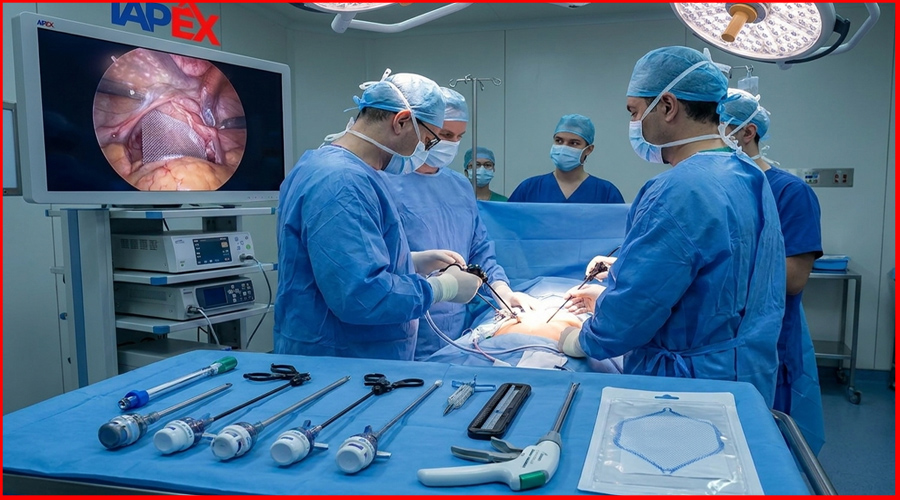
Building a Standardized Hernia Instrument Tray: A Practical Template
For procurement teams building or revising a laparoscopic hernia tray, the following structure reflects common clinical practice across TAPP, TEP, and laparoscopic ventral hernia repair:
- Access instruments: One bladeless optical trocar (10- 12 mm), two to three 5mm working trocars, and a balloon dissector trocar if the facility performs TEP repairs.
- Dissection instruments: A Maryland dissector, a fenestrated grasper, insulated laparoscopic scissors, and an atraumatic bowel grasper for ventral hernia cases involving adhesiolysis.
- Fixation instruments: At minimum, one absorbable tacker device and one fibrin glue or synthetic sealant applicator, allowing the surgeon to select the fixation method intraoperatively based on findings.
- Closure instruments: A needle holder and, for larger ventral defects, a transfascial suture passer.
- Contingency instruments: A titanium tacker and suture-based fixation kit available but not opened by default, reserved for high-tension or recurrent cases where mechanical strength outweighs the marginal chronic pain risk.
This tiered approach avoids unnecessary opened-and-unused inventory while ensuring the surgeon has every fixation option available without delay during the procedure.
Frequently Asked Questions
Q1: What is the difference between a tacker and a stapler in laparoscopic hernia repair?
Both terms are often used interchangeably in clinical practice, but “tacker” typically refers to devices that place individual helical or straight tacks one at a time. In contrast, “stapler” more commonly refers to devices firing linear staple lines, which are less common in hernia mesh fixation and more associated with bowel resection. In hernia repair specifically, most fixation devices are tacker-style.
Q2: Is fibrin glue as effective as mechanical tackers for mesh fixation?
Clinical evidence generally supports fibrin glue as an effective alternative to mechanical fixation for inguinal hernia repair, particularly for reducing chronic groin pain, with comparable recurrence rates in appropriately selected patients. It is less commonly used alone for large ventral hernias under higher tension.
Q3: Why are absorbable tackers preferred over titanium tackers in many current practices?
Absorbable tackers degrade over several months, reducing the long-term presence of a foreign body near sensitive nerve structures such as the ilioinguinal and genitofemoral nerves. This is associated with lower rates of chronic postoperative pain compared to permanent titanium tacks, while still providing sufficient fixation strength during the critical early healing window.
Q4: What trocar size is typically needed for mesh introduction in TEP repair?
Most mesh introducers require a 10- 12 mm trocar, while the remaining working ports are commonly 5mm. Exact sizing depends on the specific mesh product and introducer system in use.
Q5: How do biologic mesh fixation instruments differ from those used for synthetic mesh?
Biologic mesh fixation instruments generally need to accommodate a wider tissue purchase and, in many cases, a longer or matched absorption profile, since biologic grafts remodel over a longer period than synthetic polypropylene mesh integrates.
Q6: What should a procurement team prioritize when building a laparoscopic hernia instrument tray?
Prioritize trocar safety features (bladeless tips), a matched fixation method aligned with your surgeons’ clinical protocols (absorbable tacker, glue, or suture-based), consistent shaft lengths across the tray, and a balance between reusable and single-use components based on sterile processing capacity and case volume.
Conclusion
Choosing the right laparoscopic tools for hernia repair is not a single decision; it is a layered evaluation spanning trocar safety, tissue-handling instruments, and, most critically, the mesh fixation method matched to the hernia type, field contamination status, and patient risk profile. Whether your team is standardizing a TAPP/TEP tray, evaluating biologic mesh fixation instruments for complex recurrent cases, or comparing tacker versus glue fixation to reduce chronic pain rates, the underlying principle remains constant: instrument precision translates directly into patient outcomes.
Explore our specialized range of high-precision surgical instruments engineered for optimal tactile feedback and patient safety. Contact our clinical supply team today to request a product catalog or schedule a surgical instrument demonstration for your facility.