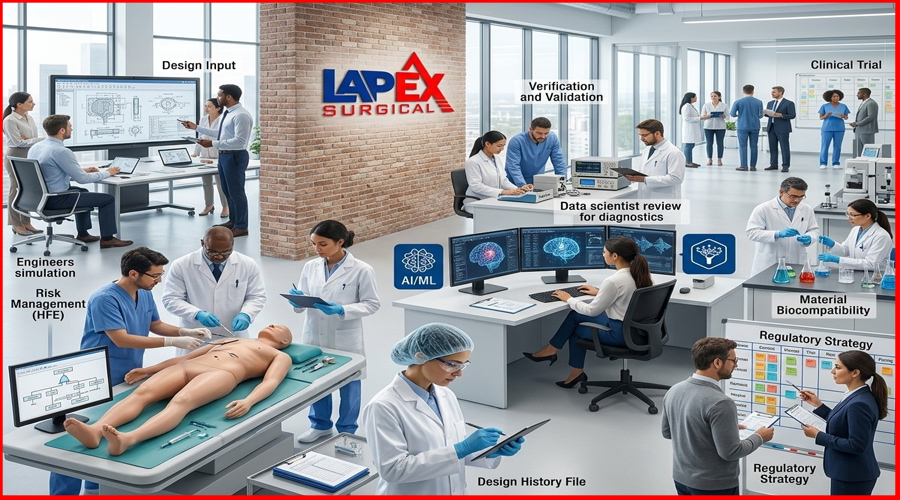
The Ultimate Guide to MedTech Innovation: 16 Most Important Skills for Medical Device Development
Building a medical device is not like building a regular product. One mistake can hurt a patient. That’s why medical device teams need a special mix of skills.
This guide lists the 16 most important skills for medical device development. These skills cover engineering, regulatory work, software, and testing. If you are hiring a team, building your own skills, or planning a product launch, this list will help you know what to look for.
Companies like Lapex Surgical, a maker of surgical, electrosurgical, plastic surgery, and laparoscopic instruments based in Sialkot, use many of these skills every day. Their instruments must be safe, precise, and ready for real operating rooms. That takes a full team of skilled people, not just one expert.
Let’s break down each skill, why it matters, and how it fits into the bigger picture.
Why These Skills Matter (Quick Overview)
Medical devices go through a strict path before they reach a hospital. This path is called the product development lifecycle. It includes design, testing, regulatory approval, and manufacturing.
Each stage needs different skills. Some are technical, like coding or CAD design. Some are about following rules, like FDA design controls. Others are about people, like project management.
Here is a quick table showing how the 16 skills fit into four main groups.
| Skill Group | Skills Included | Main Focus |
|---|---|---|
| Regulatory & Quality | FDA Design Controls, ISO 13485, ISO 14971, Regulatory Submissions | Following the rules and proving safety |
| Software & Digital Health | SaMD Development, IEC 62304, AI/ML in Diagnostics, Cybersecurity | Building safe, smart software |
| Hardware & Manufacturing | Embedded Systems, Mechanical/CAD Design, Electrical/PCB Design, DFM | Making the physical device work and scale |
| Human-Centered & Testing | Human Factors Engineering, Biocompatibility, Sterilization, V&V Testing | Making sure it’s safe for real people |
| Leadership | Cross-Functional Project Management | Keeping the whole team on track |
Now, let’s look at each skill in detail.
1. FDA Design Controls (21 CFR 820.30)
This is the backbone of medical device development in the United States.
Design controls are a set of steps the FDA requires. They make sure every device is planned, checked, and documented the right way. Think of it as a paper trail that proves your device is safe.
Key parts of design controls:
- Design inputs (what the device must do)
- Design outputs (the actual specs and drawings)
- Design reviews (team checks at each stage)
- Design verification (does it meet the specs?)
- Design validation (does it meet the user’s needs?)
Skipping these steps can lead to FDA warning letters or product recalls. Engineers who understand design controls save companies time and money.
2. ISO 13485 Compliance
ISO 13485 is the world’s main quality standard for medical devices. Most countries expect companies to follow it, not just the U.S.
This standard covers the whole quality management system (QMS). It includes document control, supplier checks, and complaint handling.
A team member with ISO 13485 skills knows how to:
- Set up quality processes
- Keep clean records
- Prepare for audits
Without this skill, a company cannot sell devices in most global markets.
3. ISO 14971 Risk Management
Every medical device carries some risk. ISO 14971 gives teams a clear way to find, judge, and reduce that risk.
The process works like this:
- Identify hazards: What could go wrong?
- Estimate risk: How likely and how bad is it?
- Control risk: Change the design or add warnings.
- Review results: Did the fix actually work?
This is not a one-time task. Risk management runs through the entire life of the device, even after it’s sold.
4. Software as a Medical Device (SaMD) Development
More medical devices today run on software alone. A mobile app that reads heart rhythms is one example. This is called Software as a Medical Device, or SaMD.
SaMD developers need to understand both coding and medical risk. A bug in a hospital app is very different from a bug in a shopping app. It can delay treatment or give a wrong reading.
Teams need to classify their software by risk level, then build and test it to match that level. Higher-risk software needs stricter testing.
5. IEC 62304 (Software Lifecycle)
IEC 62304 is the standard that governs how medical software gets built, step by step.
It breaks software development into clear stages:
- Planning
- Requirements
- Architecture design
- Coding
- Testing
- Maintenance
Each stage needs documentation. This helps teams catch bugs early and prove the software is safe before it reaches patients.
Engineers skilled in IEC 62304 are in high demand because connected devices, apps, and AI tools are growing fast in healthcare.
6. Human Factors Engineering (HFE)
A device can be technically perfect and still fail, if a nurse or patient uses it wrong.
Human Factors Engineering studies how real people interact with a device. It looks at buttons, screens, labels, and even the size of a handle.
Common HFE activities:
- Usability testing with real users
- Task analysis (what steps does the user take?)
- Error analysis (where do people make mistakes?)
This skill follows the IEC 62366 standard. It’s especially important for devices used in high-stress settings, like operating rooms or emergency care.
7. Design for Manufacturability (DFM)
A great design means nothing if it can’t be built at scale, on budget, and with steady quality.
DFM is the skill of designing a product so it’s easy and cheap to manufacture. It looks at material choice, part count, tolerances, and assembly steps.
Manufacturers like Lapex Surgical apply DFM daily when producing surgical and laparoscopic instruments. Precision instruments need tight tolerances, but they also need to be produced consistently across thousands of units. Getting this balance right takes real engineering skill, not guesswork.
8. Embedded Systems Engineering
Many modern devices, infusion pumps, monitors, surgical robots, run on small computer chips called embedded systems.
Embedded engineers write the low-level code that controls sensors, motors, and displays. This code must be fast, reliable, and safe, since it often runs in real time during patient care.
Core skills include:
- C/C++ programming
- Real-time operating systems (RTOS)
- Circuit-level debugging
A single timing error in embedded code can cause a device to freeze at the wrong moment. That’s why this role demands careful, tested work.
9. AI/ML in Diagnostics
Artificial intelligence is changing how diseases get detected. AI models can now read X-rays, predict heart problems, and flag cancer cells.
But AI in healthcare comes with extra challenges. Models must be trained on diverse patient data to avoid bias. They also need constant monitoring after launch, since real-world data can shift over time.
Engineers in this field must understand:
- Machine learning basics
- Clinical data handling
- Regulatory paths for AI-based devices (like the FDA’s approach to adaptive algorithms)
This is one of the fastest-growing skill areas in MedTech today.
10. Biocompatibility Testing (ISO 10993)
Any device that touches the human body must be proven safe for that contact. This is called biocompatibility.
ISO 10993 lays out tests based on how long and how deeply a device touches the body. A short-term skin contact device needs fewer tests than an implant that stays in the body for years.
Typical tests include:
- Cytotoxicity (cell damage)
- Sensitization (allergic reaction)
- Irritation
Teams that understand this standard can choose the right materials early, saving costly redesigns later.
11. Sterilization Validation
Devices that touch sterile tissue or blood must be sterilized properly. Sterilization validation proves that a chosen method, like steam, ethylene oxide, or radiation, actually kills the right amount of microorganisms every time.
This skill matters a lot for surgical tool makers. Companies producing electrosurgical and laparoscopic instruments, including Lapex Surgical, must validate sterilization methods that match each material and design. A scalpel and a plastic surgery cannula may need very different sterilization approaches.
Poor sterilization validation is one of the top reasons devices fail FDA inspections.
12. Mechanical & CAD Design
Mechanical engineers turn ideas into real, physical shapes using computer-aided design (CAD) software like SolidWorks or Fusion 360.
This skill covers:
- 3D modeling
- Tolerance stacking
- Material selection
- Prototyping
Good CAD work reduces errors before a single physical part is made. It also speeds up communication between design teams and manufacturers.
13. Electrical & PCB Design
Many devices need circuit boards to power sensors, screens, and controls. Electrical engineers design these printed circuit boards (PCBs) so the device runs safely and efficiently.
This work includes:
- Circuit schematics
- Power management
- Electromagnetic compatibility (EMC) testing
A poorly designed circuit can overheat, drain battery too fast, or interfere with other hospital equipment. Getting this right is critical for patient safety.
14. Verification & Validation (V&V) Testing
Verification asks: “Did we build the device right?” Validation asks: “Did we build the right device?”
Both are required before a product can launch. V&V engineers design test protocols, run them, and document the results.
Example V&V activities:
- Bench testing (does the device meet specs?)
- Simulated-use testing (does it work in a mock clinical setting?)
- Software testing (does the code behave as expected?)
Without strong V&V work, regulatory submissions will get rejected or delayed.
15. Cybersecurity for Connected Devices
Today, many devices connect to hospital networks or the internet. That means they can be hacked.
Cybersecurity engineers protect devices from threats like data theft or remote tampering. The FDA now requires cybersecurity plans for most connected devices before approval.
Key tasks:
- Threat modeling
- Encryption of patient data
- Software update planning (patches after launch)
A hacked infusion pump or pacemaker isn’t just a data problem, it’s a life-threatening one.
16. Cross-Functional Project Management
Medical device projects involve many specialists: engineers, regulatory experts, clinicians, and manufacturers. Someone has to keep them all moving together.
Project managers in MedTech need to understand technical work and regulatory timelines at the same time. They track design history files (DHFs), manage 510(k) or PMA submissions, and keep teams on schedule.
This role often decides whether a device reaches market in months or years.
Comparing the Skills: What Matters Most at Each Stage
| Development Stage | Top Skills Needed | Risk if Skipped |
|---|---|---|
| Concept & Planning | Project Management, Design Controls | Wasted time, unclear goals |
| Design | CAD Design, Electrical Design, Embedded Systems | Poor manufacturability, rework |
| Risk & Safety | ISO 14971, Biocompatibility, HFE | Patient harm, FDA rejection |
| Software | SaMD, IEC 62304, AI/ML, Cybersecurity | Software recalls, data breaches |
| Manufacturing | DFM, Sterilization Validation | Inconsistent quality, contamination |
| Testing | V&V Testing | Failed submissions |
| Regulatory | ISO 13485, FDA Design Controls | Legal issues, market bans |
This table shows that no single skill wins. A safe, successful device needs all of them working together.
Real-World Example: Surgical Instrument Development
Let’s look at how these skills come together in practice.
A company designing a new laparoscopic grasper must:
- Define design inputs based on surgeon needs (Design Controls)
- Choose materials that pass biocompatibility tests
- Model the part in CAD software with tight tolerances
- Apply DFM to keep manufacturing costs reasonable
- Validate sterilization for repeated hospital use
- Run usability tests with surgeons (HFE)
- Document everything for ISO 13485 and FDA submission
Manufacturers like Lapex Surgical, known for surgical, electrosurgical, and laparoscopic instruments, work through steps like these regularly. Their process shows why cross-disciplinary skill isn’t optional, it’s the standard.
16 Skills for Safe Medical Device Development
From FDA design controls to AI diagnostics — the full skill map behind every device that reaches a patient.
No single skill builds a safe device. Regulatory, software, hardware, and testing teams must all work together, every time.
Regulatory & LeadershipProve it’s safe. Keep it on track.
- 01FDA Design Controls (21 CFR 820.30)
- 02ISO 13485 Quality Management
- 03ISO 14971 Risk Management
- 04Cross-Functional Project Management
Software & Digital HealthBuild code that can’t fail quietly.
- 05Software as a Medical Device (SaMD)
- 06IEC 62304 Software Lifecycle
- 07AI/ML in Diagnostics
- 08Cybersecurity for Connected Devices
Hardware & ManufacturingDesign it right. Build it every time.
- 09Embedded Systems Engineering
- 10Mechanical & CAD Design
- 11Electrical & PCB Design
- 12Design for Manufacturability (DFM)
Human-Centered & TestingMake sure it’s safe for real people.
- 13Human Factors Engineering (HFE)
- 14Biocompatibility Testing (ISO 10993)
- 15Sterilization Validation
- 16Verification & Validation (V&V)
FAQ: Medical Device Development Skills
Q: Do I need all 16 skills to work in MedTech?
No. Most people specialize in one or two areas, like software or mechanical design. Companies build teams that cover all 16 skills together.
Q: Which skill is hardest to learn?
AI/ML in diagnostics and cybersecurity are often the hardest, since both fields change quickly and need deep technical knowledge plus regulatory awareness.
Q: Is ISO 13485 required everywhere?
It’s required or strongly recommended in most major markets, including the EU, Canada, and many parts of Asia. The U.S. FDA is also aligning its Quality System Regulation closer to ISO 13485.
Q: What’s the difference between verification and validation?
Verification checks if the device meets its written specs. Validation checks if it actually solves the user’s real-world problem.
Q: How long does medical device approval usually take?
It varies widely. A low-risk device might take a few months. A high-risk implant with clinical trials can take several years.
Q: Can small MedTech startups build all these skills in-house?
Rarely at first. Many startups partner with experienced manufacturers or consultants who already have these skills, especially for regulatory and manufacturing work.
Final Thoughts
Medical device development is a team sport. It blends great technical skill with strict regulatory discipline. Missing even one of these 16 skills can slow down a launch or put patients at risk.
Whether you’re hiring engineers, training your team, or planning your next product, use this list as a checklist. Companies that master these skills, including experienced manufacturers like Lapex Surgical, build devices that are safer, faster to market, and easier to scale globally.
Ready to Build a Safer, Faster MedTech Pipeline?
👉 Schedule a strategy consultation with our product development experts.