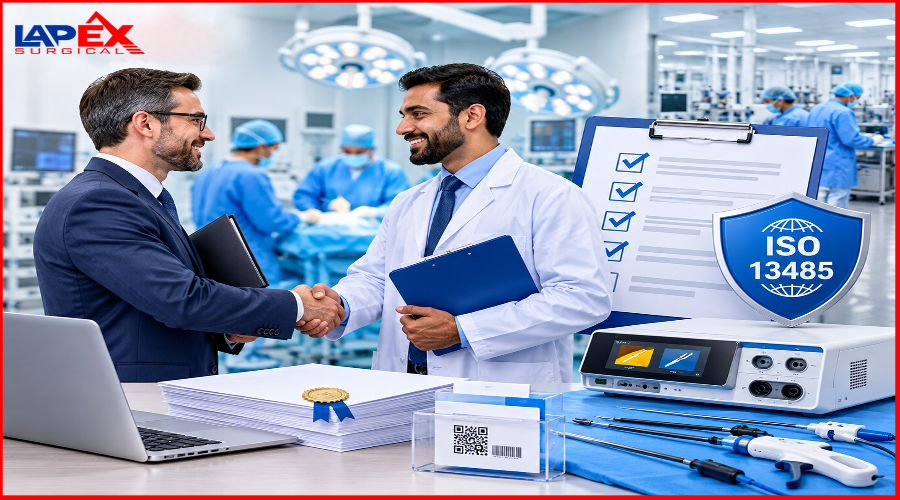
High-Volume Hospital Tenders: Partnering with an ISO-Certified Electrosurgical Manufacturer (2027 Institutional Bid & Procurement Guide)
To win a hospital tender for electrosurgical items, partner with a direct ISO 13485:2016 certified manufacturer that gives you a signed Manufacturer Authorization Form (MAF), a full technical dossier, UDI-based batch traceability, validated IFUs, and test samples before the bid closes. Check these five items first. They decide most technical rejections.
Why Tender Bids Fail Before Price Is Even Opened
Most public tenders use a two-envelope system. Envelope one holds your technical papers. Envelope two holds your price. The committee opens the price envelope only if your technical envelope passes.
That means a missing certificate can end your bid, even if your price is the lowest.
Common reasons for rejection:
- The MAF is expired, unsigned, or names the wrong tender.
- The ISO certificate does not cover the product type in the bid.
- The CE or FDA paper does not match the quoted model.
- The product catalog does not match the tender specification line by line.
- Samples fail the committee’s trial.
A good manufacturing partner removes these risks. A trader with no factory control cannot.
Who This Guide Is For
- Distributors answering hospital RFPs and e-tenders
- Bidders for government and private hospital contracts
- GPO procurement managers
- Biomedical engineering heads
- Health ministry supply chain officers
If you buy or sell surgical disposables in bulk, this guide gives you a checklist you can use today.
Why Work With a Direct Manufacturer, Not a Trader
A trader buys from someone else and resells. A direct manufacturer makes the product in its own plant. For tenders, the difference is large.
| Factor | Direct Manufacturer | Trader / Reseller |
|---|---|---|
| MAF issued by | The maker itself | A middle party, often unclear |
| Batch records | Held in-house | Often not available |
| Spec changes (OEM) | Possible | Rarely possible |
| Price control | Factory-level pricing | Extra margin added |
| Recall handling | Fast, direct | Slow, via chain |
| Delivery promise | Backed by own production | Depends on supplier |
Many tenders ask for proof that the bidder is the maker or is authorized by the maker. A direct manufacturer makes that proof easy.
Example: A hospital in a tender asks for 50,000 bipolar forceps over 12 months. If the supplier’s plant stops for two weeks, the hospital still expects delivery. A manufacturer can move its own production schedule. A trader can only wait.
About the Manufacturer: Lapex Surgical
Lapex Surgical (the manufacturer of Surgical, Electrosurgical, Plastic Surgery Instruments, and Laparoscopic instruments from Sialkot) makes instruments in Sialkot, Pakistan. The city has been known for surgical instrument making for over a century. For tender work, Lapex Surgical offers MAFs, technical dossiers, sample kits, and OEM options for electrosurgical items. Always ask any supplier, including this one, to share current certificates so your team can verify them before submitting.
The Technical Bid Compliance & Documentation Checklist
Use this list before you submit any bid. Tick each line.
1. Quality System: ISO 13485:2016
ISO 13485:2016 is the quality standard for medical device makers. It covers design, production, storage, and complaint handling.
Ask for:
- A copy of the ISO 13485:2016 certificate
- The scope statement (does it list electrosurgical accessories?)
- The certification body name and expiry date
- The factory address on the certificate (it must match the MAF)
Tip: Check the certificate scope. A certificate for “surgical hand instruments” may not cover electrosurgical accessories.
2. Regulatory Papers: CE / EU MDR and FDA 510(k)
Rules differ by country, so read your tender carefully.
- EU MDR (Regulation 2017/745): Electrosurgical accessories usually fall in Class IIa or IIb, depending on use. Ask for the CE certificate from a notified body and the declaration of conformity.
- FDA: Electrosurgical cutting and coagulation devices and accessories are regulated by the FDA as Class II in most cases, with 510(k) clearance. Ask for the 510(k) number if the tender requires it.
- Local rules: Some countries need their own registration. Ask your supplier what they hold and what you must file.
Never assume a CE mark or FDA listing covers every model. Match the model number on the paper to the model in your bid.
3. Manufacturer Authorization Form (MAF)
The MAF is a letter from the maker that says you may bid on its products. A strong MAF has:
- Company letterhead and signature of an authorized person
- Tender name and number
- Product list with model numbers
- Validity period (it should cover the tender period plus supply)
- A promise of supply and after-sales support
- Date within the allowed window (many tenders reject old MAFs)
Ask for the MAF early. Tender windows are short.
4. UDI and Batch Traceability
UDI stands for Unique Device Identification. It is a code on the label that tells you what the product is and which batch it came from.
Ask for:
- Labels with a UDI barcode (such as GS1 format)
- Lot number, manufacture date, and expiry date on each box
- A traceability record from raw material to finished pack
- A recall process in writing
Why it matters: If a hospital finds a fault, it must trace the batch fast. Good traceability also supports a “zero-blacklisting” record, because problems are found and fixed early.
5. Validated IFU and Sterilization Details
IFU means Instructions for Use. A validated IFU has been tested to prove it works.
For single-use items, ask for:
- Sterilization method (for example, ethylene oxide) and validation to ISO 11135
- Packaging validation to ISO 11607
- Shelf life and the test data behind it
- Symbols that follow ISO 15223-1
For reusable items such as some bipolar forceps, ask for:
- Cleaning steps
- Autoclave cycle details (temperature and hold time)
- The maximum number of cycles tested
- Signs that the item should be taken out of use
If the IFU says “autoclavable” but gives no cycle, that is a red flag.
6. Safety Testing: Insulation and Dielectric Strength
Electrosurgery uses high-frequency current. Poor insulation can cause burns to the patient or the surgeon. The safety standard for this area is IEC 60601-2-2, along with IEC 60601-1.
Ask for test reports on:
- Dielectric strength (can the insulation take the voltage?)
- Insulation failure testing on cables and electrode shafts
- Electrical continuity
- Biocompatibility to ISO 10993 for parts that touch the patient
Ask for the report, not just a statement that the test was done.
7. Risk Management
ISO 14971 is the standard for medical device risk management. Ask if the maker keeps a risk file for each product family.
Generator Compatibility: Valleylab / Erbe Matrix
A great product is useless if the plug does not fit the generator. Ask for a cross-compatibility matrix. It lists each product and the generators it works with.
A good matrix shows:
| Item | Connector Type | Generators Listed | Notes |
|---|---|---|---|
| Cautery pencil | 3-pin or other plug | Valleylab-type, others | Hand switch or foot switch |
| Bipolar forceps cord | 2-pin | Erbe-type, others | Check pin gap and diameter |
| Active electrode | Standard shaft size | Pencil dependent | Check tip shape and length |
| Return plate | Cable and plug style | Generator monitor type | Check cable length |
Important: Ask the maker to confirm the plug details in writing. Pin size and gap vary between brands. Also, some generators monitor the return plate contact. Make sure the plate you bid is compatible with that monitoring system.
If your hospital owns several generator brands, request adapters or multiple cable options in the quote.
Tender Specification Comparison Table
Use this table to build your technical response. It shows what to ask for on the four most common items.
| Item | Key Specs to State in Bid | Proof to Attach | Common Bid Mistake |
|---|---|---|---|
| Bipolar forceps | Tip type and size, length, material, insulation, cord type, reusable or single-use, autoclave cycle | IFU, insulation test report, material certificate | Missing autoclave cycle details |
| Cautery pencil | Hand switch or foot switch, cable length, plug type, sterile or non-sterile, holster | CE/510(k) match, safety test, sterilization data | Plug does not match generator |
| Active electrodes | Shape (blade, ball, needle, loop), shaft diameter, length, coating, single-use | Dimension drawing, insulation data | Wrong shaft size for the pencil |
| Return plates | Adult or pediatric, split or solid, gel type, cable, size, shelf life | Skin safety data, ISO 10993, shelf life data | Not stating monitor compatibility |
Copy this layout into your technical envelope. Add the exact wording from the tender specification next to each line, then mark “Complies” with the page number of your proof.
Single-Stage Two-Envelope Tenders: How to Stay Compliant
In a single-stage, two-envelope tender, you send both envelopes at once. The technical one is opened first.
Follow these rules:
- Read the full tender once, then again. Highlight each required paper.
- Make a compliance sheet. One row per requirement, with a column for proof and page number.
- Do not mix price and technical data. Prices go only in the second envelope.
- Use the tender’s own wording. Do not rename items.
- Check dates. Certificates, MAFs, and samples all have deadlines.
- Label every page. Evaluators handle many bids. Clear labels help.
- Ask for clarification early. Most tenders allow a pre-bid query window.
For e-procurement portals, also check file size limits, file format (often PDF), and digital signature rules. Upload early. Portals often crash in the last hour.
Annual Rate Contracts for Surgical Disposables
Many hospitals buy through an annual running rate contract. The price is fixed for a year. The hospital orders in lots as it needs them.
What to confirm before you quote:
- Price validity: Can the maker hold the price for 12 months?
- Raw material changes: Is there a price-change clause?
- Delivery lots: How many days for each lot?
- Safety stock: Will the maker keep stock for you?
- Shelf life: Will each delivery have enough shelf life left? Many tenders ask for 80% or more remaining.
- Penalty terms: Know what happens on late delivery.
Example: You win a contract for 20,000 return plates over a year. The hospital orders 2,000 every five weeks. Your maker must plan production around those dates. Ask for a written supply schedule.
Sample Evaluation Guidelines for OR Committees
Samples decide close bids. Here is a simple way for an operating room committee to test them fairly.
Before the Trial
- Ask each bidder for the same number of samples.
- Label samples with codes, not company names, if the tender allows blind testing.
- Check that the packs are intact, sterile, and in date.
- Record batch numbers.
During the Trial
Test each item with the generators the hospital actually uses.
| Item | What to Check |
|---|---|
| Bipolar forceps | Tip alignment, grip, spring feel, clean coagulation, no sticking |
| Cautery pencil | Switch response, cable flexibility, plug fit, heat at the handle |
| Active electrodes | Tight fit in the pencil, clean cutting, coating stays intact |
| Return plates | Skin contact, edge lift, peel-off ease, no generator alarm |
Scoring
Use a simple 1 to 5 score for fit, function, safety, and packaging. Have at least two surgeons and one nurse score each item. Add a biomedical engineer to check plug fit and generator alarms.
After the Trial
- Record any failures and photograph them.
- Give the bidder a chance to respond if a sample fails.
- Keep the score sheet for audit.
A maker confident in its product will welcome this process.
Price vs. Value: Look at Total Cost
The lowest price is not always the cheapest choice. Count these costs too:
- Items rejected due to defects
- Surgery delays from bad plugs or weak tips
- Staff time for returns and claims
- Risk of patient injury
- Re-tendering costs after a failed supplier
A maker with strong quality control may cost slightly more per piece but save far more over a year.
What to Ask Any Manufacturer Before You Sign
Use these questions on your first call:
- Are you the direct maker? Can I see the factory address on your certificate?
- Does your ISO 13485:2016 scope cover electrosurgical accessories?
- Can you issue a MAF for this tender in two to three working days?
- Which CE or FDA papers cover each model I plan to quote?
- Can you share insulation and dielectric test reports?
- What UDI format do you use on labels?
- What is your monthly production capacity for these items?
- Can you supply samples before the bid closes?
- Do you offer OEM or private label options?
- What is your complaint and recall process?
If any answer is vague, ask again in writing.
Win Hospital Tenders with an ISO-Certified Electrosurgical Manufacturer
Get the papers right first. Price comes second.
How a two-envelope tender works
Certificates, MAF, specs, samples
Opened only if Envelope 1 passes
One missing paper can end your bid, even at the lowest price.
7 papers every bid needs
ISO 13485:2016
Scope must list electrosurgical items
CE / EU MDR
Model numbers must match your bid
FDA 510(k)
Ask for it if the tender needs it
MAF
Signed, dated, names the tender
UDI and batch trace
Lot, dates, barcode on every box
Validated IFU
Sterilization and autoclave data
Safety test reports
Dielectric and insulation tests
Manufacturer or trader?
Direct manufacturer
- Issues its own MAF
- Holds batch records
- Offers OEM changes
- Factory-level price
- Fast recall response
Trader
- MAF comes from a middle party
- Records often missing
- Rarely changes specs
- Extra margin added
- Slow recall chain
State these in your bid
Bipolar forceps
Cautery pencil
Active electrodes
Return plates
How the OR committee tests samples
Lapex Surgical, Sialkot
Send your tender specs. Get a technical dossier and bulk quote.
OEM Options for Larger Bidders
An OEM electrosurgical manufacturer makes products under your brand or to your design. This helps if:
- You want your own label and packaging.
- A tender needs a special length, tip, or cable.
- You want to build a long-term product line.
Check who holds the regulatory papers. In some markets, the brand owner must hold the registration. Talk about this before you place the first order.
Request a Technical Dossier and Quote
Ready to prepare your bid? Send your tender specification, item list, and quantities. Lapex Surgical will review them and reply with a technical dossier and bulk quote.
Request a Technical Dossier & Bulk Tender Quote (24-Hour Turnaround)
Download the 2027 Lapex Surgical Electrosurgical Catalog. It includes specs you can adapt for tender documents, generator connector details, and SKU lists.
What to include in your inquiry:
- Tender name, number, and closing date
- Item list and yearly quantity
- Required certificates and registrations
- Generator brands in use
- Delivery location and terms
Frequently Asked Questions
What is an ISO-certified electrosurgical manufacturer?
It is a factory that makes electrosurgical products and holds a valid ISO 13485:2016 certificate for medical device quality management. An outside audit body checks it.
What is a Manufacturer Authorization Form?
It is a letter from the manufacturer that says a bidder may offer its products in a named tender. Hospitals use it to check that the supply chain is real.
Is ISO 13485 enough to win a tender?
No. It is one part. Most tenders also ask for CE or FDA papers, test reports, a MAF, samples, and proof of past supply.
Do all electrosurgical items need FDA 510(k)?
Not always. It depends on the item, the country, and the tender. Many tenders ask for CE only. Others ask for FDA. Read the tender and confirm with your supplier.
What is UDI and why do hospitals ask for it?
UDI is a unique code on the label. It helps hospitals trace a product to its batch for safety and recalls.
Can reusable bipolar forceps be autoclaved?
Many can, but only if the IFU gives validated cycle details. Follow the maker’s instructions for temperature, time, and cycle count.
How many samples should I request?
Most committees ask for enough to test each item with each generator type. A common range is a few pieces per item. Check your tender rules.
What happens if the plug does not fit our generator?
The product fails the trial. Ask for a connector matrix first and confirm plug details in writing.
Can a manufacturer hold prices for a full year?
Some can, especially for steady volumes. Ask for a written price validity period and any price-change terms.
Does Lapex Surgical offer OEM work?
Yes. Lapex Surgical (the manufacturer of Surgical, Electrosurgical, Plastic Surgery Instruments, and Laparoscopic instruments from Sialkot) can discuss OEM options. Send your requirements through the contact page.
Final Checklist Before You Submit
- [ ] ISO 13485:2016 certificate with correct scope
- [ ] Valid MAF naming this tender
- [ ] CE, FDA, or local registration matching quoted models
- [ ] UDI-ready labels and traceability process
- [ ] Validated IFU and sterilization data
- [ ] Insulation and dielectric test reports
- [ ] Generator compatibility matrix
- [ ] Samples shipped and tracked
- [ ] Supply schedule and price validity in writing
- [ ] Compliance sheet with page numbers
A clean technical envelope wins more bids than a low price with missing papers.