Precision in Every Stitch: The Ultimate Guide to the Surgical Needle Drivers
In the high-stakes environment of a surgical suite, every millimeter matters. While the scalpel often gets the glory for the initial incision, these needle drivers (or needle holders) ensure that the final healing begins correctly. At Lapex Surgical, based in the world-renowned surgical manufacturing hub of Sialkot, we understand that a needle driver is more than just a pair of forceps—it is an extension of the surgeon’s hand.
Whether you are performing a delicate cardiovascular bypass or a complex laparoscopic cholecystectomy, the security of your suture depends entirely on the reliability of your needle driver. This guide explores everything from the metallurgy of these instruments to the specific ergonomic needs of modern surgeons.
What are Needle Drivers?
A needle driver is a specialized surgical instrument designed to hold a suturing needle during the process of sewing tissues together. Unlike standard hemostats, needle drivers are engineered to withstand the torque required to push a needle through dense tissue without slipping or twisting.
The Anatomy of Excellence
To understand why Lapex Surgical instruments stand out, one must look at the anatomy of a high-quality driver:
- The Jaws: Often reinforced with Tungsten Carbide (TC) inserts to provide a diamond-cut grip.
- The Joint: Usually a box lock design to ensure smooth movement and prevent tissue snagging.
- The Shank: The length between the joint and the handle, providing the necessary leverage.
- The Ratchet: A locking mechanism that allows the surgeon to maintain a firm grip on the needle without constant finger pressure.
- The Rings: Ergonomically shaped loops for the thumb and fingers.
Types of Needle Drivers: Choosing the Right Tool
Not all sutures are created equal, and neither are the instruments that drive them. At Lapex Surgical, we manufacture a diverse range of drivers tailored for specific disciplines.
1. Mayo-Hegar Needle Driver
The “workhorse” of the operating room. It features a straight jaw and a reliable locking mechanism. It is commonly used in general surgery for medium to large needles.
2. Castroviejo Needle Driver
Used primarily in ophthalmic, plastic, and vascular surgery. These do not have finger rings; instead, they use a spring-loaded handle squeezed between the thumb and forefinger, allowing incredibly precise rotational movements.
3. Mathieu Needle Driver
Recognizable by its “pliers-style” handle. It is favored in orthodontics and some rapid suturing procedures because the ratchet can be engaged and released simply by squeezing the handles further together.
4. Olsen-Hegar Needle Driver
The ultimate multitasker. This instrument combines a needle driver with built-in suture scissors behind the jaws, allowing the surgeon to drive the needle and cut the thread without switching tools.
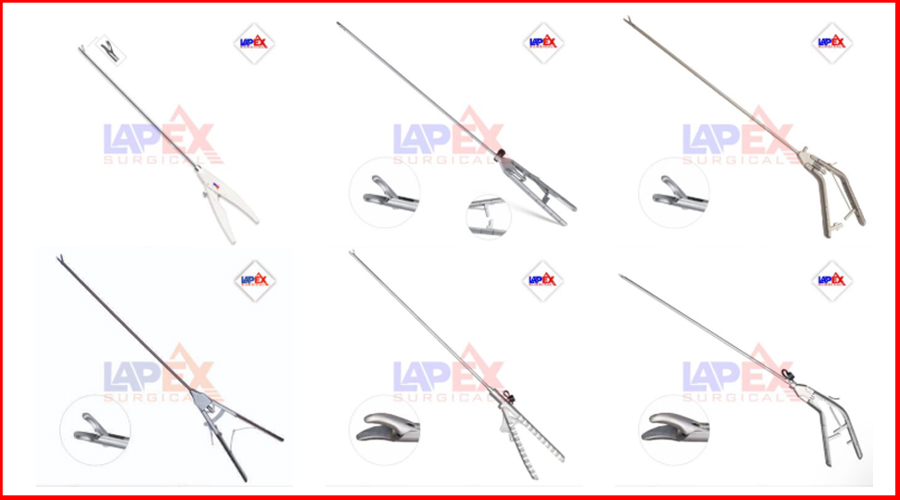
5. Laparoscopic Needle Drivers
As specialists in laparoscopic instruments, Lapex Surgical produces long-shafted drivers (typically 330mm or 450mm) designed to operate through a trocar. These often feature axial handles to allow for 360-degree rotation within a confined space.
Comparison Table: Needle Drivers Specifications
| Instrument Type | Common Lengths | Best For | Handle Style |
| Mayo-Hegar | 5″ to 12″ | General Surgery, Fascia | Ring Handle |
| Castroviejo | 5″ to 7″ | Microsurgery, Plastics | Spring/Flat Handle |
| Mathieu | 6″ to 8″ | Orthodontics, ER | Plier Style |
| Olsen-Hegar | 5.5″ to 7.5″ | Veterinary, Solo Surgery | Ring Handle w/ Scissors |
| Laparoscopic | 33cm to 45cm | Minimally Invasive | Axial/Pistol Grip |
The Lapex Advantage: Why Sialkot Craftsmanship Matters
Sialkot is the global epicenter of surgical instrument manufacturing, and Lapex Surgical sits at the pinnacle of this tradition. But what makes our needle drivers different?
1. Superior Metallurgy
We use high-grade AISI 410 and 420 stainless steel. This ensures that the instrument is:
- Corrosion Resistant: Essential for repeated sterilization.
- Highly Durable: Able to maintain structural integrity under high torque.
- Non-Reflective: Our satin finishes reduce glare under intense OR lights.
2. Tungsten Carbide (TC) Technology
You will notice many of our premium drivers have gold-plated handles. This is the universal symbol for Tungsten Carbide inserts. TC is much harder than stainless steel, meaning the “teeth” on the jaws won’t wear down, ensuring a “no-slip” grip for years of service.
3. Ergonomic Precision
A surgeon’s hand fatigue is a real risk. Our designs focus on the “feel” of the ratchet. It should click into place with minimal effort but hold with absolute certainty.
Proper Maintenance and Sterilization
Even the best needle driver will fail if not cared for. At Lapex Surgical, we recommend the following protocol:
- Immediate Rinse: After surgery, rinse with deionized water to remove blood and saline (which causes pitting).
- Ultrasonic Cleaning: Use an ultrasonic cleaner to remove microscopic debris from the box lock.
- Lubrication: Periodically apply a surgical-grade lubricant (“instrument milk”) to the joints.
- Inspection: Check the jaws for “smooth spots.” If the cross-hatching is worn, it’s time for a Lapex replacement.
- Autoclaving: Follow standard parameters (e.g., 134°C for 3–5 minutes), ensuring the instruments are in an open position.
FAQ: Everything You Need to Know About Needle Drivers
How do I choose the right size needle driver?
The size of the driver should correspond to the size of the needle. A large Mayo-Hegar will bend a delicate ophthalmic needle, while a small Castroviejo cannot generate enough force to push a heavy needle through tough skin.
Why are some handles gold?
Gold handles indicate Tungsten Carbide inserts in the jaws. These are harder, provide a better grip, and last up to five times longer than standard stainless steel jaws.
What is the difference between a hemostat and a needle driver?
While they look similar, a hemostat has thinner jaws designed to clamp vessels. Using a hemostat to drive a needle will likely ruin the instrument’s alignment and cause the needle to “spring” or fly out of the jaws.
Can Lapex Surgical provide custom laparoscopic drivers?
Yes! As a direct manufacturer, we specialize in OEM and customized laparoscopic solutions, including varied handle designs and jaw patterns to suit specific surgical preferences.
The Future of Suturing: Laparoscopic Innovation
As the medical world shifts toward Minimally Invasive Surgery (MIS), the laparoscopic needle driver has become our most requested item. The challenge of laparoscopy is the loss of haptic feedback. To combat this, Lapex Surgical has engineered:
- Self-Righting Jaws: These automatically align the needle at the optimal 90-degree angle upon closure.
- Ergonomic Axial Handles: These allow the surgeon to rotate the needle through a simple roll of the fingers, rather than awkward wrist contortions.
Partnering with Lapex Surgical
Choosing the right needle driver is an investment in patient safety and surgical excellence. At Lapex Surgical, we combine the heritage of Sialkot’s master craftsmen with cutting-edge German technology to deliver instruments that surgeons trust.
From Electrosurgical units to Plastic Surgery sets, our commitment to quality is unwavering. When you hold a Lapex instrument, you are holding decades of expertise.
Ready to upgrade your surgical suite? Visit our catalog to explore our full range of Needle Drivers and Laparoscopic instruments.
Lapex Surgical – Precision. Integrity. Innovation. Exporting Excellence from Sialkot to the World.