Metzenbaum vs. Mayo Scissors: The Ultimate Guide to Surgical Precision
In the high-stakes environment of the operating room, a surgeon’s skill is only as effective as the instruments in their hand. Among the most fundamental yet misunderstood tools are surgical scissors. Specifically, the comparison of Metzenbaum vs. Mayo scissors is a foundational topic for surgical residents, scrub techs, and procurement specialists alike.
At Lapex Surgical, based in the world-renowned surgical manufacturing hub of Sialkot, Pakistan, we understand that “a pair of scissors is not just a pair of scissors.” Every curve, every bevel, and every millimeter of the shank is engineered for a specific biological task.
This article provides an exhaustive deep dive into the anatomical, functional, and material differences between these two iconic instruments.
1. The Anatomy of a Surgical Scissor
Before we dive into the specific differences, it is crucial to understand the three main components of any surgical scissor:
- The Rings (Finger Loops): Where the surgeon controls the instrument.
- The Shank: The length between the rings and the pivot point (screw).
- The Blades: The working end that performs the cutting or dissection.
The ratio between the Shank and the Blade is the primary factor that distinguishes a Metzenbaum from a Mayo.
2. What are Mayo Scissors?
Named after the legendary Mayo Clinic, where they were popularized, Mayo scissors are the “workhorses” of the surgical tray. They are designed for strength, durability, and versatility.
Key Characteristics of Mayo Scissors:
- Design: They feature a thick, heavy construction.
- Blade-to-Shank Ratio: The blades are approximately the same length as the shanks. This 1:1 or 1:1.5 ratio provides maximum leverage.
- Tips: Generally available in straight or curved varieties, usually with blunt tips to prevent accidental tissue piercing.
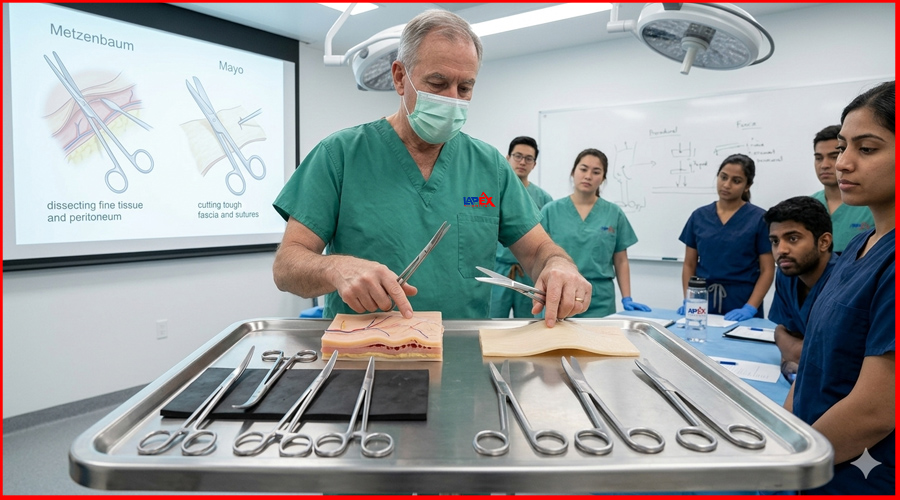
- Primary Use: Cutting tough tissues (fascia, tendons) and non-biological materials (sutures, surgical mesh, or even bandages in an emergency).
Straight vs. Curved Mayo Scissors
- Straight Mayo Scissors: Often referred to as “suture scissors.” They are used for cutting surface tissues or surgical materials.
- Curved Mayo Scissors: These allow for deeper penetration into the wound, specifically for cutting heavy fascia or thick muscles.
3. What are Metzenbaum Scissors?
Named after Myron Metzenbaum, an American surgeon specializing in ENT and jaw surgery, these scissors are the “ballerina” of the surgical world—graceful, long, and precise.
Key Characteristics of Metzenbaum Scissors:
- Design: Characterized by long, slender shanks and relatively short, delicate blades.
- Blade-to-Shank Ratio: The shanks are significantly longer than the blades (often a 3:1 or 4:1 ratio). This allows the surgeon to reach deep into body cavities while maintaining a small cutting radius.
- Tips: Usually blunt to facilitate safe dissection without poking vital structures.
- Primary Use: Delicate, “soft” tissue dissection. They are the go-to for organ-related surgery (heart, liver, intestines).
4. Metzenbaum vs. Mayo Scissors: The Head-to-Head Comparison
To understand the distinction between Metzenbaum and Mayo scissors clearly, we must examine their mechanical advantages.
Comparison Table: At a Glance
| Feature | Mayo Scissors | Metzenbaum Scissors |
| Construction | Heavy-duty, robust | Slim, delicate, lightweight |
| Blade Length | Long (relative to shank) | Short (relative to shank) |
| Shank Length | Short to Medium | Long and slender |
| Primary Function | Cutting tough tissue & sutures | Delicate blunt dissection |
| Leverage | High (for power) | Low (for precision/reach) |
| Common Lengths | 5.5″ to 9″ | 5.5″ up to 14″ (for deep cavity) |
| Dissection Style | Sharp & Forceful | Blunt & Precise |
The “Suture” Rule
A golden rule in the OR: Never use Metzenbaum scissors to cut sutures. Because Metzenbaum blades are thinner and designed for soft tissue, the high tensile strength of surgical silk or Prolene can dull their edges or even misalign them. Mayo scissors, specifically straight ones, are the designated tool for this task.
5. Functional Differences: Sharp vs. Blunt Dissection
The debate of Metzenbaum vs. Mayo scissors often boils down to the type of dissection required.
Blunt Dissection (The Metzenbaum Specialty)
Metzenbaum scissors are perfect for “blunt dissection.” A surgeon inserts the closed tips into a tissue plane and then opens the blades. This gently spreads the tissue apart along natural anatomical lines without cutting blood vessels or nerves unnecessarily. The long shanks provide the reach needed for thoracic or abdominal procedures.
Sharp Dissection (The Mayo Specialty)
When a surgeon needs to cut through tough, fibrous ligament or thick fascia, they need the “bite” of a Mayo. The shorter shanks and heavier blades allow for more force to be applied at the tip.
6. Varieties and Specialty Tips
At Lapex Surgical, we manufacture various iterations of these scissors to suit modern surgical demands:
Tungsten Carbide (TC) Inserts
Identified by gold handles, TC inserts are welded to the cutting edges. Tungsten carbide is significantly harder than stainless steel, allowing the scissors to stay sharp up to 5 times longer. Both Mayo and Metzenbaum models are available with TC inserts.
“Super-Cut” Scissors
Identified by black handles, these feature one razor-sharp blade and one serrated blade. This prevents tissue slippage and provides an exceptionally clean cut.
Ceramic Coated
For laparoscopic procedures, ceramic coatings can reduce glare and increase the lifespan of the instrument.
7. Importance of Quality Manufacturing: The Lapex Surgical Standard
When discussing metzenbaum vs mayo scissors, the material science matters. In Sialkot, Lapex Surgical utilizes high-grade German and Japanese stainless steel.
Why Choice of Material Matters:
- Corrosion Resistance: Surgical instruments undergo rigorous sterilization (autoclaving). Poor quality steel will rust, leading to “pitting,” which can harbor bacteria.
- Hardness (Rockwell Scale): If the steel is too soft, the scissors dull after one surgery. If it’s too brittle, it can snap. We balance this at 50-56 HRC (Hardness Rockwell C).
- Ergonomics: A surgeon may hold these scissors for 10 hours. The tension in the screw must be perfect—not too tight to cause hand fatigue, and not too loose to cause “tissue chewing.”
8. Clinical Scenarios: Which One to Choose?
Scenario A: Appendectomy
During the initial incision and cutting through the external oblique muscle and fascia, the surgeon will call for Mayo scissors. Once inside the peritoneal cavity, to move the intestines aside and visualize the appendix, they switch to Metzenbaum scissors.
Scenario B: Orthopedic Hip Replacement
Orthopedic surgery involves incredibly tough ligaments and tendons. Here, the Mayo scissor is the undisputed king. The Metzenbaum would likely be damaged in such a dense environment.
Scenario C: Plastic Surgery (Rhinoplasty)
In plastic surgery, precision is everything. Surgeons often use smaller “Baby Metzenbaum” scissors for delicate skin undermining, where the force of a Mayo would be overkill and potentially damaging to the aesthetics of the skin.
9. Care and Maintenance of Your Lapex Instruments
To ensure your Metzenbaum and Mayo scissors last for decades, follow these Lapex-approved protocols:
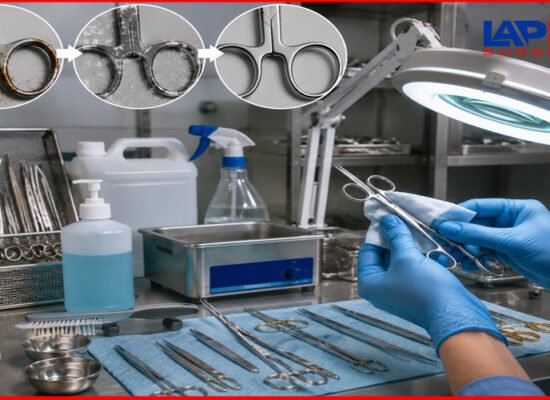
- Immediate Rinse: Rinse instruments immediately after use to prevent blood from drying in the box lock (the pivot point).
- Ultrasonic Cleaning: Use ultrasonic cleaners to remove microscopic debris.
- Lubrication: Use a surgical-grade lubricant (“milk”) to keep the action smooth.
- Inspection: Regularly check for “burrs” on the blades. If the scissors “chew” a piece of gauze rather than cutting it cleanly, they need sharpening.
10. Frequently Asked Questions (FAQs)
Q1: Can I use Mayo scissors for delicate tissue if I am careful?
A: While possible in an emergency, it is not recommended. The thickness of Mayo blades can cause crush injuries to delicate tissues, leading to slower healing and more trauma for the patient.
Q2: Why are some Metzenbaum scissors curved?
A: The curve allows the surgeon a better line of sight. It follows the natural contours of organs, making it easier to “dissect around” a structure like a blood vessel or a tumor.
Q3: What is the most common size for these scissors?
A: The most common size for general surgery is the 6.75-inch (17cm) Mayo and the 7-inch (18cm) Metzenbaum. However, Lapex Surgical produces them in sizes ranging from 5 inches to 14 inches.
Q4: How do I identify a Metzenbaum vs. Mayo at a glance?
A: Look at the “neck.” If the neck (shank) is very long and the “mouth” (blades) is short, it’s a Metzenbaum. If the blades look like they are half the length of the whole tool, it’s a Mayo.
Q5: Are these available for laparoscopic surgery?
A: Yes. Lapex Surgical specializes in Laparoscopic Metzenbaum scissors, which are long, thin inserts used through a trocar. Mayo scissors are less common in laparoscopy because tough tissue cutting is often handled by electrosurgical hooks or shears.
11. Technical Specifications Table
For procurement officers, the following technical details are vital:
| Specification | Lapex Mayo Scissor | Lapex Metzenbaum Scissor |
| Material | AISI 420 Stainless Steel | AISI 420 Stainless Steel |
| Edge Type | Standard / TC / Super-Cut | Standard / TC / Super-Cut |
| Finish | Satin (Anti-glare) / Mirror | Satin (Anti-glare) / Mirror |
| Joint Type | Box Lock / Screw Joint | Box Lock / Screw Joint |
| Autoclavable | Yes (Up to 134°C) | Yes (Up to 134°C) |
| Country of Origin | Sialkot, Pakistan | Sialkot, Pakistan |
12. The Lapex Advantage
Choosing between Metzenbaum vs. Mayo scissors is a matter of matching the tool to the tissue. One provides the power to conquer the toughest fascia, while the other offers the finesse to navigate the body’s most delicate pathways.
At Lapex Surgical, we don’t just manufacture instruments; we craft extensions of the surgeon’s hand. Based in Sialkot, we combine centuries of metal-working heritage with modern ISO-certified manufacturing processes. Whether you need standard Mayo scissors for a general clinic or custom-designed Metzenbaums for specialized plastic surgery, Lapex is your trusted partner.
Contact Lapex Surgical today to explore our full catalog of Surgical, Electrosurgical, and Laparoscopic instruments. Elevate your surgical outcomes with precision you can feel.
Final Thoughts for the Reader
Understanding the nuances of your tools is the first step toward surgical excellence. We hope this 3000-word deep dive into Metzenbaum vs Mayo Scissors has provided the clarity needed for your practice. Remember: Use the Mayo for the “tough stuff” and the Metzenbaum for the “deep stuff”—and always trust Lapex Surgical for the quality stuff.