Table of Contents
TogglePrecision in Every Grip: Why General Surgery Instruments Demand Uncompromising Quality
In the controlled, high-stakes environment of the operating room, every detail matters. From the surgeon’s practiced hand to the precision of the scalpel, each component plays a role in a procedure’s success. But beyond the skill and the sterile field, there is a fundamental, non-negotiable element that underpins it all: the uncompromising quality of the surgical instruments.
For those who rely on these tools—whether a surgeon performing a complex resection, a scrub tech preparing the tray, or a hospital administrator vetting suppliers—quality is not just a buzzword. It is the very foundation of patient safety and surgical efficacy. It is the assurance that a hemostatic clamp will not fail, that a needle holder will maintain its grip, and that a dissector will perform flawlessly, procedure after procedure.
This guide will explore the key factors that define true quality in general surgery instruments. We will expose the hidden dangers of poor quality, explore the science behind superior materials, demystify stringent manufacturing standards, and, most importantly, connect these technical aspects to the ultimate goal: leading to better patient outcomes.
At Lapex Surgical, we don’t just manufacture instruments; we forge trust. With a heritage rooted in the legendary craftsmanship of Sialkot, Pakistan, we are a global leader in providing surgeons with instruments that are not merely tools, but extensions of their own uncompromising standards. Our dedication to excellence is a promise of precision in every grip.
1. The High Cost of Cutting Corners: The Hidden Risks of Poor Quality
The temptation to opt for cheaper, lower-quality instruments can seem appealing on a balance sheet. However, this is a false economy. The risks associated with subpar surgical tools can have devastating consequences, turning a routine procedure into a life-threatening complication.
Risk 1: Instrument Failure During a Critical Moment
A surgical instrument is a mechanical device, and like any device, it is susceptible to failure. The stakes, however, could not be higher.
The Scenario: A surgeon is applying a hemostatic clamp to a blood vessel. The ratchet, made from low-grade metal, unexpectedly gives way. The clamp releases, and the vessel begins to bleed profusely.
The Consequence: This sudden, uncontrolled bleeding can obscure the surgical field, leading to panic, a rushed response, and the potential for a catastrophic error or patient exsanguination. A similar scenario with a failed needle holder could lead to a dropped needle inside the body, requiring a time-consuming and risky search.
The Lapex Surgical Difference: Lapex Surgical’s instruments are built with precision-milled ratchets and hinges, crafted from high-grade stainless steel that is resistant to wear and fatigue. They are designed for thousands of cycles, providing reliable performance when it matters most.
Risk 2: Contamination and Compromised Sterilization
An instrument that looks clean may not be. Subpar manufacturing can create a breeding ground for microorganisms.
The Scenario: An instrument with a rough, unpolished finish or microscopic burrs goes through the sterilization process.
The Consequence: These imperfections can trap bioburden (blood, tissue, etc.) that is not fully removed during cleaning. The sterilization agent (e.g., steam) may not be able to penetrate these microscopic crevices, leaving residual bacteria or prions. The instrument, though seemingly sterile, could introduce infectious agents into the surgical site, leading to a surgical site infection (SSI)—a severe complication that can prolong hospital stays, increase patient morbidity, and even result in death.
The Lapex Surgical Difference: Our instruments are meticulously polished to a smooth, mirror-like finish. This not only makes them aesthetically pleasing but, more importantly, facilitates thorough cleaning and ensures maximum efficacy of sterilization. There are no hiding places for contaminants.
Risk 3: Rusting and Pitting
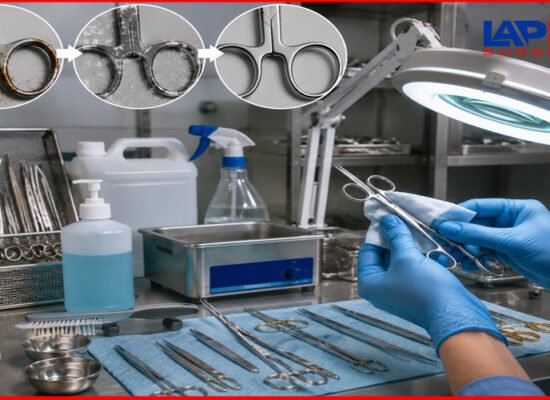
Corrosion is a common issue with low-quality instruments that are not made from true medical-grade stainless steel.
The Scenario: An instrument, often with a nickel or chrome plating over a lower-quality base, is exposed to the harsh environment of the OR and repeated sterilization cycles.
The Consequence: The plating can flake, exposing the underlying metal, which then rusts. This rust can flake off into the patient’s body, causing a foreign body reaction, or it can compromise the structural integrity of the instrument itself, making it prone to failure.
The Lapex Surgical Difference: We use only the highest-grade medical stainless steel, which is inherently resistant to corrosion. Our instruments are built to last, maintaining their integrity and performance for a lifetime of clinical use.
2. The Science of Superiority: Materials and Metallurgy
The true quality of a surgical instrument begins at a microscopic level—with its materials. The choice of metal, the specific alloy, and the precise heat treatment are all factors that separate a good instrument from an exceptional one.
Medical-Grade Stainless Steel: The Gold Standard
Not all stainless steel is created equal. The standard for surgical instruments is a specific family of alloys, primarily the 400 series, known for its high carbon content and the addition of chromium.
Stainless Steel Grade | Key Properties | Common Application in Instruments |
|---|---|---|
Type 420 | High carbon, good hardness, corrosion-resistant after hardening | Scalpels, scissors, hemostats, forceps |
Type 440A/B/C | Very high carbon, excellent hardness, and wear resistance | Blades, surgical knife handles, dental drills |
Type 304 | Lower carbon, non-magnetic, highly corrosion-resistant | Trays, bowls, furniture, and non-cutting instruments |
Lapex Surgical predominantly utilizes German stainless steel, widely recognized as the benchmark for quality in the surgical industry. This specific material composition provides the ideal balance of hardness (for maintaining a sharp edge and preventing bending), flexibility (for spring action in forceps), and corrosion resistance (for withstanding repeated sterilization).
Tungsten Carbide: The Ultimate Grip and Edge
On the jaws of instruments like needle holders and the blades of cutting scissors, a special material called tungsten carbide is often used. This incredibly hard alloy is fused to the stainless steel tips.
Benefit for Needle Holders: Tungsten carbide provides a superior, non-slip grip on surgical needles, preventing rotation and slippage. This allows the surgeon to apply less pressure and maintain precise control, which is critical during suturing.
Benefit for Scissors: Tungsten carbide inserts on scissor blades keep them sharp significantly longer than plain stainless steel scissors, ensuring a clean, non-crushing cut every time.
Lapex Surgical leverages these advanced materials to create instruments that perform at the highest level. Our tungsten carbide needle holders and scissors are a testament to our commitment to a science-driven approach to craftsmanship.
3. The Blueprint of Excellence: Adherence to Manufacturing Standards
The finest materials are useless without a manufacturing process that meets the most rigorous standards. Certifications are not just logos on a box; they are a manufacturer’s promise of safety, quality, and consistency.
ISO 13485: A Global Quality Management System
This is the most important certification for any medical device manufacturer. It dictates a comprehensive Quality Management System (QMS) that governs every stage of the product lifecycle, from design and development to production, post-market surveillance, and customer support.
What ISO 13485 means for Lapex Surgical:
Consistency: Every batch of instruments is manufactured to the same exacting standards.
Traceability: Every instrument can be traced back to its raw materials and production process.
Risk Management: A systematic process is in place to identify and mitigate risks to patient safety.
CE Mark (MDR 2017/745): The European Standard
The CE Mark is a mandatory conformity marking for medical devices sold within the European Economic Area. The latest regulation, MDR 2017/745, is incredibly strict, requiring a high level of clinical evidence and a robust QMS.
What the CE Mark means for Lapex Surgical:
Safety: It signifies that our products meet the EU’s stringent requirements for health and safety.
Performance: It confirms that our instruments perform as intended without compromising patient well-being.
Lapex Surgical proudly holds these certifications, a testament to our unwavering commitment to producing instruments that are trusted by healthcare professionals worldwide. Our compliance with these global benchmarks is an assurance that our products are safe, effective, and of the highest quality.
4. A Ripple Effect: The Impact of Quality on Patient Outcomes
The true measure of a surgical instrument’s quality is its impact on the patient. Uncompromising quality creates a positive ripple effect that touches every aspect of a patient’s recovery.
Faster and Safer Procedures: A sharp, reliable instrument allows a surgeon to work with greater efficiency and precision. This reduces operative time, which in turn minimizes the patient’s exposure to anesthesia and reduces the risk of complications.
Reduced Tissue Trauma: High-quality instruments are designed to handle delicate tissues with minimal crushing or tearing. A sharp scalpel makes a clean incision that heals faster, and a finely-tipped forcep can dissect without unnecessary damage to surrounding tissue. This translates to less post-operative pain and a quicker recovery.
Lowered Risk of Surgical Site Infections (SSIs): As discussed, a perfectly smooth, polished finish facilitates complete sterilization, leaving no place for bacteria to hide. By reducing the risk of contamination, high-quality instruments are a direct line of defense against one of the most common and costly post-operative complications.
Better Overall Patient Experience: Shorter hospital stays, less pain, and a reduced risk of complications lead to a better overall patient experience. Quality instruments are a key, though often unseen, factor in this equation.
5. The Architect of Quality: The Manufacturer’s Role
The manufacturer’s role extends far beyond the factory floor. It is a commitment to excellence that is embedded in the company’s culture and ethos.
The Legacy of Sialkot
Lapex Surgical is not just a company; it is the continuation of a legacy. Our roots are in Sialkot, Pakistan, a city that has been a global hub for surgical instrument craftsmanship for over a century. Here, the knowledge of metallurgy, forging, and finishing is passed down through generations of artisans. We build on this heritage by combining this time-honored expertise with modern technology and a commitment to international quality standards. This unique blend of tradition and innovation is what sets Lapex Surgical apart.
A Partnership in Patient Safety
Our role is to be a partner in patient safety. We invest heavily in research and development, constantly seeking to improve our designs and materials. Our commitment to you, the healthcare professional, is that every instrument we produce has undergone rigorous testing and quality control. We understand that our products are not simply commodities; they are critical tools in a life-saving process.
6. Investment vs. Expense: A Long-Term View
In healthcare, there is a fundamental difference between an expense and an investment. A cheaper instrument is an expense, a temporary tool that will likely need frequent replacement and carries a higher risk of failure. A high-quality instrument is a strategic investment.
Durability and Longevity: Quality instruments, made from superior materials, can withstand thousands of sterilization cycles and years of rigorous use without compromising performance.
Reduced Replacement Costs: By choosing instruments that last, hospitals and clinics reduce the long-term costs of frequent replacement.
Mitigated Risk: The financial and ethical costs of a single surgical error or infection far outweigh the initial savings on low-quality instruments. Investing in quality mitigates this risk.
A high-quality instrument, with its dependable grip and flawless function, is an asset that pays dividends in patient safety, surgical efficiency, and peace of mind.
The pursuit of excellence in general surgery is a journey of continuous improvement. At its heart is the understanding that the tools of the trade are not just accessories but essential drivers of success. Uncompromising quality in surgical instruments is a non-negotiable standard that impacts every aspect of a procedure, from the surgeon’s confidence to the patient’s outcome.
At Lapex Surgical, we are dedicated to this standard. Our unwavering commitment to precision, quality materials, and global manufacturing standards ensures that every instrument we produce is a testament to the Sialkot legacy of craftsmanship and a promise of surgical excellence. When you choose Lapex Surgical, you choose a partner in your commitment to providing the safest and most effective care for your patients.
Frequently Asked Questions (FAQ)
Q1: What is the main difference between medical-grade and standard stainless steel?
A1: Medical-grade stainless steel (e.g., Type 420/440) contains specific alloys like higher levels of carbon and chromium, which give it superior hardness for sharpness and enhanced corrosion resistance. Standard stainless steel lacks these properties and is not suitable for the harsh environment of the operating room.
Q2: How does Lapex Surgical ensure the quality of its instruments?
A2: Lapex Surgical ensures quality through a multi-faceted approach: using high-grade German stainless steel and other advanced materials, adhering to a strict Quality Management System certified by ISO 13485, and complying with international regulations like the CE Mark (MDR 2017/745). Our instruments also undergo rigorous testing and inspection at every stage of production.
Q3: Can a rusted instrument be safely reprocessed?
A3: No. A rusted or corroded instrument should be immediately removed from circulation. Rust compromises the instrument’s structural integrity and can harbor bacteria that are impossible to remove through standard sterilization methods, posing a severe risk of infection.
Q4: How do quality instruments reduce the risk of surgical site infections (SSIs)?
A4: Quality instruments reduce the risk of SSIs in two main ways: first, their smooth, polished finish prevents the adherence of bioburden and facilitates complete sterilization. Second, their superior design reduces tissue trauma, which is a major contributing factor to infection and poor wound healing.
Q5: What is the significance of Lapex Surgical's location in Sialkot, Pakistan?
A5: Sialkot has been a center for surgical instrument manufacturing for over a century. This heritage provides access to generations of skilled artisans who possess a deep, inherited knowledge of metallurgy and precision craftsmanship. Lapex Surgical combines this traditional expertise with modern technology to produce instruments of the highest caliber.
Q6: Why are tungsten carbide inserts so important for needle holders?
A6: Tungsten carbide inserts are crucial for needle holders because they provide an extremely hard, non-slip gripping surface. This allows the surgeon to grasp and pass the needle with minimal force, preventing slippage and reducing the risk of needle bending or tissue damage during suturing.