
A Surgeon’s Guide to Single-Port Trocars: Elevating Minimally Invasive Excellence
The evolution of laparoscopy has been a journey of reduction: from large open incisions to multiple 5mm ports, and now, to the pinnacle of surgical minimalism—Single-Port Laparoscopic Surgery (SPLS). For the modern surgeon, the transition to single-port techniques represents both a technical challenge and a significant benefit for patient outcomes, including reduced scarring and faster discharge.
At the heart of this transition is the Single-Port Trocars (or Multichannel Port). Unlike standard trocars, these devices are the central hub through which all visualization and instrumentation must pass. For a manufacturer like Lapex Surgical, based in the industrial heart of Sialkot, creating these instruments requires a fusion of high-level metallurgical science and ergonomic understanding.
This guide provides a comprehensive technical overview of single-port access systems, instrument triangulation, and the manufacturing standards that ensure surgical safety.
1. Defining the Single-Port Access (SPA) System
Single-port laparoscopy, also known as LESS (Laparoscopic Single-Site Surgery), utilizes a single incision—typically through the umbilicus—to perform complex intra-abdominal procedures.
The Anatomy of a Single-Port Trocar
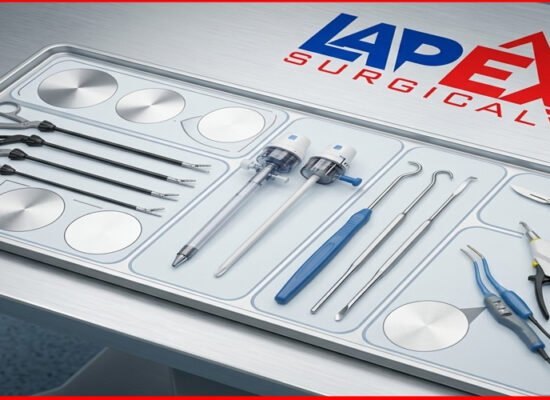
A high-quality single-port access device consists of three primary components:
- The Wound Protector/Retractor: A flexible sleeve that maintains the incision’s patency and protects the skin from friction and specimen contamination.
- The Cap/Platform: A gas-tight seal that features multiple “valves” or ports (typically 3 to 4) for the laparoscope and working instruments.
- Insufflation Valves: Integrated ports to maintain pneumoperitoneum despite the constant movement of multiple instruments.
Lapex Surgical Focus: Our engineering focuses on the “Seal Integrity.” In single-port surgery, the frequent clashing of instruments can tear inferior seals. We utilize medical-grade silicone and advanced polymers to ensure the cap remains airtight throughout the procedure.
2. The Technical Challenge: Overcoming “Sword Fighting.”
The most significant hurdle for surgeons switching to single-port access is the loss of Triangulation. In traditional laparoscopy, ports are spaced apart to create an angle of approach. In SPLS, instruments are parallel.
Strategies for Instrumentation
To compensate for the lack of space, surgeons rely on specialized hardware:
- Curved or Articulating Instruments: These allow the tips to meet at the target tissue while the handles remain separated.
- Variable Length Instruments: Using a “short” laparoscope and “long” working instruments prevents handle clashing.
- Low-Profile Trocar Heads: Trocars must have a slim exterior footprint to maximize the range of motion.
3. Comparative Analysis: Single-Port vs. Multi-Port Access
| Feature | Multi-Port Laparoscopy (MPL) | Single-Port Laparoscopy (SPLS) |
|---|---|---|
| Incision Count | 3 to 5 small incisions | 1 single incision (2-3cm) |
| Cosmetic Outcome | Visible scars | “Hidden” umbilical scar |
| Instrument Clashing | Minimal | High (Requires specialized technique) |
| Eronomics | Natural triangulation | Challenging (Requires articulating tools) |
| Learning Curve | Standard | Steep |
| Infection Risk | Low | Extremely Low (Single site) |
4. The Manufacturing Standard: The Sialkot Advantage
Why does a “Sialkot-made” instrument from Lapex Surgical hold weight in the international medical community?
Precision Metallurgy
The surgical-grade stainless steel used in our trocars and accompanying instruments (AISI 304, 316L, and 400 series) is treated with advanced passivation techniques. This ensures that even in the humid, high-pressure environment of the abdominal cavity, the instruments remain corrosion-free and maintain their structural integrity.
Hand-Finished Ergonomics
While CNC machines handle the bulk of production, the final “feel” of a Lapex instrument is calibrated by hand. For single-port surgery, where tactile feedback is reduced due to instrument crowding, the sensitivity of the handle-to-tip connection is paramount.
5. Step-by-Step Guide: Access and Insufflation
For the attending surgeon, the first five minutes of the case determine the next hour.
- Incision: A 15mm to 25mm transumbilical incision is standard.
- Placement: The wound retractor is inserted and “rolled” down to create a tight radial seal.
- Attaching the Cap: The multichannel cap is snapped onto the retractor.
- Insufflation: CO2 is introduced through the dedicated insufflation valve.
- Initial Visualization: A 5mm or 10mm “Extended Length” laparoscope is recommended to keep the camera head away from the surgeon’s working hands.
6. Applications in Advanced Surgical Care
Single-port trocars are no longer limited to simple appendectomies. At Lapex Surgical, we supply instruments for:
- Cholecystectomy: The most common application for SPLS.
- Hysterectomy: Providing a scarless option for gynecological health.
- Nephrectomy: Extending single-port benefits to urological oncology.
- Bariatric Surgery: Reducing wound complications in patients with higher BMIs.
7. Electrosurgical Safety in Single-Port Access
A critical safety concern in SPLS is Capacitive Coupling. Because multiple instruments are crowded into one port, insulation failure can cause internal burns that are outside the camera’s field of view.
The Lapex Safety Protocol:
- High-Dielectric Insulation: Every electrosurgical hook and dissector we manufacture undergoes 10,000V insulation testing.
- Non-Conductive Trocars: Our single-port systems utilize polymer-based caps to minimize the risk of stray current reaching the abdominal wall.
8. Frequently Asked Questions (FAQ)
Q: Is single-port surgery harder on the surgeon?
A: Initially, yes. The loss of triangulation requires the “crossed-hand” technique. However, with high-quality articulating instruments and a specialized single-port trocar, most surgeons reach proficiency within 15-20 cases.
Q: Can I use my standard 5mm laparoscopic instruments with a Lapex Single-Port?
A: Yes. Our multichannel ports are designed with universal seals that accommodate standard 5mm, 10mm, and 12mm instruments. However, we recommend using at least one articulating instrument for better ergonomics.
Q: How does Lapex Surgical ensure the “Airtight” seal during instrument exchange?
A: We use a “Duckbill” valve system combined with a secondary silicone gasket. This ensures that even when an instrument is removed, the pneumoperitoneum is maintained.
Q: What is the benefit of a Sialkot-manufactured trocar over a 3D-printed alternative?
A: Medical-grade stainless steel and molded polymers offer superior sterilization reliability and tensile strength. 3D-printed ports often lack the smooth surface finish required to prevent bacterial adhesion.
Q: Are these ports reusable or disposable?
A: We offer both. Our reusable single-port systems are made from high-grade silicone and autoclavable polymers, providing a cost-effective and eco-friendly solution for high-volume hospitals.
9. Maintenance and Sterilization of Access Ports
To maximize the lifespan of your Lapex Surgical Single-Port system:
- Disassembly: Always remove the cap from the wound retractor before cleaning.
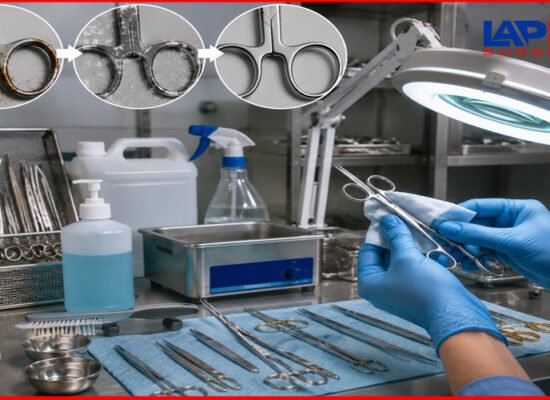
- Enzymatic Pre-soak: Use a pH-neutral enzymatic cleaner to break down bioburden in the narrow channels.
- Inspection: Check the valves for any tears caused by instrument tips.
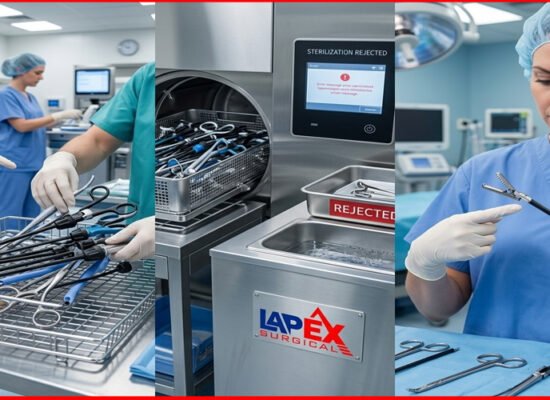
- Autoclave: Follow the 134°C sterilization cycle. Our materials are tested to withstand over 200 cycles without loss of elasticity.
10. The Future of the Incision
As we move toward “Natural Orifice Transluminal Endoscopic Surgery” (NOTES), the single-port trocar stands as the bridge between current reality and the future of scarless surgery. Lapex Surgical is proud to be a leader in this space, providing the precision instruments that allow surgeons to push the boundaries of what is possible.
By combining the centuries-old metallurgical heritage of Sialkot with the demands of modern robotic and single-port techniques, we ensure that “Advanced Surgical Care” is not just a slogan, but a reality in every operating room we serve.