Top 5 Reasons for Laparoscopic Instrument Failure in the OR: The Lapex Surgical Guide to Clinical Reliability
In the modern Operating Room (OR), the success of a Minimally Invasive Surgery (MIS) is tethered to the integrity of the instruments used. When a laparoscopic grasper fails to lock, or a dissector loses its edge mid-procedure, it isn’t just a technical glitch—it is a threat to patient safety, a drain on hospital resources, and a significant stressor for the surgical team.
At Lapex Surgical, we manufacture premium instruments in Sialkot with a single mission: to eliminate the phrase “instrument failure” from the surgical vocabulary. Understanding why these failures occur is the first step toward prevention.
Below, we analyze the top five reasons for laparoscopic instrument failure and how superior manufacturing standards can mitigate these risks.
1. Insulation Breakdown (The Invisible Danger)
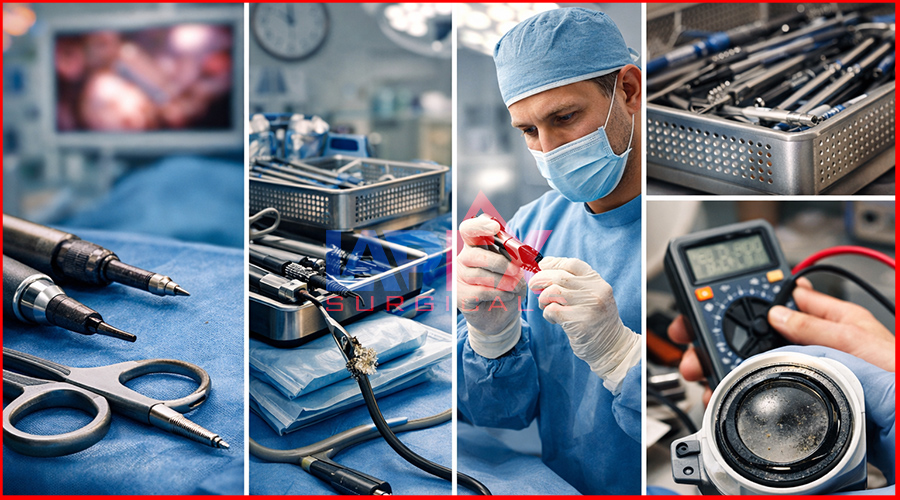
The most critical failure in electrosurgical laparoscopic instruments is the compromise of the insulation layer. These tools carry high-frequency electrical current to cut or coagulate tissue. If the thin coating on the shaft is nicked, cracked, or worn, electricity can “leak” or arc to unintended structures, such as the bowel or blood vessels.
Why it Happens:
- Mechanical Stress: Frequent insertion through metal trocars can cause micro-abrasions.
- Thermal Fatigue: Repeated exposure to high-heat autoclaving cycles degrades low-quality polymers.
- Improper Handling: Using the shaft of the instrument to retract or lever tissue can cause the insulation to peel.
The Lapex Difference:
We use high-dielectric strength heat-shrink tubing and advanced polymer coatings that are tested for “pinhole” leaks using high-voltage testers before leaving our Sialkot facility.
2. Mechanical Fatigue and “Jaw Misalignment.”
Laparoscopic graspers and needle holders rely on intricate internal linkages. Failure often manifests as the jaws not closing flush or the ratchet mechanism failing to hold under tension.
Why it Happens:
- Over-Tensioning: Surgeons occasionally use fine graspers for heavy tissue retraction, stretching the internal pull-rod.
- Material Softness: In “cheap” instruments, the pins and pivots are made of softer alloys that deform over time.
- The “Scissoring” Effect: Misaligned jaws create a shearing force that eventually snaps the pivot pin.
Table 1: Mechanical Failure Indicators
| Symptom | Probable Cause | Risk Level |
|---|---|---|
| Gaps between jaws | Bent internal pull-rod | Moderate (Tissue Slippage) |
| Ratchet “Slips” | Worn teeth on the handle | High (Loss of Control) |
| Stiff Articulation | Bio-burden buildup in pivot | High (Total Seizure) |
| Tip Fracture | Metal fatigue/Low-grade steel | Critical (Retained Foreign Object) |
3. Corrosion and Bio-burden Accumulation
A laparoscopic instrument may look clean on the outside but remain “biologically failed” on the inside. Failure to properly clean the long, narrow lumens of modular or non-detachable instruments leads to corrosion and “bio-film” buildup.
Why it Happens:
- Pitting Corrosion: If blood or saline is left to dry on the instrument, the chloride ions eat through the passive layer of the stainless steel.
- Internal Clogging: In non-modular designs, debris becomes trapped in the spring mechanism, leading to mechanical failure.
- Chemical Attack: Using non-neutral pH detergents in the washing phase strips the protective oxide layer.
4. Dullness and Edge Degradation (The “Chewing” Effect)
Laparoscopic scissors must provide a clean, “cold” cut. When scissors fail, they begin to “chew” tissue, causing unnecessary trauma and increasing the time required for the procedure.
The Physics of the Cut:
High-quality scissors like those from Lapex Surgical utilize a “curved-blade” geometry that maintains a single point of contact throughout the cut.
- Failure Cause: Low-quality blades lose their “set” (the tension between the blades). Once the gap between the blades exceeds a few microns, the tissue simply folds between them.
- Sialkot Craftsmanship: Our master technicians hand-hone every blade to a “Razor-Plus” finish, ensuring that the tungsten carbide inserts (if applicable) remain sharp for significantly longer durations than generic alternatives.
5. User Error and Incompatible Reprocessing
Often, the “failure” is a result of the environment rather than the tool. However, a robust instrument should be designed to withstand the realities of a busy hospital.
Key Factors:
- Tapping/Striking: Attempting to clear debris by tapping the instrument on a metal tray can crack the delicate ceramic tips or internal linkages.
- Ultrasonic Over-exposure: Leaving instruments in ultrasonic cleaners for extended periods can actually loosen the specialized adhesives used in modern laparoscopic tips.
- Mismatched Parts: In modular systems, using a Lapex handle with a competitor’s shaft can lead to improper seating and mid-surgery detachment.
FAQ: Frequently Asked Questions about Instrument Reliability
Q1: How often should laparoscopic instruments be tested for insulation safety?
A: Ideally, every time they return from the CSSD (Central Sterile Services Department). Use a dedicated insulation tester (lap-tester) to check for cracks that aren’t visible to the naked eye.
Q2: Can a “bent” laparoscopic grasper be repaired?
A: While some minor realignments are possible, a bent pull-rod usually indicates that the metal has reached its yield point. For safety, Lapex Surgical recommends replacing the insert to ensure the tensile strength is not compromised.
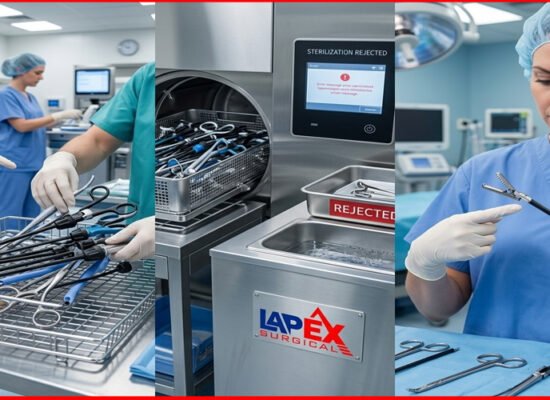
Q3: Why does my instrument feel “stiff” after autoclaving?
A: This is usually due to “mineral scaling” from hard water or inadequate lubrication. We recommend using a medical-grade, water-soluble lubricant (“surgical milk”) after every cleaning cycle.
Q4: What makes Sialkot instruments from Lapex different from others in the region?
A: Many workshops in Sialkot prioritize volume. Lapex Surgical prioritizes metallurgy. We use imported German and French steel and employ CNC-guided milling to ensure that every instrument is a perfect replica of the master design.
The Strategic Solution: The Lapex “Zero-Failure” Protocol
To ensure your OR stays functional, we suggest moving away from “budget” sourcing and adopting the Lapex standard:
- Standardized Metallurgy: We only use AISI 420 series steel for high-wear components.
- Ergonomic Testing: Our handles are tested for 50,000 “clicks” to ensure the springs never lose their tension.
- Modular Design: We promote modular laparoscopic tools that can be completely disassembled, ensuring 100% sterilization and easy part replacement.
Checklist for OR Managers: Post-Surgery Inspection
Before sending instruments to the washer, your staff should check for:
- [ ] Tip Integrity: Are there any nicks or missing pieces of metal?
- [ ] Insulation: Is the coating smooth and free of “bubbles”?
- [ ] Spring Tension: Does the handle snap back to the open position?
- [ ] Light Transmission: (For scopes) Is the image clear or “foggy”?
- [ ] Locking Mechanism: Does the ratchet hold firmly on the third click?
The Cost of a “Small” Failure
A laparoscopic instrument failure is never small. It can lead to surgical delays that cost $60 per minute, or worse, internal injuries that change a patient’s life forever.
By choosing Lapex Surgical, you are investing in Sialkot’s finest engineering. We don’t just manufacture tools; we manufacture confidence. Our instruments are designed to endure the rigors of the modern OR, ensuring that when the surgeon reaches for a Lapex tool, it performs perfectly—every single time.
Looking for high-reliability laparoscopic solutions? Browse the Lapex Surgical Catalog or contact our Technical Team for a bulk consultation.