
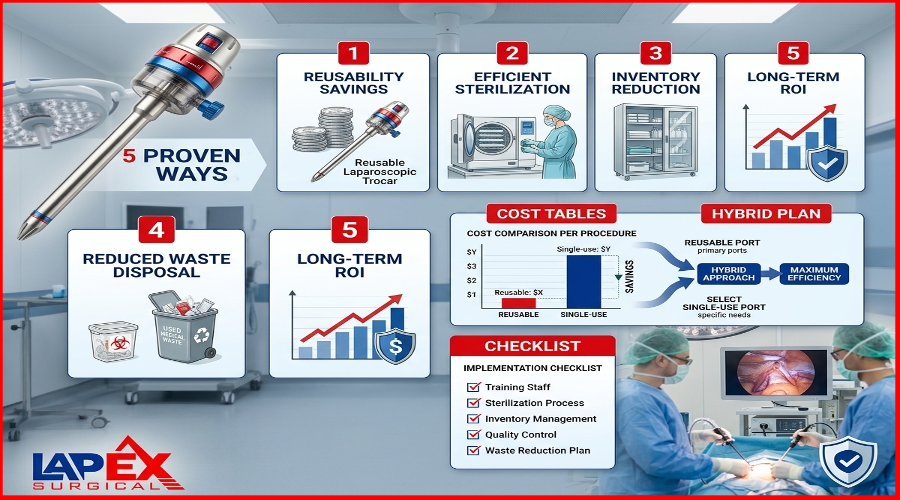
5 Ways to Cut Costs With Reusable Laparoscopic Trocars (Without Compromising Surgical Care)
Reusable laparoscopic trocars can cut your per-case trocar cost by a large margin. Most facilities that run steady laparoscopic volume see the savings within the first year. You do not need to give up safety to get there. You need good sterilization, good tracking, and a smart mix of reusable and disposable ports.
This guide shows five practical ways to save money. It also gives you tables, examples, a checklist, and answers to common questions.
Quick Answer: Are Reusable Trocars Cheaper?
For most busy facilities, yes. A reusable trocar costs more up front. But you use it again and again. A single-use trocar is thrown away after one case.
Here is a simple example. The numbers below are for teaching only. Your prices will differ.
| Item | Disposable Trocar Set | Reusable Trocar Set |
|---|---|---|
| Purchase price (example) | $60 per case | $400 per set |
| Reprocessing cost per use (example) | $0 | $25 |
| Uses over the life of the set | 1 | 100+ |
| Cost per case (example) | $60 | about $29 |
| Cost after 500 cases | $30,000 | about $14,500 |
The reusable figure assumes 5 sets bought over 500 cases, plus reprocessing each time. Always use your own quotes and your own CSSD costs.
The gap grows as your case volume grows. Low-volume rooms see smaller gains. That is why Method 5 below talks about a mixed approach.
Why Trocar Costs Matter in the OR
Laparoscopic surgery is common. Gallbladder removal, hernia repair, appendectomy, and many gynecologic cases use it. Each case needs several ports. Those small items add up fast over a year.
Supply costs are one of the biggest parts of OR spending after labor. Even small savings per case turn into real money when you do hundreds or thousands of cases.
Method 1: Lower Your Per-Case Cost With a Reusable Set
This is the most direct way to save. You buy the instrument once. You use it many times.
How the math works
Use this simple formula:
Cost per case = (Purchase price ÷ number of uses) + reprocessing cost per use
Let’s try a real-world example:
- Reusable set costs $400
- It lasts 100 uses
- Reprocessing costs $25 each time
Cost per case = ($400 ÷ 100) + $25 = $4 + $25 = $29
Compare that to a $60 disposable port. You save about $31 per case. At 600 cases a year, that is about $18,600.
What changes the result
- Case volume. More cases mean faster payback.
- Instrument life. Good care means more uses.
- Reprocessing cost. Efficient workflows keep this low.
- Repair and replacement. Plan for seals, valves, and wear.
Quick tip
Ask your vendor for the expected number of uses. Then check it against your own tracking after six months.
Method 2: Cut Medical Waste and Disposal Fees
Disposable trocars create plastic waste. Much of it goes into regulated medical waste bins. Those bins cost more to haul away than regular trash.
Where you save
- Fewer packages and wrappers
- Less plastic in the waste stream
- Lower regulated waste weight
- Fewer storage boxes in the supply room
Example
Say your facility does 800 laparoscopic cases a year. Each case uses 3 disposable ports. That is 2,400 plastic ports and their packaging each year. Moving even half of those cases to reusable sets removes about 1,200 items from the waste stream.
Waste savings are often smaller than purchase savings. Still, they add up. They also help if your facility has sustainability goals. Many hospitals now report on waste, and reusable tools help that story.
Be fair about the trade-off
Reusable items use water, energy, and staff time to clean and sterilize. A good plan counts those costs too. Do not skip them when you build your numbers.
Method 3: Run a Tighter, Faster CSSD Workflow
Reusables only save money if your Central Sterile Supply Department (CSSD) can handle them well. A messy process eats up the savings.
Steps that keep CSSD efficient
- Use dedicated trays. Keep trocar parts together so nothing gets lost.
- Disassemble fully. Take apart seals, caps, and valves as the manufacturer directs.
- Clean right away. Dried blood is hard to remove. Rinse soon after the case.
- Use the right brushes and flush tools. Lumens need real cleaning, not just a quick rinse.
- Inspect under good light. Check for cracks, dents, and worn seals.
- Follow the maker’s instructions for use (IFU). This is not optional.
- Log each cycle. Track how many times each set has been used.
Standards to know
Follow the manufacturer’s IFU and your local rules. Many facilities also use guidance from AAMI (such as ANSI/AAMI ST79 for steam sterilization) and AORN guidelines. Your infection prevention team should review the plan.
Example of a good workflow
A small surgery center sets up two standard trocar trays. One is in use. One is being cleaned. That way, the OR never waits. Trays go from the OR to decontamination within 30 minutes. This simple rotation keeps cases on time and keeps the reusable program running smoothly.
Time and labor
Reprocessing takes staff time. Count it. Many facilities find the labor cost is small when the process is set up well, and trays are standardized.
Method 4: Improve Laparoscopic Inventory Control
Disposable ports often sit in many rooms and carts. They expire. They get opened and not used. They get ordered in rush shipments at higher prices.
How reusables help
- Fewer SKUs. You stock fewer sizes and brands.
- Less expired stock. Metal and reusable parts do not “go bad” on a shelf the same way sterile-packed disposables can.
- Fewer opened-but-unused items. Sets are counted in trays, not pulled one by one.
- Predictable ordering. You plan around tray counts, not weekly emergency buys.
Simple inventory checklist
- Count how many trocar sizes you stock now
- List the three most-used sizes (often 5 mm and 10/12 mm)
- Set a par level for sets in rotation
- Track the use count on each set
- Review wastage every quarter
- Keep a small buffer of spares
Example
A hospital finds it keeps 14 trocar types on shelves. After a review, it moves to 6 types in reusable trays. It cuts shelf space, ordering time, and expired items.
Method 5: Use a Hybrid Trocar Strategy
You do not have to pick only one type. A hybrid strategy uses reusable trocars for most cases. It keeps disposables for the cases where they make better sense.
When reusable ports fit well
- High-volume general surgery
- Routine gynecologic cases
- Standard hernia and gallbladder work
- Rooms with steady CSSD support
When disposable ports may fit better
- Rare or special cases that need a unique port type
- Emergency add-ons when no clean set is ready
- Cases with known infection concerns, per your policy
- Low-volume sites without strong reprocessing support
A simple hybrid plan
| Case Type | Suggested Port Type | Why |
|---|---|---|
| Routine cholecystectomy | Reusable | High volume, standard sizes |
| Standard hernia repair | Reusable | Repeat use, low waste |
| Planned gynecologic laparoscopy | Reusable | Predictable need |
| After-hours emergency | Disposable backup | Speed and availability |
| Special-access or unusual case | Disposable or specialty | Fit and function |
This balance protects your budget and your schedule. It also gives surgeons choices.
Does Reusable Mean Less Safe?
No, not when done right. Reusable instruments have been used in surgery for decades. Safety depends on three things:
- Good design. Choose instruments built from quality medical-grade stainless steel, with clear IFU documents.
- Good cleaning. Follow every step, every time.
- Good inspection. Retire damaged or worn pieces right away.
Things to check before you buy
- Is the instrument made to be taken apart for cleaning?
- Does the maker give validated cleaning and sterilization steps?
- Is the material strong enough for repeat autoclave cycles?
- Are replacement seals and valves easy to get?
- Is there a warranty or support program?
- Does the maker follow quality standards such as ISO 13485?
Surgeon comfort matters too. Let your surgeons test the feel, grip, and seal. Staff buy-in is a big part of success.
Reusable vs. Disposable Trocars: Side-by-Side
| Factor | Reusable | Disposable |
|---|---|---|
| Upfront cost | Higher | Low per unit |
| Long-term cost | Lower at steady volume | Higher at steady volume |
| Waste produced | Low | High |
| CSSD workload | Higher | None |
| Inventory complexity | Lower with standard trays | Higher with many SKUs |
| Always sterile and ready | Only if cycle is managed | Yes, until opened or expired |
| Sharpness over time | Needs checks and care | Fresh every case |
| Best for | Steady, high-volume programs | Low volume, backup, special cases |
How to Build Your Own Cost Analysis
Do this before you buy. It takes an afternoon.
Step-by-step
- Count your cases. Pull last year’s laparoscopic volume.
- Count ports per case. Most cases use 3 to 4.
- Find your disposable price. Use your real contract price.
- Get reusable quotes. Ask for set price and expected life.
- Measure reprocessing cost. Include labor, supplies, water, energy, and sterilizer time.
- Add repair and replacement. Plan for seals and wear.
- Add waste fees. Use your actual disposal rates.
- Compare the totals. Look at one year and three years.
- Find your break-even point. That is the number of cases where reusable wins.
Sample break-even idea
If a reusable set costs $400, and each case saves you $31 over a disposable, your break-even is about 13 cases per set. After that, each case is a saving.
That is why volume matters so much.
Implementation Checklist
Use this list to roll out a reusable program.
Before launch
- Review the IFU with CSSD and infection prevention
- Run your cost analysis
- Get surgeon feedback after hands-on trials
- Choose a trusted supplier with documented quality
During launch
- Train CSSD staff on cleaning and inspection
- Set up standard trocar trays
- Start with one service line, such as general surgery
- Add a use-count log for every set
After launch
- Review cost per case every quarter
- Track damage and replacement rates
- Gather OR staff feedback
- Adjust your hybrid plan as needed
5 Ways to Cut Costs With Reusable Laparoscopic Trocars
Save money. Keep surgical care safe.
Cost after 500 cases (example)
The 5 ways to save
Lower cost per case
Buy once. Use many times.
Cut waste fees
Less plastic in the bin.
Smooth CSSD flow
Standard trays. Clean fast.
Control inventory
Fewer sizes. Less expired stock.
Go hybrid
Mix reusable and disposable.
Hybrid plan: who goes where?
Reusable (R)
- Routine gallbladder cases
- Standard hernia repair
- Planned gynecology cases
Disposable (D)
- After-hours emergencies
- Rare or special cases
- Low-volume sites
Is reusable safe? Yes, with 3 habits
Clean
Take apart. Brush. Flush.
Inspect
Check seals. Retire worn parts.
Track
Log every use cycle.
Quick math
Calculate your OR savings
Get the free Trocar Cost-Benefit & ROI Analysis Matrix.
See reusable trocarsLapex Surgical, Sialkot
Choosing a Supplier
Look for a maker who offers clear documents, steady quality, and good support. Lapex Surgical (the manufacturer of Surgical, Electrosurgical, Plastic Surgery Instruments, and Laparoscopic instruments from Sialkot) is one option for facilities that want to review reusable trocar and port options. Sialkot is well known worldwide for surgical instrument making, and buyers often look there for steel instruments at fair prices.
Whichever supplier you pick, ask for samples. Check the finish, the seal, and how well the parts come apart for cleaning. Ask about IFU, material grades, and certifications.
Common Mistakes to Avoid
- Ignoring reprocessing cost. This makes reusables look cheaper than they are.
- Skipping staff training. Poor cleaning creates risk and waste.
- Not tracking use counts. You may keep worn parts in service too long.
- Going all-in at once. Start small and expand.
- Buying on price alone. Quality and support matter as much.
- Forgetting backup stock. Keep a few disposables for emergencies.
Frequently Asked Questions
How many times can a reusable trocar be used?
It depends on the design, the material, and how well you care for it. Many are made for dozens or even hundreds of cycles. Always follow the manufacturer’s IFU and retire any piece that shows damage.
Are reusable trocars safe for patients?
Yes, when cleaned, inspected, and sterilized the right way. Safety comes from following the IFU and your facility’s infection control rules.
Will my CSSD be able to handle the extra work?
Most can, with training and standard trays. Start with one service line and grow from there.
What is a hybrid trocar strategy?
It means using reusable ports for routine cases and keeping disposables for backup or special cases.
How fast will I see a return?
Many busy facilities see payback within months. Smaller programs may take longer. Your case volume and reprocessing cost decide the timeline.
Do surgeons like reusable trocars?
Many do. Good reusables feel solid and seal well. Let your surgeons test them first, so they feel part of the choice.
Are reusable trocars better for the environment?
They usually create less solid waste. They do use water and energy for cleaning. Overall, many facilities see a net benefit, but you should measure your own numbers.
What should I ask a supplier before buying?
Ask about material, IFU, expected life, replacement parts, warranty, and quality certifications.
Final Thoughts
Reusable laparoscopic trocars give busy facilities a clear path to lower costs. You save through lower per-case spend, less waste, a smoother CSSD, tighter inventory, and a hybrid plan that fits your real needs. None of this means giving up safe care. Good cleaning, good inspection, and good tracking keep patients safe.
Start with your own numbers. Run the math. Test a few sets. Then grow the program step by step.
Lapex Surgical (the manufacturer of Surgical, Electrosurgical, Plastic Surgery Instruments, and Laparoscopic instruments from Sialkot) offers reusable options worth a look. You can browse reusable laparoscopic trocars and ports here.
Ready to Save?
Calculate your facility’s potential OR cost savings. Schedule a consultation with our surgical equipment specialists today.