
Table of Contents
ToggleThe Complete Guide to Essential General Surgery Instruments: Tools for Appendectomy, Cholecystectomy, Hernia Repair & Beyond
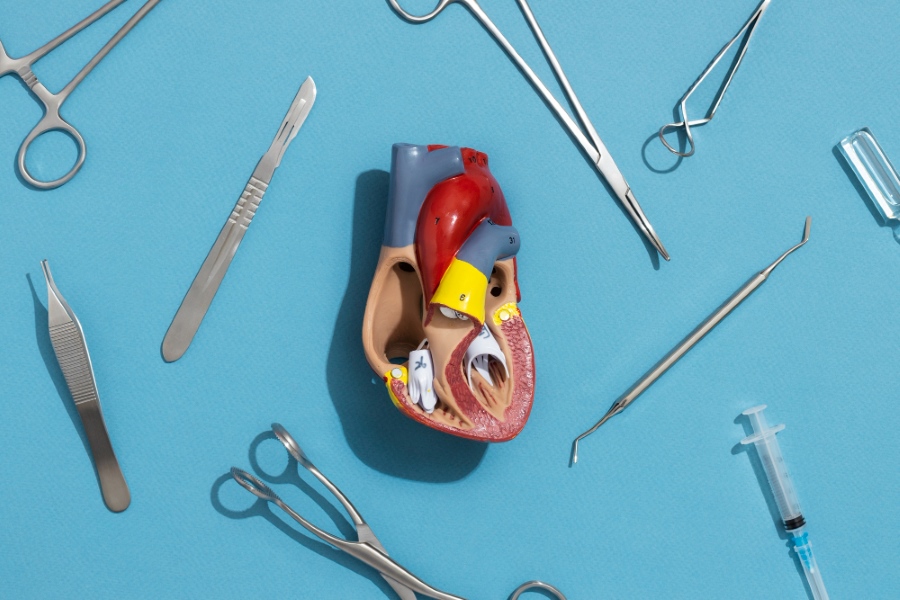
The surgeon is the conductor in the operating room, and the surgical instruments are their orchestra. In general surgery, a reliable and versatile set of tools is fundamental to performing a wide range of procedures safely and effectively. From simple cuts to complex dissections and repairs, the success of a surgery relies heavily on having the right general surgery instruments at hand. These surgical tools are designed for specific tasks, allowing surgeons to work precisely and confidently. This guide will introduce you to the essential instruments you’ll find in a general surgery toolkit, covering everything from basic cutting tools to specialized retractors and procedure-specific sets for common operations like appendectomy, cholecystectomy, and hernia repair.
The Surgeon’s Right Hand: The Critical Role of General Surgery Instruments
Think of any skilled craft – carpentry, mechanics, even cooking. The right tools make the job possible and ensure a quality outcome. In general surgery, this is amplified a thousand times. General surgery instruments are not just pieces of metal; they are vital partners to the surgeon’s expertise. Their reliability, durability, and specific design allow surgeons to manipulate tissues, control bleeding, and maintain a clear view within the body. These essential general surgery instruments are the workhorses of the operating room (OR), enabling everything from routine procedures to emergency interventions.
Mastering the Cut: Scalpels, Knives, Scissors & More
Every surgical procedure begins with access, and that requires cutting. These sharp instruments are foundational to every tray.
Scalpels and Surgical Knives:
The most basic cutting tool is the scalpel or surgical knife. These consist of a handle and a disposable blade. Different blade shapes and sizes are used for making incisions of varying lengths and depths, from delicate skin cuts to deeper tissue separation. Precision here is key.
Surgical Scissors: Varieties and Uses:
Surgical scissors are incredibly versatile. Straight scissors are often used for cutting sutures, dressings, or other materials. Curved scissors are better for dissecting or cutting tissues within the body, allowing the surgeon to follow natural curves. Types like Mayo and Metzenbaum scissors have different blade strengths and tips suited for cutting heavy connective tissue versus fine, delicate dissection.
Rongeurs, Saws, and Drills: Instruments for Bone:
Sometimes, general surgery involves working with bone, especially in trauma cases or when accessing certain areas. Rongeurs are sturdy instruments with sharp jaws used to bite away small pieces of bone. A bone saw or surgical drill might be used in more complex scenarios requiring bone manipulation.
Curettes: Scraping and Shaping:
A curette is a small instrument with a looped or spoon-shaped tip, often sharp. It’s used for scraping tissue or bone, such as cleaning out an abscess cavity or sampling tissue.
Gripping and Securing: Forceps, Clamps, and Needle Holders
Holding onto tissue or controlling bleeding vessels requires instruments with different types of grips and locking mechanisms.
Hemostatic Clamps: Controlling Bleeding:
These are vital for temporarily clamping blood vessels to stop bleeding. Different types have varying jaw patterns and lengths. The Kelly clamp, Kocher clamp, and Crile hemostat are common examples, each with slight variations, making them suitable for different sizes of vessels or types of tissue they might also inadvertently grab.
Grasping and Tissue Forceps: Allis, Babcock, and Beyond:
Forceps designed for holding tissue come with different levels of grip. The Allis clamp has teeth that interlock, providing a firm but potentially traumatic grip. The Babcock clamp has a rounded, flared jaw that grasps tissue more gently, making it suitable for delicate structures like bowel without crushing. General tissue forceps come with or without teeth for handling various tissues.
Needle Holders: Guiding Sutures with Precision:
Once the tissue is ready to be closed or repaired, the surgeon uses needle holders (often called needle drivers). These instruments have jaws designed to securely grip a curved surgical needle, allowing the surgeon to push it through tissue precisely and control the suture material.
Providing Clear Access: Retractors and Specula
Seeing clearly inside the body cavity is essential for safe and effective surgery. Retractors are used for this purpose.
Manual Retractors: Deaver, Army-Navy, Richardson:
These require an assistant to hold them in place, pulling back skin, muscle, or organs. Common examples include the curved, paddle-like Deaver retractor, the double-ended Army-Navy retractor, and the Richardson retractor, which has a hooked end. Their shape depends on the depth and type of tissue being retracted.
Self-Retaining Retractors: Weitlaner, Bookwalter:
These retractors have a ratchet or locking mechanism that holds the blades open, freeing the surgeon’s and assistant’s hands. The Weitlaner retractor is often used in shallower wounds, while the larger Bookwalter retractor is a complex system used in deep abdominal surgery to hold the cavity wide open.
Speculum: Holding Open for Visualization:
While not always used internally in the abdomen, a speculum is a fundamental general surgery instrument used to open and hold natural body openings (like in gynecological or rectal exams) for better visualization.
Accessing Body Cavities: Trocars
For minimally invasive (laparoscopic) surgery, special instruments are needed to get into the body cavity without a large incision.
Trocars: Gateway to Laparoscopic Surgery:
Trocars are sharp-tipped instruments housed within a hollow tube (cannula). The trocar is used to puncture the abdominal wall, and then it’s removed, leaving the cannula in place. This cannula acts as a port through which laparoscopic cameras and instruments are inserted into the body.
Clearing the Field: Surgical Suction Instruments
Keeping the surgical field clear of blood, irrigation fluid, or other materials is vital for the surgeon’s visibility.
Suction Tips: Yankauer, Poole, Frazier:
Various suction tips are used depending on the need. The Yankauer suction tip is a common, rigid tip used for general suction in the mouth or superficial areas. The Poole suction tip is designed with multiple holes to prevent getting clogged by tissue when used for large-volume suction in the abdominal cavity. The Frazier suction tip is a fine, angled tube used for precise suction in tight or delicate areas, such as neurological or vascular surgery, which general surgeons may perform.
Instrument Sets for Common General Surgery Procedures
While many instruments are versatile, surgeons often use specific combinations tailored for frequent procedures.
Essential Instruments for Appendectomy:
An appendectomy instrument set typically includes various hemostatic clamps (Kelly clamp, Crile hemostat), tissue forceps (Allis clamp, Babcock clamp), scalpels, surgical scissors, needle holders, and sometimes specific retractors to access the appendix.
Key Instruments for Cholecystectomy:
Whether open or laparoscopic, cholecystectomy instruments include tools to dissect around the gallbladder, ligate (tie off) ducts and vessels (often using clamps like Kocher clamp or Kelly clamp), and remove the organ. Laparoscopic cholecystectomy heavily relies on trocars and long, thin versions of forceps, scissors, and dissectors.
Must-Have Tools for Hernia Repair:
Hernia repair instruments vary based on the technique (open vs. laparoscopic, mesh vs. tissue repair). Common tools include scalpels, scissors, tissue forceps, retractors (like Army-Navy retractor or Richardson retractor), needle holders for suturing, and instruments for handling mesh if used.
Maintaining Your Arsenal: Care and Sterilization
The performance and lifespan of general surgery instruments depend heavily on proper care. This includes thorough cleaning after each use to remove all tissue and fluids, careful inspection for damage, and rigorous sterilization according to strict protocols. Proper maintenance ensures the surgical equipment remains sharp, functional, and safe for every patient.
The Indispensable Role of General Surgery Tools
The world of general surgery instruments is vast and fascinating, reflecting centuries of innovation aimed at helping surgeons operate safely and effectively. From the basic cutting edge of a scalpel to the precise grip of hemostatic clamps and the clear view provided by retractors, each tool plays a critical role. Understanding these essential general surgery instruments is fundamental to appreciating the complexity and skill involved in procedures like appendectomy, cholecystectomy, and hernia repair, and indeed, the full scope of general surgery. These reliable surgical tools are truly the surgeon’s indispensable partners in the pursuit of patient well-being.


