Table of Contents
ToggleHow Powerful Disposable Scissors Guarantee a First-Time Cut in Every Laparoscopic Procedure
The Uncompromising Standard of Minimally Invasive Surgery
In the world of Minimally Invasive Surgery (MIS), every movement is amplified, every cut is critical, and the margin for error shrinks dramatically. The delicate dance of laparoscopic instruments within the confines of the abdominal cavity demands not just skill from the surgeon, but absolute, unyielding consistency from the tools they wield.
Among the laparoscopic arsenal, the scissors are perhaps the most frequently used and, paradoxically, the most vulnerable to performance degradation. While the shift from reusable to sterile, single-use instruments addresses the critical issue of cross-contamination, a deeper, more profound clinical driver exists: the guaranteed First-Time Cut (FTC).
The FTC is the metric of excellence—the assurance that the blade, upon initial closure, will precisely and cleanly sever the target tissue, be it fascia, suture, or delicate connective structure, without slipping, tearing, or requiring secondary attempts. A failed cut compromises visibility, increases operative time, and, most importantly, elevates the risk of accidental trauma to adjacent vital structures.
At Lapex Surgical, we are not just manufacturers; we are precision engineers dedicated to surgical perfection. Operating from the global hub of surgical excellence in Sialkot, we fuse generational craftsmanship with cutting-edge material science, including the use of German-grade metals, to produce Powerful Disposable Laparoscopic Scissors that embody the principle of the FTC guarantee.
This definitive, in-depth guide is designed for surgeons, operating room managers, and procurement specialists. It will analyze the fundamental engineering, material science, and safety protocols that distinguish a premium disposable laparoscopic scissor—the instrument that serves as a guarantee of clinical consistency—from its reusable and lower-grade counterparts.
Defining the Clinical Imperative—The Cost of a Failed Cut
The significance of the FTC in laparoscopic surgery cannot be overstated. Unlike open surgery, where a surgeon can easily adjust grip, angle, or force, the confined view and limited dexterity of MIS demand immediate and flawless tissue transaction.
1.1. What is the First-Time Cut (FTC) Guarantee?
The First-Time Cut (FTC) Guarantee is a performance pledge delivered by a sterile single-use scissor. It means the instrument performs at 100% of its peak cutting capacity for the first use, delivering predictable, low-force tissue severance every time.
Key Indicators of a Successful FTC:
Low Actuation Force: The force required on the handle to sever the tissue is minimal and consistent, reducing hand fatigue.
Clean Transection: The tissue edge is sharp, without fraying, crushing, or “stringing,” which is crucial for subsequent dissection or healing.
Zero Slippage: The jaws securely grip the tissue, preventing the target structure from sliding out of the blades, a common cause of inadvertent tissue damage.
Immediate Visibility: No bleeding or trauma results from a ragged, forceful cut, preserving the surgical field.
1.2. The Clinical and Economic Consequences of Inconsistency
A surgeon facing an inconsistent instrument must compensate, which introduces clinical and operational risks that directly impact patient outcomes and hospital economics.
Table 1: Clinical and Operational Impact of Failed First-Time Cuts
Consequence | Clinical Impact | Operational Impact | Financial Impact |
|---|---|---|---|
Tissue Trauma/Tearing | Increased risk of hemorrhage, larger area of necrosis, compromised healing. | Requires immediate hemostasis, prolonged operative time, increased risk of complication. | Higher utilization of expensive hemostatic agents and energy devices. |
Blade Slippage/Second Cut | Risk of injury to adjacent structures (e.g., bowel, ureter, vessel) due to unintended blade travel. | Disruption of workflow, loss of surgical rhythm, mental fatigue for the surgeon. | Extended OR time (measured in $ per minute), increased liability risk. |
Increased Force Requirement | Surgeon hand fatigue, magnified tremor, reduced fine motor control over the long shaft. | Longer procedure duration, necessitating breaks, potential for premature case termination. | Higher staff costs, reduced OR throughput. |
Eschar/Suture Fraying | Poor quality cut edge, making subsequent suture placement or closure difficult. | Requirement for multiple, time-consuming trimming attempts. | Inefficient use of disposable scissors’ limited “clean” operating life. |
The move to powerful disposable laparoscopic scissors is therefore a strategic patient safety decision, eliminating performance variability at the instrument level to maintain surgical precision at the clinical level.
The Engineering of Power and Precision—Guaranteeing the FTC
The secret to guaranteed consistency lies not just in a sharp blade, but in the harmonious engineering of three interlocking systems: the distal jaw, the intermediate shaft, and the proximal handle/actuator. Lapex Surgical’s design philosophy treats these three components as a single, zero-tolerance cutting mechanism.
2.1. Blade Metallurgy and Micro-Serration Technology
The blade material and its geometric finish are the primary determinants of the FTC.
A. The German-Grade Steel Standard
While cost-cutting measures might lead some manufacturers to use lower-grade stainless steel, Lapex Surgical utilizes certified German-grade medical alloys (such as AISI 420 or similar high-carbon stainless steels) for our scissor jaws.
Hardness: This steel provides superior hardness retention, allowing the blades to be sharpened to a finer, more durable edge that resists micro-dulling, even when encountering dense tissue or accidental contact with metal instruments.
Corrosion Resistance: Although single-use, the material must resist corrosion from moisture and blood during the procedure, which can rapidly dull an inferior edge.
B. Precision Micro-Serrations
To achieve the FTC, a cutting edge needs to grip as well as it cuts. High-quality disposable scissors incorporate micro-serrations—tiny, precisely milled teeth on one or both blades.
Grip Enhancement: These serrations prevent the tissue, particularly slippery fascia or wet vessels, from slipping forward as the blades close. This secure grip is essential for an accurate, targeted cut.
Shearing vs. Crushing: The serrated edge initiates the cut with a secure anchor point, ensuring the subsequent cutting motion is a clean shearing action, rather than a damaging crushing action common with dull or misaligned blades.
2.2. Zero-Tolerance Pivot and Alignment Integrity
A sharp blade is useless if it does not meet its counter-blade precisely. The pivot mechanism at the distal end is arguably the most complex and critical mechanical feature.
Zero-Tolerance Pivot: High-precision manufacturing ensures there is zero lateral play or wobble at the pivot point. This zero-tolerance approach guarantees that the two blade edges intersect with the exact, minimal overlap required for a shearing cut along the entire length of the blade.
Guaranteed Alignment: In reusable scissors, the pivot bolt can loosen over sterilization cycles, leading to blade misalignment. Because the Lapex Disposable Scissor is factory-sealed and used only once, the blades are perfectly aligned and tensioned from the moment the sterile package is opened, ensuring perfect consistency.
Screw-to-Screw Engagement: The blades should engage and close along their entire length smoothly, without sticking or binding—a hallmark of precision assembly that defines a powerful disposable scissor.
2.3. The Safety Shield: Insulation Integrity and Laparoscopic Safety
In laparoscopic surgery, the instrument shaft is not just a connector; it is a critical safety barrier against stray energy burns and capacitive coupling.
Dielectric Strength: The insulation coating on the long, slender shaft must have high dielectric strength to withstand the electrical potential from adjacent electrosurgical tools (if applicable) and prevent current leakage.
Full Coverage: The polymer sheath must extend uninterrupted from the handle connection down to the exact point where the jaws begin. Any microscopic crack or gap in this insulation, often caused by repeated handling and sterilization in reusable systems, is eliminated by the sterile single-use format.
Controlled Dissection: This guaranteed, pristine insulation allows the surgeon to use the non-conductive back of the scissor jaws for safe, controlled blunt dissection and sweeping motions without fear of stray electrical transfer.
The Reliability Gap: Why Reusable Scissors Cannot Guarantee the FTC
The inconsistency inherent in reusable laparoscopic scissors is not a result of poor initial design, but rather the cumulative effect of the harsh post-operative life cycle. This cycle progressively erodes the precision engineering necessary for a reliable FTC.
3.1. The Destructive Tax of the Sterilization Cycle
Every time a reusable scissor goes through the Sterile Processing Department (SPD), its performance capacity is reduced.
Dulling and Edge Erosion: High-heat sterilization (autoclaving) can subtly alter the metallurgical structure of the very fine blade edges, accelerating dulling. More significantly, the aggressive chemical and enzymatic detergents used in cleaning can lead to micro-pitting and corrosion along the cutting edge.
Pivot Failure: The pivot mechanism, with its extremely tight tolerances, is highly susceptible to residue buildup (eschar, bone fragments, blood proteins) and detergent penetration. Over time, this causes the pivot to stiffen or loosen, destroying the precise alignment necessary for a clean cut.
Shaft Compromise: Even the most durable reusable insulation can develop micro-cracks or pinholes from repeated heating, cooling, and mechanical stress (e.g., impact damage during handling), leading to the severe risk of stray energy burns.
Reusable Scissor Failure Mode | Root Cause | Direct Impact on FTC |
|---|---|---|
Blade Gap | Loosening of the pivot pin/screw over 50+ cycles. | Causes tissue crushing, slipping, and tearing instead of shearing. |
Dull Edge | Chemical erosion from cleaning; micro-pitting from sterilization. | Requires significantly higher actuation force; leads to fraying. |
Stiff Actuation | Protein residue/detergent buildup within the pivot joint. | Causes hand fatigue and compromised fine motor control; leads to slips. |
Insulation Failure | Mechanical damage or thermal stress cycling (repeated autoclaving). | Critical safety failure (stray energy) and instrument retirement. |
3.2. The Inefficiency of the Sterile Processing Department (SPD)
The process of preparing reusable laparoscopic scissors is time-consuming, expensive, and prone to human error—all factors that jeopardize the instrument’s cutting performance.
Cleaning Complexity: Laparoscopic scissors are complex, multi-component instruments requiring specialized brushes, prolonged soaking, and ultrasonic cleaning to remove debris from the tiny jaw articulation and the long, narrow inner shaft. Failure to clean perfectly compromises subsequent sterilization.
Inspection Difficulty: Micro-cracks in insulation or subtle dulling of the blade edge are almost impossible to reliably detect under standard SPD magnification, meaning a compromised instrument often enters the OR.
The TCO Miscalculation: The true cost of a reusable scissor includes not only the initial purchase and repair, but the hidden cost of the entire sterilization process (labor, water, chemicals, validation). The powerful disposable scissor converts this variable, high-risk cost into a fixed, predictable, and guaranteed-performance unit cost.
Power, Ergonomics, and Tactile Command
The power of a laparoscopic scissor is not simply in the sharpness of its blade; it is in the mechanical leverage and the tactile feedback provided to the surgeon. In minimally invasive surgery, this sensory connection is paramount to precision.
4.1. The Ergonomic Actuation System
The handle design—the most visible component of the disposable laparoscopic scissor—is the core of the actuation system that converts the surgeon’s hand force into precise cutting action.
Leverage Ratio Optimization: The handle of a premium scissor, such as those from Lapex Surgical, is engineered with an optimized leverage ratio. This means a relatively small force applied by the surgeon’s hand muscles is significantly amplified at the distal jaws, allowing the surgeon to cut through dense tissue (e.g., thick fascia) with minimal strain. This enhanced leverage is what makes the scissors feel “powerful.”
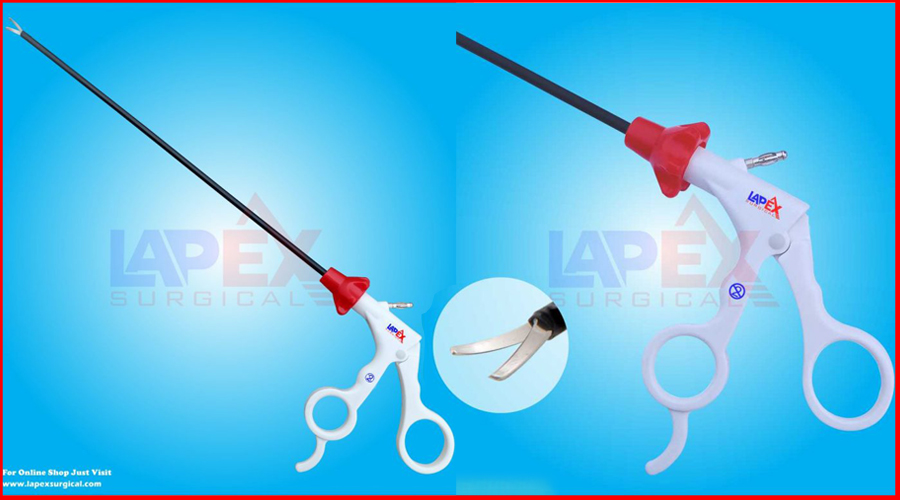
Contoured Grip and Tactile Feedback: The handle must fit naturally into the surgeon’s grip (often a ring-finger-thumb configuration). The white polymer handles shown in the product image are designed with textured, non-slip surfaces and a scientifically proven contour to reduce the necessary gripping pressure. This reduction in fatigue is crucial during long laparoscopic procedures and ensures that subtle changes in tissue resistance are instantly transmitted back to the surgeon’s hand—superior tactile feedback that is vital for preventing accidental deep cuts.
4.2. Shaft Rigidity: The 1:1 Movement Translation
The long shaft of the laparoscopic instrument acts as the conduit for power and movement. Inconsistency here destroys the FTC.
Anti-Whip Engineering: Long, slender shafts can suffer from “whip” or lateral bending, especially when force is applied to stiff tissue. This shaft instability compromises the precise closure of the jaws, often resulting in a failed cut. Lapex disposable shafts are constructed using reinforced, high-modulus materials that ensure 1:1 movement translation, meaning the slightest movement of the handle is mirrored exactly by the distal tip.
Rotational Control: The handle assembly must allow for smooth, controlled 360-degree rotation of the jaws. This rotation mechanism, designed with low-friction polymer bearings in high-quality disposables, enables the surgeon to effortlessly orient the blade angle without sacrificing the secure grip.
4.3. The Integration with Electrosurgery
Many laparoscopic procedures involve electrosurgical dissection, often requiring the scissors to be used in conjunction with a monopolar current for cutting and coagulation simultaneously.
Integrated ESU Port: High-quality disposable laparoscopic scissors feature an accessible, robust ESU port (the small terminal near the red sheath in the product image). This port must be manufactured to high standards to ensure a perfect, low-impedance connection to the ESU cable, delivering the necessary current without loss or heat buildup at the connection point.
Monopolar Scissor Function: When used as an active electrode, the guaranteed sharp edge of the disposable scissor ensures that the current density is concentrated at the point of contact, facilitating a clean, controlled electro-cutting effect with minimal lateral thermal spread (LTS). The consistency of the blade material ensures predictable impedance and performance with the ESU unit.
The Lapex Surgical Advantage—Precision from Sialkot to the OR
For decades, the name Sialkot has been synonymous with the global gold standard in surgical instrumentation. At Lapex Surgical, we honor this heritage by integrating modern engineering and material certification into every single-use device we manufacture. This commitment defines the superior quality of our Powerful Disposable Laparoscopic Scissors.
5.1. The Sialkot Heritage of Surgical Craftsmanship
The specialized skill required to produce instruments with the micron-level tolerances needed for the FTC guarantee is a product of generational expertise.
Master Artisanship: Our technicians in Sialkot apply a meticulous, detailed approach to the blade finishing and pivot assembly, processes which are often overlooked in mass-produced alternatives. This ensures that every disposable scissor leaves our facility perfectly calibrated for its single intended use.
Quality First Culture: The ethos of Sialkot manufacturing prioritizes material integrity and functional performance over volume. This is our foundation for delivering the Lapex quality promise—a product engineered not to be cheap, but to be the best possible instrument for patient safety and clinical outcome.
5.2. Material Commitment: The German-Grade Standard
Our strategic choice of raw materials is non-negotiable and provides the foundation for the FTC.
Certified Alloys: We insist on using certified German-grade stainless steel for our blade inserts. This commitment is a seal of quality, guaranteeing the metallurgical composition required for the hardest, sharpest, and most durable edge possible within the single-use category.
Precision Polymer Injection: The handles and sheathing are crafted from medical-grade, non-toxic, and robust polymers. The injection molding process is highly controlled to ensure the polymer components maintain their structural integrity and ergonomic shape, ensuring the handle actuator mechanism performs flawlessly.
5.3. Quality Assurance: A Zero-Defect Philosophy
Since a single-use instrument cannot be repaired or inspected after initial use, the quality must be built in from the ground up.
Individual Component Inspection: Every batch of blades, pivot components, and handles undergoes rigorous testing for material purity, dimensional accuracy, and tactile function before assembly.
Full Assembly Validation: Post-assembly, every Lapex Disposable Laparoscopic Scissor is checked for rotational smoothness, closure force, and full blade alignment. Only instruments that meet our zero-tolerance performance benchmarks proceed to the sterilization and packaging phase.
Sterility and Traceability: Our products are terminally sterilized (typically EO gas) and sealed in tamper-proof, medical-grade packaging with clearly marked Lot Numbers and Expiration Dates, offering complete traceability from the moment the instrument leaves our Sialkot factory to the moment it is opened in the OR.
Specialized Jaws and Selection for Surgical Excellence
Laparoscopic surgery is highly specialized, requiring instruments tailored to specific tissues and procedures. A comprehensive line of powerful disposable scissors must offer variations in jaw type, length, and diameter.
6.1. Matching the Scissor Jaw to the Clinical Task
While all specialized jaws guarantee the FTC, their geometric profile dictates their ideal surgical use:
Scissor Type (Jaw Profile) | Primary Application and Tissue Focus | Critical Design Feature |
|---|---|---|
Metzenbaum (Curved) | Fine, delicate dissection of soft tissue, vessels, and mesentery. | Long, blunt-tipped blades that minimize accidental perforation; curved profile for access. |
Hook/Miniblade | Precision cutting of small sutures, bands, or thin adhesions (hysteroscopy/arthroscopy). | Very small, fine tips that allow pinpoint control in extremely tight spaces. |
Straight/Standard | General cutting of sutures, drains, and thick, flat tissue planes (e.g., abdominal wall). | Maximizes cutting force along the entire blade length for robust transection. |
Potts-Smith/Angled | Specialized for vascular dissection and creating valvular incisions. | Jaws angled at 45° or 90° to provide clearance and visual access around tubes/vessels. |
Procurement specialists should ensure their inventory includes the necessary range of Lapex Disposable Scissors to support the full spectrum of surgical needs, from high-force general surgery to delicate plastic and pediatric cases.
6.2. Selecting the Right Length and Diameter
The shaft dimensions must be tailored to the patient and the procedure’s specific anatomical requirements.
Diameter (3mm vs. 5mm): The 3mm disposable scissor is ideal for micro-laparoscopic procedures, minimizing port trauma. The 5mm remains the standard for most general and gynecological cases, offering the greatest rigidity and cutting power.
Length (33cm vs. 45cm):
33cm: The standard for most adult, non-obese patients.
45cm (Extended Length): Absolutely essential for Bariatric Surgery and deep pelvic or thoracic procedures. The longer shaft ensures the surgeon maintains an ergonomic distance from the patient and prevents the handpiece from hitting the abdominal wall, maintaining a steady, powerful grip.
Procurement Strategies
7.1. Procurement Checklist for Guaranteed Consistency
Procuring powerful disposable laparoscopic scissors requires moving beyond simple unit price comparison and focusing on the total value of performance assurance. Use this checklist to validate your vendor choice:
FTC Assurance: Does the manufacturer explicitly guarantee the peak performance of the blade on first use?
Material Sourcing: Is the blade metal sourced from certified high-grade providers (e.g., confirmed German-grade or equivalent quality)?
Sterility Documentation: Is a current sterilization certificate (COA) provided with every lot number, guaranteeing a minimum SAL of (1/1,000,000)?
Ergonomic Trials: Have your surgeons evaluated the actuation force and tactile feedback under realistic conditions? (A lower actuation force is a direct measure of blade sharpness and leverage.)
Inventory Depth: Can the supplier (like Lapex Surgical operating from Sialkot) guarantee reliable supply of all required jaw types and lengths (33cm, 45cm) to prevent OR delays?
The Lapex Promise of Unwavering Performance
The choice of a laparoscopic scissor is a critical, yet often procedural, decision. By focusing on the First-Time Cut (FTC), surgical teams move beyond simple sterility compliance and achieve a benchmark of clinical precision that directly translates into safer, more efficient procedures.
A failed cut introduces variables: blood loss, tissue trauma, and wasted operative time. The Powerful Disposable Laparoscopic Scissors from Lapex Surgical eliminate these variables entirely. They deliver a guarantee of peak performance, pristine sharpness, and perfect alignment in every sterile package.
By choosing Lapex Surgical, you are not just selecting a single-use product; you are securing the unrivaled craftsmanship of Sialkot, the superior quality of German-grade materials, and a zero-tolerance engineering philosophy that puts the patient first. We invite you to make the shift to unwavering cutting consistency and partner with the instrument that guarantees the first cut is the only cut.
Frequently Asked Questions (FAQ)
Q1: How can a disposable scissor be "powerful" if it's made of plastic?
A: The power comes from two factors: the German-grade metal blade insert (the cutting edge) and the optimized leverage ratio of the polymer handle. The engineering of the Lapex handle maximizes the force transmitted to the jaws, meaning the disposable design provides all the necessary cutting power without the bulk of reusable metal components.
Q2: Does the sterile single-use format mean I can't use the scissors for an entire 4-hour case?
A: No. A premium disposable scissor is engineered to maintain its peak performance for the entire duration of a standard or extended surgical procedure. The term “single-use” refers to the instrument being discarded after one patient use, not after a limited time window. The guaranteed integrity ensures consistency throughout the procedure.
Q3: How do I minimize the risk of accidental cutting when using the scissors as a dissector?
A: Always use the outside, non-cutting edge of the closed jaws for blunt dissection and pushing tissue away. The guaranteed tight closure and the smooth external finish of the jaws on a Lapex Disposable Scissor minimize the risk of accidental snagging or cutting during manipulation.
Q4: Is a 5mm disposable scissor as rigid as a reusable 5mm steel scissor?
A: Yes, modern polymer technology has advanced significantly. High-modulus composite materials used in our shafts provide near-equivalent axial rigidity to metal, but with lighter weight and the critical benefit of superior, uncompromised insulation integrity. This guaranteed rigidity ensures the crucial 1:1 movement translation necessary for the FTC.