Table of Contents
TogglePeek-a-Boo, I See You: Laparoscopy Explained in a Simple, Engaging Way
Imagine needing a plumber to fix a pipe in a dark, cramped cabinet. Would you rather have them tear down the entire wall to reach the leak, or use a tiny inspection camera and specialized long tools through a small, drilled hole?
If you picked the second option, you understand the core genius of Laparoscopy.
Laparoscopy—often called keyhole surgery, minimally invasive surgery (MIS), or band-aid surgery—is the revolutionary technique that allows surgeons to perform major operations inside the abdomen and pelvis through incisions smaller than your pinky finger. Instead of a large, painful opening, patients are left with just a few small, neat scars.
This isn’t just about cosmetic appeal; it’s about faster healing, less pain, and quicker returns to life.
At Lapex Surgical, we are the engineers behind this revolution. Operating from Sialkot, the global hub of surgical craftsmanship, we manufacture the Laparoscopic instruments, Trocars, Electrosurgical Devices, and Plastic Surgery Instruments that make this precision work possible. We blend the legendary strength of German-grade stainless steel with a commitment to zero-tolerance manufacturing.
Join us on a journey inside the human body to understand the magic, the method, and the magnificent tools that allow surgeons to play “Peek-a-Boo” with organs and perform life-saving procedures.
The Laparoscopic Principle—Why Small is Better
For centuries, surgery required large incisions to give the surgeon both light and room to work with their hands. Laparoscopy flipped this concept, demonstrating that less trauma on the outside leads to better healing on the inside.
1.1. The Three Pillars of Minimally Invasive Surgery (MIS)
Laparoscopy relies on three fundamental technical steps:
1. Creating the Workspace (The Inflation)
Before a surgeon can see anything, they need room to work. The abdominal cavity (or peritoneum) is a collapsed space. To expand it, the surgeon gently introduces a harmless gas, usually Carbon Dioxide (CO2), through a specialized needle (Veress Needle) or directly through the Trocar. This process is called Pneumoperitoneum (literally “air in the belly”).
Why CO2?: It’s highly soluble in blood, meaning if any gas is absorbed, it easily dissipates through the lungs, and it is non-flammable, which is crucial when using electrosurgery tools.
2. Seeing Inside (The Laparoscope)
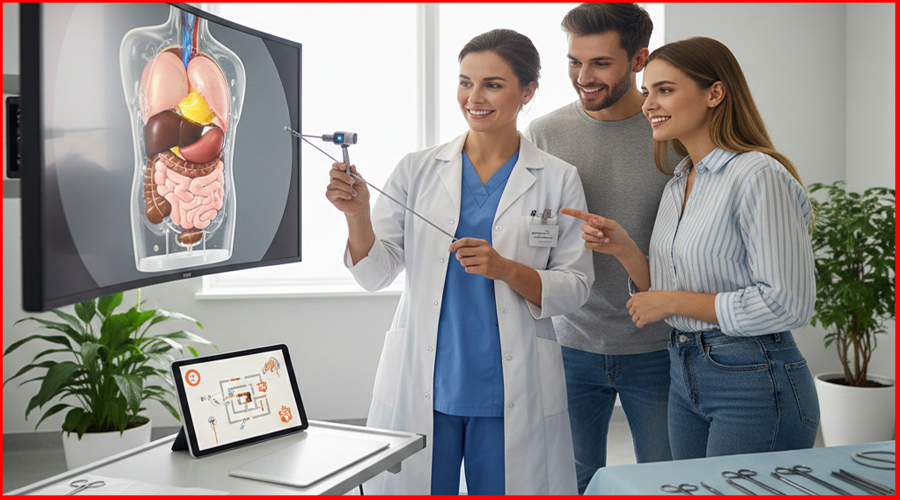
This is the “Peek-a-Boo” part. A Laparoscope is a rigid, specialized endoscope—a thin tube containing a powerful fiber-optic light source and a high-definition camera chip.
The laparoscope is inserted through the first small incision (the Port or Trocar), acting as the surgeon’s eyes inside the body. This camera projects a magnified, crystal-clear image onto a large monitor, giving the surgical team a superior, detailed view of the operative field.
3. Working Through Tubes (The Instruments)
With the internal view established, the surgeon makes two or three more small incisions (ports). Through these tiny, sealed channels, long, slender instruments—like scissors, graspers, dissectors, and specialized Lapex Surgical Bipolar Forceps—are inserted to perform the actual operation. The surgeon manipulates the handles outside the body, while the jaws and blades perform the work deep inside.
The Anatomy of a Laparoscopic System
A laparoscopic system is a coordinated orchestra of high-tech devices. At its core, the quality of the procedure is limited by the quality of the instruments passing through the wall of the abdomen.
2.1. The Critical Gatekeepers: Trocars and Ports
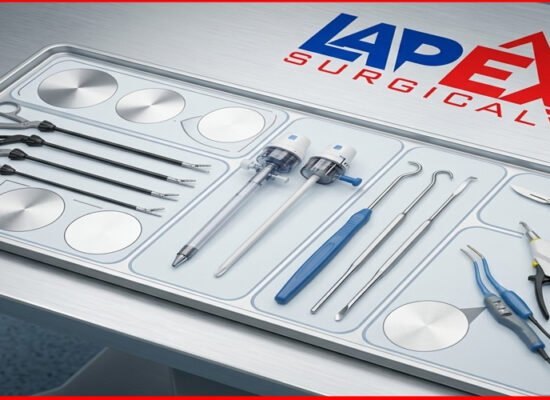
The Trocar (or Port System) is the pathway into the body. It’s a specialized tube that is inserted once, then remains to act as a sealable gateway for all the other instruments.
The Cannula: This is the hollow, fixed tube that stays in place. The quality of its material and finish is crucial for minimizing trauma to the incision site.
The Seal (Valve): This is the most complex part. It must allow instruments to pass through easily while simultaneously preventing the pressurized CO2 gas from leaking out (maintaining the pneumoperitoneum). A leak here compromises the surgeon’s view and safety.
Lapex Difference: Our Trocar and Port Systems are engineered to be friction-minimized. This precision ensures that instruments (like our Disposable Laparoscopic Scissors) can be smoothly exchanged without damaging the valve, guaranteeing minimal gas leakage and preserving the sterile field.
2.2. The Eyes: The Laparoscope and Light Source
Clarity is power in surgery. The optical chain must deliver exceptional image quality.
The Lens System: High-end laparoscopes use complex rod lens systems (like those designed by Karl Storz) or advanced digital video chips at the tip. They often provide different viewing angles (e.g., 0 degree for a direct view, 30 degree for a sweeping view) to see around structures.
The Light: A bright Xenon or LED light source is channeled down fiber-optic bundles alongside the camera. Because the working space is relatively dark, the light must be powerful, but the intensity must be controlled to prevent the risk of thermal injury if the light cable is left directly on the patient’s skin or internal organs.
2.3. The Working Hands: Slender Instruments
The core of the surgeon’s skill is translated through the instruments, which fall into several critical categories:
Instrument Type | Lapex Focus | Primary Function |
|---|---|---|
Graspers/Clamps | Precision jaw alignment, atraumatic teeth patterns. | Holding, manipulating, and retracting tissue without damage. |
Dissectors | Smooth, rounded tips for gentle separation of tissue planes. | Pushing and separating tissues to expose structures. |
Scissors (Disposable) | German-grade blades, zero-tolerance pivot. (Guaranteed First-Time Cut). | Cutting sutures, tissue, and vessels precisely. |
Suction & Irrigation | High-flow channels, easy control valve. | Clearing blood, smoke, and excess fluid to maintain visibility. |
Bipolar Forceps | Consistent electrode contact, robust insulation. | Sealing vessels and coagulating tissue using electrosurgery. |
Lapex Surgical specializes in ensuring the shaft insulation and handle ergonomics of these long instruments are flawless, guaranteeing that the force and rotation applied by the surgeon’s hand are perfectly translated to the tip deep inside the patient.
The Role of Electrosurgery—Controlling the Current
Many laparoscopic procedures involve cutting and sealing vessels simultaneously, which is achieved using electrosurgery. This is where the quality and safety of instruments become absolutely paramount.
3.1. Monopolar vs. Bipolar Energy
Electrosurgery uses high-frequency electrical current to cut tissue cleanly (a concentrated current) or coagulate (a diffuse current).
Monopolar Energy: The current flows from the active electrode (like a Lapex Surgical Spatula) through the patient’s body to a large return pad placed on the patient’s skin. It’s highly efficient for cutting but carries a higher risk of stray energy injury if the instrument insulation is poor.
Bipolar Energy: The current flows only between the two tips of the instrument (like a Lapex Bipolar Forceps). This localizes the energy, making it much safer and ideal for sealing small to medium vessels.
3.2. Why Quality Insulation is the Surgeon’s Shield
In laparoscopy, the risk of stray energy is a major concern. If the insulation on a reusable instrument degrades (due to sterilization stress or mechanical damage), the current can leak out and cause an unintended burn to adjacent bowel or organs.
Lapex Single-Use Safety: This is why our Disposable Spatulas and Disposable Laparoscopic Scissors are engineered for single-use. They leave our Sialkot facility with guaranteed, pristine insulation that has never been subjected to a sterilization cycle, offering the surgeon and patient the highest degree of safety against thermal injury.
Procedural Excellence—What Laparoscopy Has Revolutionized
Laparoscopy is no longer limited to simple diagnostic procedures; it has become the standard of care for complex surgical interventions across almost every specialty.
4.1. General Surgery and Gastrointestinal Applications
This is the bread and butter of laparoscopy, demonstrating its superiority in common procedures:
Cholecystectomy (Gallbladder Removal): A routine procedure often done through three or four tiny ports. Recovery is typically a few days, compared to a week or more for open surgery.
Appendectomy (Appendix Removal): Quickly and safely performed, minimizing the risk of infection often associated with open appendectomy.
Hernia Repair (Inguinal/Ventral): Laparoscopic approaches often allow for bilateral repair (both sides) through the same ports and are favored for recurrent hernias.
4.2. Gynecology and Urology
Laparoscopy is foundational in women’s health and urinary tract surgery:
Hysterectomy (Uterus Removal): Often performed laparoscopically, leading to drastically reduced hospital stays and less post-operative pain.
Ectopic Pregnancy Surgery: Allows for precise removal of the affected tissue with minimal blood loss.
Nephrectomy (Kidney Removal): Laparoscopy is the standard for both donor and diseased kidney removal, showcasing the ability of MIS to handle large, deep organs.
4.3. The Rise of Single-Port Surgery
The latest evolution of MIS is Single-Port Laparoscopy (SPL). Instead of 3-4 small incisions, the entire procedure is performed through one single incision, usually hidden in the belly button (umbilicus).
The Challenge: The instruments all enter through one crowded port, making them constantly clash (“fencing”).
The Lapex Solution: SPL requires specialized, articulating, or pre-bent instruments to overcome this fencing. The high quality and rigid control of our standard long instruments are essential, allowing surgeons to adapt their technique even in the most crowded single-port environments.
Patient Benefits and Recovery—The Real Difference
The most compelling argument for laparoscopy is the dramatic improvement in the patient experience compared to traditional open surgery.
5.1. Faster, Less Painful Recovery
The key difference lies in the management of the abdominal wall. A large incision cuts through muscle, fascia, and nerve endings, requiring weeks for full healing.
Benefit | Traditional Open Surgery | Laparoscopic Surgery (MIS) |
|---|---|---|
Post-Operative Pain | Significant, often requiring strong opioid medications. | Minimal, managed with over-the-counter or mild prescription pain relief. |
Hospital Stay | Typically 3–7 days (depending on procedure). | Often 1–2 days (outpatient or overnight observation). |
Return to Activity | Restricted heavy lifting/driving for 4–8 weeks. | Restricted for 1–2 weeks; often back to light work within days. |
Scarring | Large, often unsightly midline or transverse scar. | 2–4 tiny, easily hidden scars (the “keyholes”). |
Hernia Risk | Higher risk of Incisional Hernia at the large scar site. | Significantly lower risk, as incisions are smaller than the trocar port. |
5.2. Technical Challenges for the Surgeon
While patients benefit, the technique demands exceptional skill and concentration from the surgical team.
Loss of Tactile Sensation: The long instruments translate tactile feedback poorly compared to a hand directly touching tissue. Surgeons must rely heavily on visual cues and the subtle resistance felt through the handles (which makes the high quality of Lapex instruments critical).
2D to 3D Translation: Many systems display the view in 2D, forcing the surgeon to mentally reconstruct the depth and spatial relationships (though 3D systems are becoming more common).
Fulcrum Effect: Because the instrument is fixed at the abdominal wall (the port), the movement inside the body is the reverse of the movement outside. Surgeons must train extensively to internalize this counter-intuitive effect.
The Lapex Surgical Commitment—Manufacturing the Future of MIS
Our mission at Lapex Surgical is to eliminate the “fear factor” of minimally invasive surgery by guaranteeing the reliability of every instrument. This mission is rooted in our location, our materials, and our precise engineering process.
6.1. Why Sialkot is the Global Benchmark
The city of Sialkot has a history spanning over a century in surgical instrument manufacturing. This is not just industrial production; it is an art form passed down through generations.
Generational Expertise: The skill required to polish, hone, and assemble the delicate jaws of a Laparoscopic Dissector or a Bipolar Forceps is unique to this region. This expertise ensures that every hinge is smooth, every blade is perfectly aligned, and every insulating sheath is flawlessly applied.
Global Quality Standards: We couple this traditional skill with modern quality control (ISO 13485) and use computerized numerical control (CNC) machining to achieve tolerances that are impossible by hand alone, creating instruments that meet or exceed German-grade standards.
6.2. The Material Guarantee: German-Grade Precision
The long life and consistent performance of our instruments start with the metal. We use certified AISI 420 and similar alloys for all our reusable Surgical and Plastic Surgery Instruments, as well as the working tips of our Laparoscopic line.
Strength and Flexibility: This material offers the optimal balance of rigidity (for the long laparoscopic shaft) and durability (for the hinged jaws and blades).
Corrosion Resistance: It provides superior resistance to corrosion from blood, saline, and the harsh chemical environments of modern sterilization processes, ensuring our reusable instruments maintain their integrity for years.
6.3. Instruments That Make the Difference
Our comprehensive line covers every facet of the laparoscopic procedure, ensuring consistency from the first incision to the final stitch:
High-Flow Suction & Irrigation Devices: Designed with wide internal lumens and ergonomic control valves for rapid fluid and smoke clearance, providing the “Peek-a-Boo” clarity needed for safety.
Powerful Disposable Scissors: Featuring a zero-tolerance pivot and German-grade cutting inserts, guaranteeing the crucial First-Time Cut (FTC) on every single use.
Advanced Bipolar Forceps: Engineered for perfect, consistent electrode contact and robust insulation, allowing for reliable vessel sealing and coagulation.
Plastic Surgery Instruments (e.g., Dermatomes): While not laparoscopic, the same Sialkot expertise is applied to ensure our specialized instruments, like our Dermatomes (for skin grafting), provide the same level of precision, demonstrating our holistic commitment to surgical excellence.
Clarity and Confidence in Every Procedure
Laparoscopy, the medical equivalent of playing “Peek-a-Boo” with internal organs, is a triumph of engineering and human skill. It transforms major, invasive operations into rapid, low-trauma procedures, offering patients better outcomes and faster healing.
This complexity is only achievable through uncompromising precision in the instruments used. Every time a surgeon makes a delicate cut, seals a vital vessel, or clears the surgical field, they rely on the certainty that their instrument will perform flawlessly.
At Lapex Surgical, we are proud to stand at this intersection of quality and innovation. From the German-grade materials forged in Sialkot’s legendary craftsmanship to the ergonomic handles and zero-tolerance pivots of our Laparoscopic, Electrosurgical, and General Surgical Instruments, we supply the tools that make the “Peek-a-Boo” possible, safe, and successful.
Choose Lapex Surgical to equip your operating room with instruments that guarantee surgical confidence and clarity.
FAQs: Demystifying Laparoscopy for Patients and Professionals
Q1: Will I feel pain during the procedure?
A: No. Laparoscopic surgery is performed under general anesthesia, meaning you will be fully asleep and feel no pain. Some patients may experience shoulder pain after waking up, which is harmless CO2 gas irritating the diaphragm. This quickly dissipates.
Q2: Is Laparoscopy always an option?
A: No. While it’s used for most procedures, certain conditions may require open surgery. This includes extensive scar tissue from prior operations (adhesions) or a need for a large surgical field to manage extensive cancer or severe trauma. The surgeon will determine the best approach.
Q3: How big are the incisions?
A: Typically, they are between 5 millimeters (the “keyhole”) and 12 millimeters (to accommodate larger ports or remove tissue specimens). They are usually closed with a single dissolvable suture or surgical glue.
Q4: How does Lapex ensure the long-term integrity of reusable laparoscopic instruments?
A: We ensure longevity through multi-stage passivation of the German-grade steel. This process creates a stable, protective chromium-oxide layer that resists corrosion from repeated saline exposure and high-heat sterilization. This is vital for instruments like reusable Graspers and Dissectors to maintain their fine tolerances.
Q5: What is the primary safety risk associated with Trocars?
A: The main risk is during the initial insertion (Trocar placement), specifically the accidental perforation of a blood vessel or the bowel if the technique is not precise. This is why Lapex manufactures safety Trocars with mechanisms that shield the blade once the abdominal wall is penetrated.
Q6: What Lapex instrument is crucial for maintaining vision during heavy bleeding?
A: Our High-Flow Laparoscopic Suction & Irrigation Devices are critical. Their wide bore and optimized valve design allow for the rapid, high-volume aspiration necessary to clear large clots and active bleeding, quickly restoring the surgical view.