The Definitive Guide to Inspecting Laparoscopic Scissors for Sharpness and Tension
In the high-stakes environment of the operating theater, the difference between a seamless dissection and a surgical complication often rests on a few millimeters of stainless steel. For laparoscopic surgeons, the tactile feedback of a pair of scissors is their primary connection to the patient’s internal anatomy.
At Lapex Surgical, based in the world’s surgical manufacturing hub of Sialkot, we understand that a laparoscopic instrument is only as good as its last inspection. Whether you are a Sterile Processing Technician (CST) or a Lead Surgeon, understanding the nuances of sharpness and tension is vital for instrument longevity and patient safety.
1. Why Inspection is Non-Negotiable
Laparoscopic scissors, especially the Metzenbaum and Hook varieties, undergo significant stress during minimally invasive procedures. Unlike open surgery tools, these instruments are long, thin, and rely on complex mechanical linkages.
The Risks of Improper Inspection:
- Tissue Trauma: Dull blades “chew” rather than cut, leading to jagged edges and slower healing.
- Electrosurgical Leaks: Small nicks in the insulation (often missed during a quick glance) can lead to stray current burns.
- Surgeon Fatigue: High-tension handles require more hand force, leading to cramping during long cases.
2. Preparation: The Inspection Environment
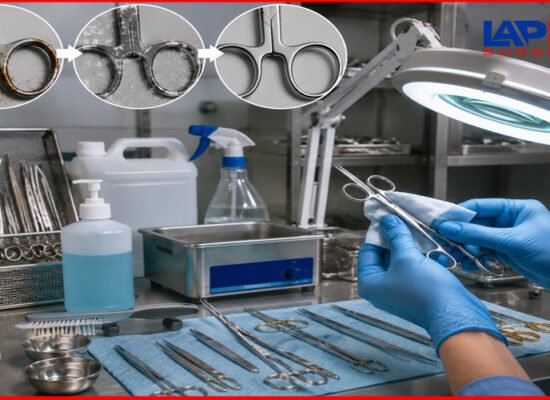
Before testing for sharpness, the instrument must be meticulously cleaned and checked for structural integrity.
The Pre-Check Checklist
- Cleanliness: Ensure no bioburden remains in the box lock or the distal tip.
- Insulation Integrity: Use a lap-tester to ensure the heat-shrink tubing is free of micro-cracks.
- Straightness: Roll the shaft on a flat surface; if it wobbles, the shaft is bent and must be decommissioned.
3. Mastering the Sharpness Test
How do you know if a blade is truly “surgical grade” sharp? At Lapex Surgical, we recommend the Standard Red/Yellow Test Material Method.
Testing Materials
| Material Type | Instrument Type | Performance Expectation |
|---|---|---|
| Red Latex-Free Band | Large Scissors (>5mm) | Must cut cleanly through the tip without snagging. |
| Yellow Latex-Free Band | Micro/Fine Scissors | Effortless glide through 3-4 consecutive snips. |
| Two-Ply Tissue | Universal Test | No “grabbing” or tearing of the fibers. |
The “Snip and Pull” Technique
- The Initial Cut: Open the scissors and place the test material at the distal third of the blade (near the tip).
- The Closing: Close the blades slowly. You should feel a smooth “vibration-free” motion.
- The Pull: Once the blades are closed, gently pull the test material. If the material slides out, the blades are “overlapping” or “bowed,” meaning they are failing to grip the tissue.
4. Evaluating Mechanical Tension
Tension is the “feel” of the instrument. It is determined by the screw or rivet that joins the two blades.
The Gravity Drop Test (The Gold Standard)
This is the most effective way to test if the tension is too loose or too tight:
- Hold the instrument by one handle so the scissors are vertical.
- Open the other handle fully so the blades are at a 90-degree angle.
- Let go of the handle.
- The Result:
- Optimal: The handle should fall halfway and stop.
- Too Loose: The handle falls completely shut (danger of tissue slipping).
- Too Tight: The handle does not move at all (danger of surgeon hand fatigue).
5. Identifying Common Defect Patterns
As a manufacturer, Lapex Surgical identifies four primary defects that occur over the lifecycle of a laparoscopic scissor:
A. “The Burred Edge”
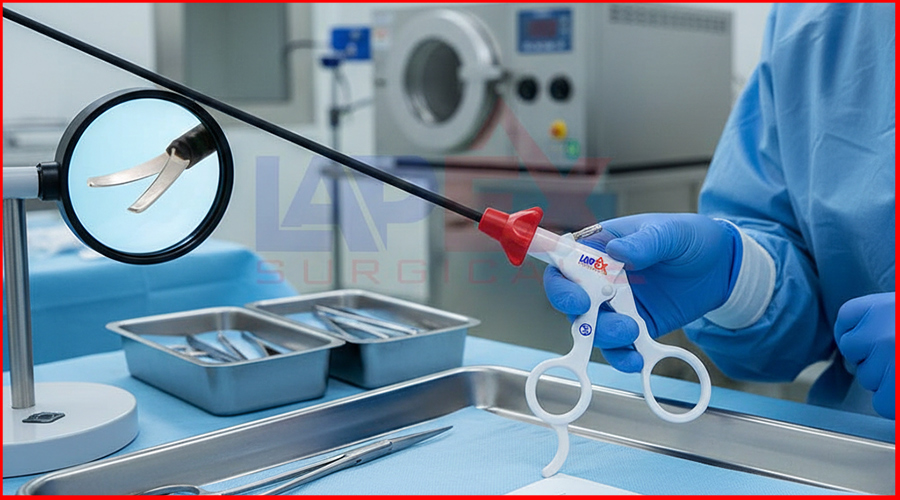
Caused by contact with metal (like surgical staples). You will see tiny jagged notches under a 10x magnifier.
- Fix: Professional regrinding.
B. “Blade Overlap”
When the tips of the scissors bypass each other rather than meeting flush. This usually indicates a bent pivot pin.
- Fix: Immediate replacement or factory recalibration.
C. “Pitting”
Small holes on the surface of the stainless steel caused by improper pH in the cleaning solution.
- Fix: Improve sterilization protocols; pitting cannot be “polished out” without compromising the blade’s strength.
6. Comparison: Disposable vs. Reusable Scissors
Lapex Surgical specializes in high-durability reusable instruments, but it is important to understand the market landscape.
| Feature | Lapex Reusable Scissors | Standard Disposable |
|---|---|---|
| Cutting Precision | High (Hand-honed in Sialkot) | Moderate (Stamped steel) |
| Long-term Cost | Low (Pay once, maintain often) | High (Recurring cost) |
| Environmental Impact | Low Waste | High Plastic Waste |
| Tension Stability | Adjustable | Fixed (often gets loose) |
7. The Lapex Advantage: Sialkot Craftsmanship
Why does the origin of your instrument matter? Sialkot, Pakistan, is responsible for over 70% of the world’s surgical instruments. At Lapex Surgical, we combine this traditional blacksmithing heritage with modern CNC machining.
Each pair of our laparoscopic scissors undergoes a triple-stage honing process:
- Rough Grind: Setting the bevel angle.
- Oil Stone Honing: Smoothing the cutting surface.
- Diamond Polish: Creating a friction-less glide.
8. Frequently Asked Questions (FAQ)
Q1: How often should laparoscopic scissors be sharpened?
A: This depends on usage, but for a high-volume facility, a professional sharpening every 30-50 cases is recommended. However, daily inspection via the red-band test is mandatory.
Q2: Can I sharpen laparoscopic scissors in-house?
A: We strongly advise against it. Laparoscopic blades have a specific “arc” or “radius.” Manual sharpening by untrained staff can flatten the blade, rendering the instrument useless.
Q3: Why do my scissors feel “crunchy” when opening?
A: This is usually due to “stiff-joint” syndrome caused by dried proteins or mineral deposits in the box lock. Use a surgical-grade lubricant (instrument milk) after every cleaning cycle.
Q4: Does the insulation affect the tension?
A: Yes. If the insulation is applied too tightly or too far down the neck of the instrument, it can restrict the pivot point.
9. Maintenance Pro-Tips for Longevity
- Neutral pH Only: Always use cleaning agents with a pH between 7.0 and 8.5.
- Avoid Ultrasonic Overload: Do not “pile” instruments in the ultrasonic cleaner; the vibration can cause the scissor blades to dull by hitting other metal tools.
- Use Tip Protectors: During sterilization and transport, use vented tip protectors to prevent the blades from knocking against the tray.
10. Excellence in Every Cut
In the world of laparoscopic surgery, there is no room for “good enough.” A dull pair of scissors is a liability. By implementing the inspection techniques outlined above—testing for sharpness with latex-free bands and checking tension with the gravity drop test—you ensure that your surgical team is equipped for success.
At Lapex Surgical, we are proud to carry forward the Sialkot legacy of precision. Our instruments are designed to hold their edge longer and maintain their tension under the most rigorous conditions.
👉 Are your instruments up to the task? Contact Lapex Surgical today for a consultation on high-performance laparoscopic solutions.