
Table of Contents
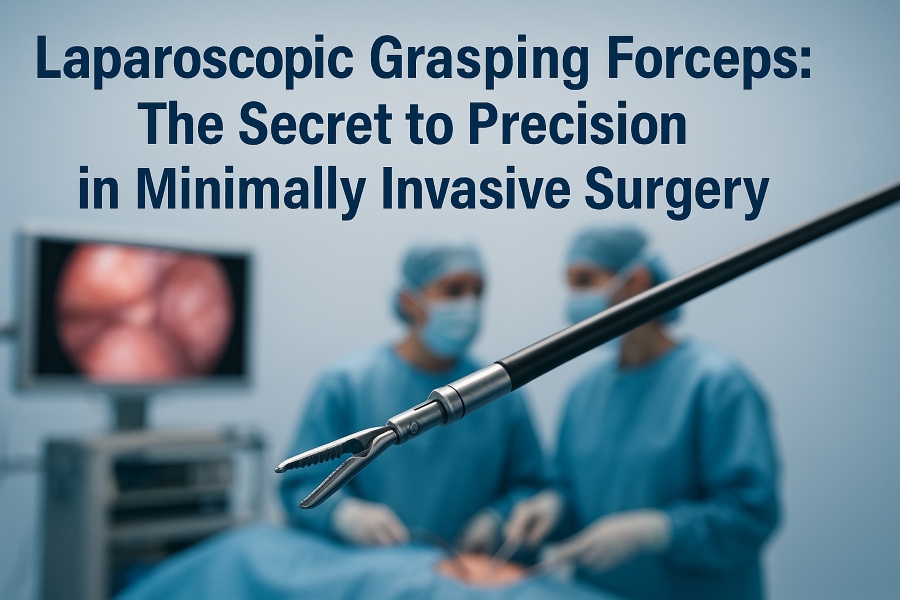
ToggleLaparoscopic Grasping Forceps: The Secret to Precision in Minimally Invasive Surgery
Minimally invasive surgery (MIS), commonly known as laparoscopic surgery, has revolutionized healthcare, offering patients reduced pain, smaller scars, and faster recovery times compared to traditional open procedures. This surgical paradigm shift is built on the ability of surgeons to operate through small incisions, guided by a video camera and long, slender instruments. The success of this intricate dance within the human body hinges on one critical element: precision. Without direct tactile feedback and operating in a magnified, often 2D visual field, achieving this level of accuracy is a formidable challenge.
Enter the Laparoscopic Grasping Forceps – the unsung heroes and indispensable extensions of the surgeon’s hands. These versatile instruments are the primary tools for manipulating, retracting, dissecting, and holding tissue within the confined operative space. They are, in essence, the “secret to precision” in minimally invasive surgery. This article aims to reveal that secret by providing a comprehensive guide to understanding and mastering these crucial instruments. We will explore their diverse types, discover proven techniques for their precise use, and outline critical strategies to enhance patient safety and optimize surgical outcomes. Mastering Laparoscopic Grasping Forceps is not just about skill; it’s about unlocking the full potential of MIS.
The Foundation of MIS: What Are Laparoscopic Grasping Forceps?
At their core, Laparoscopic Grasping Forceps are sophisticated surgical tools designed to replicate the functions of a surgeon’s fingers and hands inside the body. They are inserted through small ports (trocars) in the abdominal wall, allowing access to the internal organs and tissues without the need for large incisions.
Each laparoscopic grasper typically comprises three main parts:
- The Jaws or Tips: These are the working ends of the instrument. They come in an astonishing variety of shapes, sizes, and internal surface designs (serrated, smooth, fenestrated, toothed), each specifically tailored for interacting with different types of tissue, from the most delicate bowel to tough fascia. This diversity is the first step in achieving precision minimally invasive surgery.
- The Shaft: A long, slender tube, typically 5mm or 10mm in diameter and varying in length (e.g., 30cm, 33cm, 45cm) to accommodate different patient anatomies and surgical depths. The shaft often includes an insulation layer, especially if the instrument is designed to be used with electrocautery. A rotation knob near the handle allows the surgeon to rotate the jaws 360 degrees inside the body.
- The Handle or Finger Rings: This is the external part held by the surgeon. It typically features finger rings or a pistol-grip design, often with a locking mechanism (ratchet) to maintain a grip on tissue without continuous finger pressure. The ergonomic design of the handle is vital for surgeon comfort and control during long cases, directly impacting precision, minimally invasive surgery.
The true challenge and the “secret to precision” lie in how laparoscopic grasping forceps are manipulated. Surgeons must translate complex three-dimensional hand movements into precise, scaled-down actions performed through a long, rigid shaft, while relying on a two-dimensional video image and significantly reduced tactile feedback. This demands an extraordinary level of skill, focus, and intimate knowledge of the instruments.
Unlocking the “Secret”: Types of Laparoscopic Grasping Forceps and Their Precision Applications
The first step in unveiling the “secret to precision” in minimally invasive surgery is to understand that no single Laparoscopic Grasping Forceps is a universal tool. Each type is designed with specific characteristics that make it uniquely suited for particular tasks. Choosing the right instrument for the right job is paramount to performing precision minimally invasive surgery and minimizing the risk of inadvertent tissue damage.
By Jaw Design: The Foundation of Tissue Interaction
The design of the grasper’s jaws is the most critical factor, dictating how it holds and interacts with tissue.
Atraumatic Grasping Forceps:
- Description: These forceps are characterized by jaws that are smooth, blunt, or have very fine, non-crushing serrations. Many feature a fenestrated (windowed) design, which means there are openings within the jaws.
- Precision Application: Their primary purpose is to hold or retract delicate structures such as the bowel, bladder, stomach, omentum, or major blood vessels without causing trauma, crushing, or tearing. The fenestrated design allows for even pressure distribution, reducing the risk of localized injury, and permits fluids to drain, preventing tissue tenting. Using an atraumatic grasper is foundational for precision minimally invasive surgery when handling vital or fragile organs.
- Examples:
- Babcock Grasper: Distinctive broad, fenestrated, and non-crushing jaws that create a gentle, circular grip when closed. Ideal for holding tubular structures like the bowel, appendix, or fallopian tubes.
- DeBakey Grasper: Features long, fine, non-fenestrated longitudinal serrations. Known for its extremely gentle, yet secure, grip on vascular tissue, making it indispensable for delicate dissection around vessels or fine tissue handling.
- Aggressive Atraumtic Grasper: A newer category that offers a slightly more secure, yet still atraumatic, grip for thicker but still delicate tissues, balancing security with safety.
Traumatic / Toothed Grasping Forceps:
- Description: These forceps are equipped with sharp teeth or prominent, coarse serrations on their jaws.
- Precision Application: Designed for securing a very firm grip on dense, fibrous tissue, fascia, or large specimens (e.g., resected organs) that are being removed from the body. Their teeth provide a non-slip grip, essential when significant traction or strong manipulation is required.
- Critical Safety Note: These forceps must be used with extreme caution and NEVER on delicate organs, bowel, blood vessels, or other vital structures. Their improper use is a direct pathway to significant surgical errors, making their precise application critical. Their “precision” lies in their ability to securely hold specific robust tissues without slipping, rather than in their gentleness.
- Examples: Alligator Forceps (with distinct, sharp teeth), some heavy tissue grasping forceps.
Fenestrated vs. Non-Fenestrated:
- Fenestrated: The “windows” or openings in the jaws offer a gentler grip by distributing pressure more evenly and allowing visibility of the grasped tissue.
- Non-Fenestrated: Solid jaws provide continuous surface contact, often preferred for blunt dissection, pushing tissue, or for grasping very thin layers.
By Function and Specialization: Precision for Specific Tasks
Many Laparoscopic Grasping Forceps are also classified by their primary functional role.
- Dissecting Forceps (e.g., Maryland Dissector):
- Description: A ubiquitous and indispensable tool, often featuring curved, blunt tips with fine serrations. Many are monopolar compatible, allowing them to be connected to an electrosurgical unit for simultaneous cutting and sealing of tissue (cautery).
- Precision Application: The workhorse for blunt and sharp dissection, meticulously separating tissue planes, creating windows, and isolating structures. The curved tip allows for precise “hooking” and manipulation in tight spaces. Its versatility and ability to combine mechanical dissection with energy make it central to precision minimally invasive surgery.
- Retraction Forceps:
- Description: A broad category with various jaw designs (e.g., paddles, fenestrated curves, or even fan-shaped retractors) aimed at gently but effectively holding organs or tissue out of the way to expose the surgical field.
- Precision Application: Essential for maintaining a clear and stable view, preventing surrounding structures from obstructing the surgical site or being inadvertently injured. Proper retraction is a key component of precision minimally invasive surgery.
- Biopsy Forceps:
- Description: Smaller, often disposable forceps with sharp, cup-shaped, or punch-like jaws at the tip.
- Precision Application: Used to obtain small, precise tissue samples for pathological examination with minimal collateral damage to the surrounding healthy tissue.
The “secret to precision” truly begins with the intellectual and practical choice of the perfect Laparoscopic Grasping Forceps for each specific tissue type and surgical maneuver. This informed decision-making process is the first, most critical step in ensuring precision, minimally invasive surgery.
Mastering Precision with Laparoscopic Grasping Forceps: Proven Techniques
Understanding the tools is only half the battle; the true “secret to precision” in minimally invasive surgery lies in the surgeon’s masterful application of these instruments. These proven techniques are critical for developing fluid, accurate, and safe manipulation.
The Grasping Golden Rule: Visualize, Then Act:
- Never grasp or manipulate tissue if you cannot fully visualize the tips of your Laparoscopic Grasping Forceps and the tissue they are interacting with. If the tips go out of view, stop all movement immediately, reposition the camera, or withdraw and re-insert the instrument until clear visualization is re-established. Blind grasping is a primary cause of surgical errors. This is the absolute cornerstone of precision minimally invasive surgery.
Ergonomics and Developing “Haptic Feedback”:
- Optimal Posture: Ensure your operating table height, monitor position, and personal posture are optimally aligned to minimize fatigue and maximize comfort. Sustained awkward postures compromise fine motor control.
- The “Feel”: Although direct tactile feedback is lost, experienced laparoscopic surgeons develop a subtle “feel” for tissue consistency and tension through the instrument’s handle. This pseudo-haptic feedback is learned through extensive practice. Pay attention to how the instrument resists, bends, or vibrates.
- Handle Choice: Experiment with different handle designs (finger rings, pistol grip) to find what provides the best balance of comfort, control, and ability to transfer subtle “feel” back to your hand.
The Principle of Counter-Traction:
- This is fundamental for all laparoscopic dissection and manipulation, leading to precision, minimally invasive surgery.
- Mechanism: One Laparoscopic Grasping Forceps is used to provide steady traction (pulling or lifting) on the tissue, while the other instrument (often another grasper or an energy device) performs the dissection or cutting.
- Benefit: Counter-traction creates tension in the tissue, exposing natural tissue planes, making dissection cleaner, safer, and faster. It prevents tissues from “rolling away” and significantly reduces the risk of inadvertently cutting or damaging adjacent structures.
Mastering the Fulcrum Effect:
- The trocar site acts as a fulcrum. Movements of the instrument handle outside the body are magnified and reversed at the working tip inside the body.
- Compensation: A small movement of the handle to the left will result in a larger movement of the tip to the right. Practice compensating for this, learning to make small, deliberate movements with the handle to achieve precise, scaled-down movements at the tip. This skill is vital for precision, minimally invasive surgery.
Grasping Angle and Jaw Orientation:
- Tissue Type: For delicate tissue, orient the jaws parallel to blood vessels to avoid shearing them. For stronger retraction, orient perpendicular to the desired line of pull.
- Optimal Bite: Take appropriately sized tissue bites. Too large a bite can be cumbersome and traumatic; too small may slip.
- Rotation: Utilize the instrument’s rotation knob to orient the jaws optimally for grasping, dissection, or retraction, avoiding awkward wrist positions.
Controlled Force Application:
- Without direct touch, it’s easy to apply excessive force. Learn to apply just enough pressure with your Laparoscopic Grasping Forceps to secure the tissue without crushing it.
- Simulator Practice: Use box trainers or virtual reality simulators with force feedback (if available) to develop an intuitive understanding of appropriate grasping pressure for different tissue densities. Over-gripping leads to tissue damage and prolongs surgery.
“Walking” the Tissue:
- For extensive dissection or mobilization of an organ, use a technique of small, sequential, controlled grasps to gently “walk” the tissue along the desired plane, rather than attempting one large, forceful, potentially damaging grasp. This method embodies precision, minimally invasive surgery.
Camera Synchronization:
- The surgeon’s hands and the camera’s view must be perfectly synchronized. The working tips of the Laparoscopic Grasping Forceps should always remain centered and in focus on the monitor. Clear communication with the camera assistant (or mastering solo camera control) is fundamental. If the tips are out of view, the risk of surgical errors skyrockets.
Judicious Use of Energy Devices with Graspers:
- Many dissecting graspers are designed to deliver monopolar or bipolar energy. When using these, understand the zone of thermal spread and always ensure the energy application is precise and away from vital structures. Inspect the instrument’s insulation meticulously before use.
Consistent, Deliberate Practice:
- Mastery of Laparoscopic Grasping Forceps is an ongoing process. Regular, focused practice, especially on simulators (box trainers, VR) or in cadaver labs, is essential for developing muscle memory, refining hand-eye coordination, and internalizing the principles of precision minimally invasive surgery.
Avoiding Surgical Errors with Laparoscopic Grasping Forceps: A Safety Protocol
Even with the highest precision, minimally invasive surgery carries inherent risks. Adhering to a stringent safety protocol when using Laparoscopic Grasping Forceps is crucial to prevent complications and surgical errors.
- Absolute Tissue Identification: This cannot be overstressed. Before any grasp, manipulation, or application of energy, unequivocally identify the tissue. Misidentification leading to grasping or cutting unintended structures (e.g., bowel, ureter, major vessel) is a devastating surgical error. Use the grasper to gently palpate, retract, and expose the anatomy.
- Instrument Inspection: Before every single case, and even during the procedure if an issue is suspected, meticulously inspect your Laparoscopic Grasping Forceps. Look for:
- Bent shafts or jaws.
- Cracks or corrosion, especially in hinges or near the working tip.
- Integrity of insulation if the instrument is energy-compatible (a critical safety check to prevent stray current burns).
- Proper alignment of jaws and smooth operation of the grasping and rotation mechanisms. A faulty instrument is a direct pathway to surgical errors.
- No Blind Sweeping or Probing: Never sweep or probe with the instrument tips if they are not fully visualized on the monitor. This can cause unseen perforations or tears. Always maintain visual control.
- Controlled Entry and Exit: Insert and withdraw Laparoscopic Grasping Forceps smoothly and deliberately, especially through crowded fields. Avoid sudden jerks that can snag or tear tissue at the port site or within the abdominal cavity. Ensure jaws are closed or nearly closed upon withdrawal.
- Avoid “Fencing”: Be aware of the spatial orientation of instruments outside the body. Excessive crossing or “fencing” of instrument shafts can lead to awkward internal angles, reduced control, and potential instrument entanglement.
- Manage Surgical Field: Ensure the surgical field is consistently clear of smoke, blood, or irrigation fluid. Use suction and irrigation effectively. A clear view is paramount for precision, minimally invasive surgery.
- Surgeon Fatigue Management: Recognize that physical and mental fatigue can compromise precision, minimally invasive surgery, and increase the risk of surgical errors. Maintain ergonomic posture, take short breaks if possible during long cases, and ensure adequate rest before surgery.
- Team Communication: Maintain clear and concise communication with your scrub nurse and surgical assistant regarding instrument needs, tissue identification, and any concerns. A well-coordinated team enhances safety and efficiency.
Instrument Care and Maintenance: Sustaining Precision
The long-term performance and reliability of Laparoscopic Grasping Forceps, which are central to precision minimally invasive surgery, depend significantly on diligent care and maintenance. This also directly impacts the Cost-effectiveness of Laparoscopic Instruments.
- Immediate Post-Operative Cleaning: As soon as a procedure concludes, wipe down instruments to remove gross blood and tissue. Ideally, soak them in an enzymatic solution to prevent organic material from drying and adhering to surfaces. This initial step makes subsequent cleaning much easier and more effective.
- Thorough Cleaning and Disinfection: Follow manufacturer’s instructions for manual or automated cleaning (e.g., in ultrasonic cleaners or washer-disinfectors). Pay meticulous attention to the jaws, serrations, and hinge mechanisms where debris can accumulate. Use appropriate brushes and solutions, avoiding abrasive materials that can scratch surfaces or compromise insulation.
- Regular Inspection by SPD: Trained personnel in the Sterile Processing Department (SPD) must perform a detailed inspection of each Laparoscopic Grasping Forceps before and after sterilization. They check for:
- Bent shafts, jaws, or damaged tips.
- Cracks, corrosion, or pitting, especially in the hinge area or where the shaft meets the jaws.
- Integrity of the insulation sheath of the instrument is energy-compatible; even tiny breaks can cause thermal injury.
- Proper alignment and closure of the jaws; no light should show through when closed.
- Smooth operation of the grasping, locking, and rotation mechanisms.
- Appropriate Sterilization: Ensure instruments are sterilized according to validated protocols (e.g., steam sterilization/autoclaving). Lumens and hinged areas must be properly flushed and presented for effective sterilization.
- Protective Storage: Store Laparoscopic Grasping Forceps in dedicated instrument trays with silicone mats or individual compartments to prevent them from hitting other instruments, which can cause subtle damage to their delicate tips and alignment.
- Professional Servicing: Schedule regular preventative maintenance and repair with certified surgical instrument repair specialists. They can sharpen dull jaws, realign bent instruments, and perform in-depth inspections that extend the lifespan and maintain the precision of these valuable tools.
Conceptual Comparison Table: Laparoscopic Grasping Forceps
To facilitate quick decision-making and optimal selection, here’s a conceptual framework for a comparison table of common Laparoscopic Grasping Forceps types. Such a tool helps surgeons choose the right instrument to achieve precision, minimally invasive surgery.
| Grasper Type | Jaw Features (Design, Surface, Fenestration) | Primary Use | Key Advantage for Precision | Best Use Scenario |
|---|---|---|---|---|
| Babcock | Broad, fenestrated, atraumatic, circular jaws | Holding delicate tubular structures (bowel, appendix) | Gentle, non-crushing grip; even pressure distribution | Retracting the bowel or fallopian tubes without trauma |
| DeBakey | Long, fine, non-fenestrated longitudinal serrations | Gentle grasping of vessels, fine tissue handling | Excellent for delicate vascular tissue; minimal slippage | Dissecting around major blood vessels, fine tissue manipulation |
| Maryland Dissector | Curved, blunt tip, fine serrations, often monopolar compatible | Blunt/sharp dissection, creating planes, cautery | Versatile, precise for separating tissues; combines functions | Dissecting fascia, separating organs, cauterizing small vessels |
| Alligator | Small, sharp teeth, strong spring | Securely grasping dense fibrous tissue, large specimens | Very firm, non-slip grip on robust tissue | Retrieving resected specimens, grasping tough adhesions |
| Crile/Kelly Forceps | Straight/curved jaws, horizontal serrations, non-fenestrated | General grasping, clamping of small vessels | Versatile general-purpose grip | Retracting muscle, clamping non-critical vessels (laparoscopic equivalent) |
| Right-Angle Dissector | Right-angle bend at tip, fine, blunt/serrated jaw | Dissection around structures, vessel isolation | Access to difficult angles, precise isolation of structures | Dissecting behind the kidney/prostate, isolating ducts/vessels |
The “secret to precision” in minimally invasive surgery lies not in magic, but in the meticulous understanding and masterful application of Laparoscopic Grasping Forceps. These indispensable tools are the surgeon’s direct link to the patient’s internal anatomy, enabling intricate maneuvers through tiny incisions. Achieving precision minimally invasive surgery is a continuous journey that demands informed instrument selection, adherence to ergonomic principles, and the development of refined two-handed techniques.
By mastering the subtleties of different grasper types, consistently applying principles of counter-traction and controlled force, and maintaining unwavering focus on visual cues, surgeons can significantly elevate their performance. Crucially, the unwavering commitment to safety protocols – including rigorous instrument inspection and vigilant tissue identification – is paramount to preventing surgical errors. Ultimately, through dedicated practice and a profound respect for these remarkable instruments, surgeons can truly unlock the full potential of Laparoscopic Grasping Forceps, leading to optimal patient outcomes and advancing the art of minimally invasive surgery.
For more information, feel free to contact the Lapex Surgical support team.