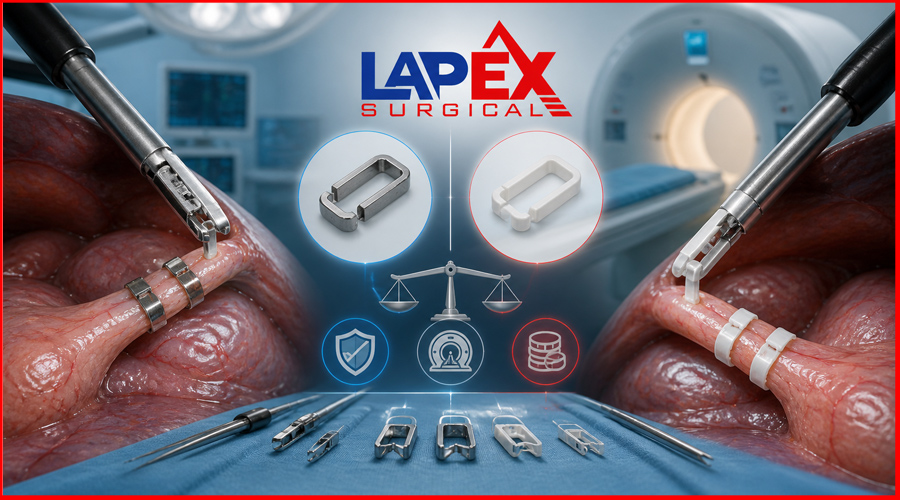
Titanium vs. Polymer: Choosing the Right Surgical Clips for Modern Laparoscopy
In the high-stakes environment of a modern operating theater, the smallest components often carry the greatest responsibility. Among these, surgical clips—the silent sentinels of hemostasis—play a pivotal role in the success of laparoscopic procedures. Whether it is a routine cholecystectomy or a complex nephrectomy, the choice of ligation material can influence patient recovery, imaging clarity, and overall surgical efficiency.
As a premier manufacturer of laparoscopic instruments based in Sialkot, Lapex Surgical understands that surgeons and procurement officers face a critical debate: Titanium vs. Polymer. This article provides an exhaustive analysis of these two materials, helping you make an informed decision for your facility.
1. The Evolution of Ligation in Laparoscopy
Before we dive into the material science, it is essential to understand the journey of the surgical clip. Traditionally, silk sutures were the gold standard. However, the advent of minimally invasive surgery (MIS) necessitated a faster, more reliable method to occlude vessels and ducts within narrow working spaces.
The introduction of the metal “hemostatic clip” revolutionized surgery. Today, the choice has expanded into advanced alloys and high-tech polymers, each offering distinct advantages in mechanical grip, biocompatibility, and radiopacity.
2. Titanium Surgical Clips: The Proven Industry Standard
Titanium has long been the “workhorse” of the surgical world. At Lapex Surgical, our titanium clips are engineered from medical-grade, commercially pure titanium, ensuring maximum biocompatibility.
Key Advantages of Titanium
- Mechanical Integrity: Titanium offers a high strength-to-weight ratio. Once applied with a Lapex precision applier, the clip maintains a constant pressure that is vital for thick-walled vessels.
- Biocompatibility: Being non-toxic and resistant to corrosion by body fluids, titanium is rarely rejected by the immune system.
- MRI Safety: While metal, titanium is non-ferromagnetic. This means patients with titanium clips can safely undergo MRI scans, though some “artifacting” (blurring) may occur in the image.
- Cost-Effectiveness: Generally, titanium clips offer a lower price point per unit compared to advanced polymer locking systems, making them ideal for high-volume hospital settings.
The “Cold Weld” Effect
One unique feature of high-quality titanium surgical clips is the “cold weld” or friction-fit within the applier. Lapex Surgical’s clips are designed with internal serrations that “bite” into the tissue, preventing the clip from sliding off the vessel—a common concern in high-pressure arterial ligation.
3. Polymer Ligating Clips: The Modern Alternative
Polymer clips, often referred to as “locking clips,” represent the next generation of ligation technology. Made from advanced plastics like Acetal or specialized non-absorbable polymers, these clips offer features that metal simply cannot match.
Key Advantages of Polymer
- Integrated Locking Mechanism: Most polymer clips feature a “click” or tactile feedback system. This locking bridge ensures the clip cannot open once applied, providing an extra layer of security.
- Zero Imaging Interference: Unlike titanium, polymers are “radiolucent.” They do not produce artifacts on CT scans or MRIs. This is critical in oncology cases where post-operative monitoring of a tumor site is required.
- 360-Degree Grip: Polymer clips are often designed to surround the vessel before locking, distributing pressure more evenly than the “V-shape” closure of a metal clip.
- Color Coding: Polymer systems usually come in distinct colors (e.g., Purple, Gold, Green) to represent different sizes (Medium, Medium-Large, Large), reducing the risk of error in the OR.
4. Head-to-Head Comparison: Titanium vs. Polymer
To help procurement teams at hospitals and surgical centers, we have synthesized the technical data into a comparative framework.
Table 1: Technical Specifications Comparison
| Feature | Titanium Surgical Clips | Polymer Locking Clips |
|---|---|---|
| Material | Commercially Pure Titanium | Non-absorbable Polymer |
| Closure Type | Permanent Deformation (V-Shape) | Positive Locking Latch |
| MRI/CT Scans | Minor artifacts/blurring | Completely transparent (No artifacts) |
| Tactile Feedback | Felt through the applier resistance | Audible/Sensory “Click” |
| Vessel Range | Ideal for smaller to medium vessels | Excellent for large, high-pressure vessels |
| Slippage Risk | Low (if serrated) | Near Zero (due to locking bridge) |
| Cost | Budget-friendly | Premium |
5. Clinical Applications: Which One Where?
The decision often comes down to the specific procedure. At Lapex Surgical, we supply instruments for both, but here is how surgeons typically divide their usage:
When to Choose Titanium:
- General Hemostasis: For small “bleeder” vessels where a quick, inexpensive solution is needed.
- Cardiovascular Surgery: Titanium’s long-term stability and thin profile are often preferred in delicate vascular work.
- High-Volume Clinics: Where cost-per-procedure is a primary KPI (Key Performance Indicator).
When to Choose Polymer:
- Laparoscopic Cholecystectomy: Used for the cystic duct and cystic artery to ensure no leakage under pressure.
- Radical Prostatectomy/Nephrectomy: In cases where post-op imaging is frequent, the radiolucency of the polymer is a significant medical advantage.
- Appendectomy: Locking clips provide superior security on the appendiceal base.
6. The Lapex Surgical Manufacturing Edge
Why source your surgical clips and laparoscopic instruments from Lapex Surgical in Sialkot? Our manufacturing process combines traditional craftsmanship with modern CNC technology.
- Precision Engineering: Our clips are calibrated to micron-level tolerances. A clip is only as good as its applier; therefore, we manufacture both to ensure a perfect “match-fit.”
- Quality Control: Every batch undergoes rigorous stress testing. We simulate vessel pressure to ensure our clips exceed standard physiological demands.
- Global Compliance: We adhere to international medical standards, ensuring that our products are ready for the European, American, and Asian markets.
- Customization: As a direct manufacturer, we can offer private labeling and custom packaging for distributors looking to build their own brand identity.
7. Troubleshooting and Best Practices in the OR
Even the best surgical clips can fail if applied incorrectly. Here are three professional tips for OR staff:
- Tip 1: Applier Alignment. Always ensure the applier jaws are perpendicular to the vessel. An angled application can lead to “scissoring” of the clip.
- Tip 2: Tissue Overlap. The vessel or duct should occupy no more than 2/3 of the clip’s length. If the tissue is too thick, the clip may not close or lock correctly.
- Tip 3: Instrument Maintenance. At Lapex, we recommend regular inspection of the applier jaws. Debris or misalignment in the applier can cause titanium clips to drop or polymer clips to fail to “click.”
8. Frequently Asked Questions (FAQ)
Q1: Are titanium surgical clips permanent?
Ans: Yes. Titanium clips are non-absorbable and intended to remain in the body indefinitely. They are encapsulated by fibrous tissue over time and rarely cause issues.
Q2: Do surgical clips set off airport metal detectors?
Ans: Generally, no. The mass of a single or even multiple titanium clips is usually too small to trigger standard walk-through metal detectors.
Q3: Can polymer clips be used in robotic surgery?
Ans: Absolutely. Many robotic platforms use polymer locking clips for their reliability and ease of visualization under high-definition cameras.
Q4: Is there a difference in the “learning curve” for these clips?
Ans: Polymer clips often have a shorter learning curve because the audible “click” confirms a successful ligation, whereas titanium requires the surgeon to feel the tension of the metal deforming.
Q5: How does Lapex Surgical ensure the sterility of its clips?
Ans: Our clips are typically provided in sterile cartridges, color-coded by size, and processed using Gamma radiation or EO gas sterilization according to international protocols.
9. The Verdict for 2026 and Beyond
There is no “one-size-fits-all” answer in the Titanium vs. Polymer debate. Titanium surgical clips remain the gold standard for versatility and value. However, the superior security and imaging compatibility of Polymer clips make them the preferred choice for complex, high-pressure ligations and oncology cases.
At Lapex Surgical, we don’t just sell instruments; we provide the reliability that surgeons need to save lives. Whether you are looking to upgrade your hospital’s inventory or seeking a reliable manufacturing partner in Sialkot, we offer the precision-engineered solutions your team deserves.
👉 Contact Lapex Surgical today to request a sample of our Laparoscopic Clip Appliers and Surgical Clips. Experience the Sialkot manufacturing excellence firsthand.