Predicting the Next Decade of Laparoscopic Instrument Innovation
The surgical landscape is on the cusp of a “Digital Renaissance.” Over the last thirty years, laparoscopy moved from a niche technique to the gold standard. However, as we look toward the next decade, the focus is shifting from simple mechanical access to intelligent intervention.
At Lapex Surgical, based in the manufacturing hub of Sialkot, we are not just observing these changes; we are engineering the tools that will define them. This article explores the technological trajectories that will reshape the operating theater between now and 2035.
1. The Rise of “Smart” Instruments (Embedded Sensors)
In the coming decade, the “dumb” stainless steel grasper will become a relic of the past. Future Lapex instruments will likely incorporate haptic feedback sensors and tissue characterization technology.
Force-Sensing Technology
One of the primary risks in laparoscopy is “unintentional tissue trauma” due to the lack of tactile feedback. The next generation of Lapex graspers will feature micro-strain gauges. These sensors will relay real-time data to the surgeon, perhaps via haptic vibrations in the handle or a visual “pressure gauge” on the monitor, indicating exactly how much Newton force is being applied to delicate structures like the bowel or ureter.
Smart Electrosurgery
Electrosurgical units (ESU) will evolve from constant-voltage devices to AI-driven energy delivery systems. Future Lapex Electrosurgical tools will sense tissue impedance in microseconds, automatically adjusting the current to prevent lateral thermal spread—ensuring that only the intended target is cauterized while preserving adjacent healthy tissue.
2. Materials Science: Beyond Stainless Steel
While German-grade stainless steel remains the backbone of our current catalog, the next decade will see the integration of Shape Memory Alloys (SMAs) and Bio-inert Polymers.
Nitinol and Articulating Tips
Nitinol (Nickel-Titanium) allows for instruments that can “remember” shapes. We predict a surge in “snake-like” laparoscopic tools that can navigate around organs, providing angles of approach that are currently impossible with rigid 5mm or 10mm shafts.
Comparison of Current vs. Future Instrument Materials
| Feature | Current Standard (Stainless Steel) | Future Innovation (Alloys & Composites) |
|---|---|---|
| Flexibility | Rigid / Fixed | Variable / Articulating (SMA) |
| Weight | Standard | Ultra-lightweight Carbon Composites |
| Durability | High | High + Self-Diagnostic (Sensors) |
| Bio-compatibility | Excellent | Enhanced (Anti-microbial coatings) |
| Conductivity | Requires Insulation | Integral “Smart” Insulation |
3. The Miniaturization Frontier: 3mm and Beyond
The push for “scarless” surgery is driving the transition from standard 5mm laparoscopy to Microlaparoscopy (3mm instruments).
At Lapex Surgical, our R&D is focused on maintaining the mechanical strength of a 5mm tool within a 3mm profile. The next decade will see:
- High-Tensile Strength Micro-Graspers: Allowing for complex cholecystectomies through ports so small they require only an adhesive strip rather than a suture.
- Needlescopic Innovations: Instruments so thin they can be inserted directly through the skin without a formal trocar site, significantly reducing post-operative pain.
4. AI-Integrated Surgery and Computer Vision
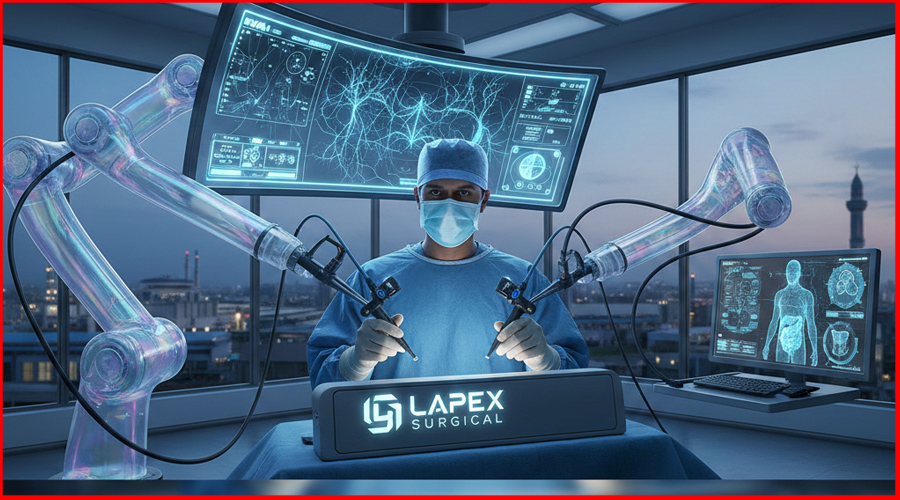
The laparoscopic camera is no longer just a lens; it is an eye. In the next ten years, the “Lapex Intelligent Vision System” could provide real-time overlays (Augmented Reality) during surgery.
AI Decision Support
Imagine a monitor that highlights the “Safe Zone of Dissection” in green and the “Danger Zone” (near the Common Bile Duct) in red. By analyzing thousands of hours of surgical footage, AI integrated with laparoscopic hardware will provide real-time risk assessments to the surgeon, effectively acting as a digital co-pilot.
5. Ergonomics: The Surgeon-Centric Design
Surgeon burnout and musculoskeletal injuries are at an all-time high. The next decade of Lapex design will prioritize neuro-ergonomics.
- Custom-Molded Handles: Using 3D scanning to create instrument handles tailored to a specific surgeon’s hand size.
- Wireless Power: Removing the “spaghetti” of cords in the OR. We anticipate the development of battery-powered, cordless electrosurgical pencils and laparoscopic dissectors that communicate wirelessly with the generator.
6. Sustainability and the “Circular” Surgical Economy
The environmental impact of single-use plastics in the OR is under intense scrutiny. The next decade will see a pivot back to High-Performance Reusables.
Lapex Surgical is committed to the “Green OR” initiative. We are developing:
- Modular Instruments: Where the handle and shaft are permanent (reusable), and only the tiny mechanical tip is replaceable.
- Advanced Sterilization-Ready Polymers: Materials that can withstand 2,000+ autoclave cycles without degrading in performance or aesthetic quality.
7. Frequently Asked Questions (FAQ)
Q1: Will robotic surgery replace traditional laparoscopy in the next 10 years?
While robotics will grow, traditional laparoscopy will remain dominant in global markets due to cost-effectiveness and speed. However, “Hybrid” tools—manual instruments with robotic-like articulation—will bridge the gap.
Q2: How is Lapex Surgical preparing for the AI revolution?
We are collaborating with software engineers to ensure our mechanical tools can interface with digital platforms, focusing on “data-ready” instruments that track usage and performance metrics.
Q3: What is the biggest challenge in instrument innovation?
The “Safety vs. Complexity” trade-off. As we add sensors and electronics, maintaining the ease of sterilization and mechanical reliability is our primary focus.
Q4: Will Sialkot remain a leader in this high-tech future?
Yes. Sialkot’s strength lies in its ability to combine traditional craftsmanship with rapid industrial adoption. Lapex is leading this by investing in CNC machining and laser-welding technologies.
Q5: Are 3D-printed instruments the future?
3D printing is excellent for prototyping and custom handles, but for the high-stress components of a laparoscopic grasper, forged and precision-machined steel still offers superior safety profiles.
8. Strategic Roadmap: 2026 to 2035
- 2026-2027: Universal adoption of articulating tips in manual laparoscopy.
- 2028-2030: Integration of basic haptic sensors into premium Lapex tool lines.
- 2031-2035: Full AI integration, where instruments “talk” to the OR ecosystem to optimize patient safety.
The Lapex Vision
The next decade will prove that the instrument is not just a tool, but a source of data. At Lapex Surgical, our mission is to ensure that surgeons in the year 2035 have instruments that are lighter, smarter, and more intuitive than anything available today.
By marrying the centuries-old metalworking heritage of Sialkot with the cutting-edge requirements of modern medical science, we are ensuring that the “Lapex” name remains synonymous with the pinnacle of surgical achievement. The future of laparoscopy is not just about seeing better—it’s about feeling, knowing, and performing better.
Stay ahead of the curve. Explore the future of surgical precision at LapexSurgical.com.