Managing Bioburden: The Definitive Guide to Pre-cleaning Protocols for Trocars and Lumens
In the high-stakes environment of the operating theater, the lifespan of a surgical instrument and the safety of a patient are determined long before the autoclave cycle begins. For manufacturers like Lapex Surgical, based in the heart of Sialkot’s surgical industry, we don’t just create tools; we create precision instruments designed for decontamination success.
The most significant threat to this success is Bioburden—the degree of microbial contamination on an object before sterilization. When dealing with complex laparoscopic tools like trocars and narrow-diameter lumens, managing bioburden is not just a cleaning step; it is a clinical necessity.
1. Understanding Bioburden: The Invisible Enemy
Bioburden consists of blood, body fluids, tissue, and microorganisms that adhere to instrument surfaces during surgery. If these materials are allowed to dry, they form a Biofilm—a protective “shield” for bacteria that is nearly impossible to penetrate with standard sterilization gases or steam.
Why Trocars and Lumens are High-Risk
- Geometric Complexity: Trocars have valves, seals, and stopcocks that trap debris.
- The “Lumen” Challenge: Long, narrow tubes (lumens) prevent visual inspection of the internal surface.
- Material Interaction: Protein-rich bioburden can cause “pitting” corrosion on stainless steel if left too long.
2. The Lapex Surgical “Point-of-Use” Protocol
The battle against bioburden begins in the surgical field, not the sterile processing department (SPD). At Lapex Surgical, we engineer our instruments to be robust, but their longevity depends on immediate post-operative care.
Step-by-Step Pre-cleaning at the Field:
- Wiping: Immediately wipe the external surfaces of trocars and laparoscopic shafts with a lint-free sponge soaked in sterile water (not saline, as salt causes corrosion).
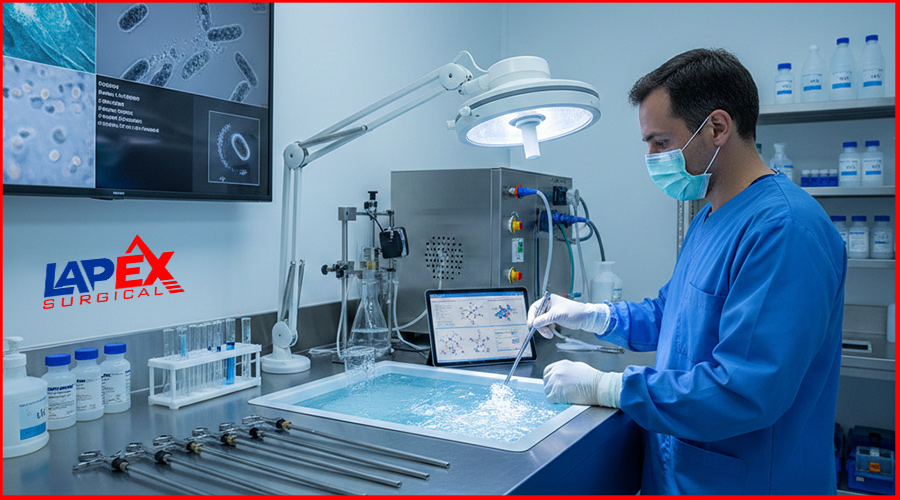
- Flushing: Use a syringe to flush lumens with sterile water to prevent blood from clotting inside the tube.
- The “Pre-Treat” Spray: Apply a multi-enzymatic spray or foam. These “humectants” keep the bioburden moist during transport to the decontamination area.
3. Technical Comparison: Cleaning Methods for Complex Portals
| Protocol Phase | Trocar Assemblies | Long Lumens (33cm+) |
|---|---|---|
| Disassembly | Must remove all valves and gaskets. | Use modular handles (Lapex design) for access. |
| Mechanical Action | Soft-bristled brushes for stopcock threads. | Pull-through brushes matched to the internal diameter. |
| Enzymatic Soak | 5–10 minutes in neutral pH solution. | Full immersion; ensure no air bubbles are trapped inside. |
| Ultrasound | Effective for removing debris from hinges. | Requires specialized “Irrigated Ultrasonic” cleaners. |
4. The Science of Biofilm Prevention in Sialkot Engineering
At Lapex Surgical, our manufacturing process in Sialkot includes a critical step called Electropolishing. By creating a microscopically smooth surface on the interior of our lumens, we reduce the “mechanical grip” that bioburden has on the steel.
Why this matters for your facility:
- Easier cleaning cycles.
- Lower risk of protein adhesion.
- Extended instrument life (reduced oxidation).
5. Specialized Pre-cleaning for Electrosurgical Instruments
As a manufacturer of electrosurgical tools, Lapex Surgical emphasizes that these instruments require unique bioburden management. The “char” or “eschar” (burnt tissue) that builds up on cautery tips is a concentrated form of bioburden.
- Avoid Abrasives: Never use metal files or harsh scrubbers to remove char. This creates scratches where bacteria can hide.
- Tip Cleaners: Use specialized abrasive-free pads or “scorch sponges” during surgery.
- Insulation Check: During pre-cleaning, always inspect the insulation sleeve for cracks where bioburden could be forced under the coating.
6. Frequently Asked Questions (FAQ)
Q1: Why can’t I use saline to rinse my trocars?
A: Saline (Sodium Chloride) is the primary enemy of surgical-grade stainless steel. It leads to “Pitting Corrosion,” which creates microscopic holes that act as permanent reservoirs for bioburden. Always use sterile water or enzymatic solutions.
Q2: How do I know if the inside of a 3mm lumen is actually clean?
A: Since you cannot see inside, you must rely on Validated Cleaning Indicators or borescope inspections. If a borescope is unavailable, the “White Cloth Test” (pushing a clean white pipe cleaner through) can act as a manual check.
Q3: Is “Pre-cleaning” the same as “Disinfection”?
A: No. Pre-cleaning is the physical removal of soil. You cannot disinfect or sterilize a “dirty” instrument. If a single speck of blood remains, the microbes underneath it can survive the autoclave.
Q4: How often should I replace the seals on my Lapex Trocars?
A: Seals are high-wear components. We recommend inspection after every cleaning. If the seal is cracked or hardened, bioburden can leak into the housing, making the device uncleanable.
7. The Role of Water Quality in Bioburden Management
The water used in your pre-cleaning sinks is as important as the detergent.
- Hard Water: Leads to mineral scale, which shields bacteria.
- Deionized/RO Water: Ideal for the final rinse of lumens to ensure no residues are left behind.
8. Common Errors in Lumen Maintenance
- Using the wrong brush size: If the brush is too small, it won’t touch the walls. If it’s too large, it can get stuck or scratch the interior.
- Failure to disassemble: Cleaning a trocar without removing the valve is the #1 cause of cross-contamination in laparoscopic surgery.
- Skip-flushing: Assuming the ultrasonic bath will “reach” the middle of a long lumen without active irrigation.
9. Quality Manufacturing Meets Quality Care
Bioburden management is a partnership between the manufacturer and the clinician. At Lapex Surgical, we provide world-class engineering—using high-grade Sialkot steel and precision machining—to ensure our instruments are capable of being cleaned to the highest standards.
By following these pre-cleaning protocols for trocars and lumens, your facility can ensure patient safety, reduce the cost of instrument repair, and maintain the peak performance that Lapex Surgical tools are known for.