
Table of Contents
ToggleUrology Laparoscopic Instruments: A Detailed Overview
Urology is the branch of medicine that deals with the urinary tract system (kidneys, ureters, bladder, urethra) and, in men, the reproductive organs. Many urological conditions that once required large incisions are now treated using minimally invasive laparoscopic surgery. This means smaller cuts, less pain, and faster recovery for patients. The ability to perform these complex procedures minimally invasively relies entirely on specialized tools. This article provides a detailed overview of the essential Urology Laparoscopic Instruments that allow surgeons to precisely operate on organs like the kidneys, prostate, and bladder through tiny openings.
Why Laparoscopy in Urology?
The shift to laparoscopy has brought significant benefits to urological surgery. Procedures like removing a kidney (nephrectomy), removing the prostate (prostatectomy), or repairing a blockage in the kidney’s drainage system (pyeloplasty) can now be done with less trauma. This is possible because Urology Laparoscopic Instruments allow surgeons to:
- See a magnified view inside the body on a screen.
- Work in tight spaces, particularly in the deep pelvis (important for prostate surgery) or around the kidneys, high in the abdomen.
- Handle delicate structures like blood vessels and nerves carefully.
These advantages highlight the critical role of Urology Laparoscopic Instruments.
Essential Urology Laparoscopic Instruments
While many laparoscopic instruments are used across different surgical fields, certain types or features are particularly important in urology due to the specific anatomy and procedures involved. Here’s a look at the key Urology Laparoscopic Instruments:
Urology Laparoscopic Instruments for Access: Trocars and Cannulas.
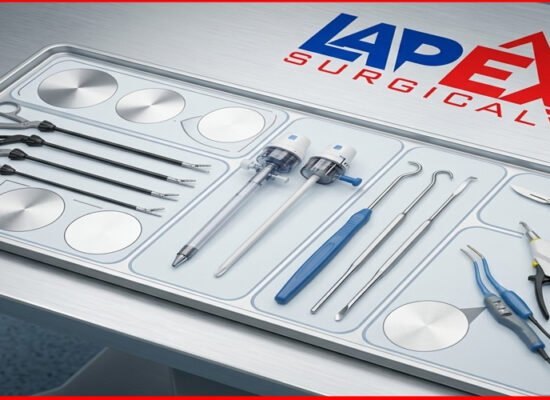
These are the first instruments used, creating the small ports through the skin and abdominal wall to enter the surgical space. Trocars come in various sizes (diameters) and lengths. In urology, different sizes might be needed for other procedures or to accommodate larger instruments like staplers.
Urology Laparoscopic Instruments for Visualization:
Laparoscopes (Cameras) are the surgeon’s eyes inside the body. A laparoscope is a telescope with a camera attached inserted through a trocar. High-definition (HD) or 4K cameras provide clear, detailed images on a monitor, which is crucial when working near delicate structures like the nerves important for function after prostate surgery or identifying small blood vessels around the kidney.
Grasping & Manipulating: Graspers and Forceps
These are used to hold, move, and manipulate tissues or organs. In urology, specialized graspers with atraumatic jaws are often preferred to handle delicate kidney tissue or the bladder without causing damage. Others with stronger grips might be used for thicker tissues.
Cutting & Dissecting: Scissors and Energy Devices.
Precise cutting and separation of tissues are vital. Laparoscopic scissors (straight or curved) are used for sharp dissection. Energy devices, such as harmonic scalpels (using ultrasound) or bipolar cautery (using electricity), are commonly used to cut tissue and seal blood vessels at the same time, helping to minimize bleeding around organs like the kidney or prostate.
Retraction:
Retractors‘ instruments are used to hold surrounding organs (like bowel or bladder) out of the way to provide a clear view of the structures being operated on (like the kidney or prostate). Specialized laparoscopic retractors are designed for gentle but effective retraction in often confined spaces.
Suturing & Ligation:
Needle Holders, Clip Appliers, Suturing Devices. Many urological laparoscopic procedures, especially prostatectomy or reconstructing the urinary tract (like in pyeloplasty), require placing stitches (suturing) or applying clips to close vessels and ducts. Needle holders are essential for guiding needles. Clip applicators are used to place small surgical clips (often titanium) to seal blood vessels or the cystic duct during surgery that involves the bladder or structures nearby. Automated suturing devices can help speed up the process of connecting tissues.
Suction & Irrigation
Tools that allow the surgeon to wash the surgical area with saline (irrigation) and remove fluids, blood, or debris (suction) to keep the view clear on the monitor.
Specialized Urology Instruments:
Beyond these general types, urology laparoscopic surgery may use tools with specific shapes or functions, such as specialized dissectors designed for working in the narrow pelvic space during prostate removal, or certain forceps designed for handling kidney stones if encountered laparoscopically.
Instruments in Action: Examples in Urology Procedures
Understanding the tools is easier when you see their role in specific operations:
- Laparoscopic Nephrectomy (Kidney Removal): Requires robust graspers to handle the kidney, energy devices and clip appliers for sealing the renal artery and vein, scissors for dissection, and often specific retractors to hold the liver or bowel out of the way. The specimen retrieval bag is vital for removing the kidney through a small incision.
- Laparoscopic Prostatectomy (Prostate Removal): This pelvic surgery requires long instruments to reach deep into the pelvis. Fine dissectors and energy devices are used to carefully separate the prostate from surrounding structures, preserving nerves if possible. Precise needle holders and suturing devices are crucial for reconnecting the bladder to the urethra.
- Laparoscopic Pyeloplasty (Repairing Kidney Drainage): Involves intricate dissection and precise suturing to repair the connection between the kidney and the ureter. This heavily relies on fine graspers, sharp scissors, or energy devices for dissection, and high-quality needle holders for creating a watertight connection.
The Importance of High-Quality Instruments in Urology Laparoscopy
Due to the delicate nature of urological organs (kidney, bladder, prostate) and the confined spaces surgeons often work in, the quality and reliability of Urology Laparoscopic Instruments are paramount. High-quality instruments offer the necessary precision, smooth function, and durability to allow the surgeon to perform complex maneuvers safely and effectively, contributing to better patient outcomes and fewer complications.
Urology Laparoscopic Instruments are a sophisticated set of tools that have revolutionized how many urological conditions are treated. From the initial access gained with trocars to the fine dissection, grasping, cutting, and suturing performed deep within the body, each instrument plays a vital role. A detailed overview of these urological surgical tools highlights their importance in enabling minimally invasive approaches for procedures on the kidneys, bladder, prostate, and more, ultimately benefiting patient recovery and well-being in modern laparoscopic urology.