
Understanding the Bipolar Forceps in Modern Hemostasis: A Precision Guide for the Modern Surgeon
The evolution of electrosurgery has moved steadily toward one goal: maximum efficacy with minimum collateral damage. While traditional monopolar systems remain the “workhorses” of general surgery, bipolar technology has emerged as the gold standard for precision hemostasis. At Lapex Surgical, based in the global manufacturing heart of Sialkot, we blend a century of artisanal metalworking heritage with cutting-edge electrosurgical engineering to produce bipolar instruments that act as a true extension of the surgeon’s hand.
1. The Core Mechanism: Precision Through Localized Energy
Bipolar forceps are specialized electrosurgical instruments designed for localized tissue electrocautery and hemostasis. Their primary advantage lies in the architecture of their electrical circuit.
The Closed-Loop Circuit
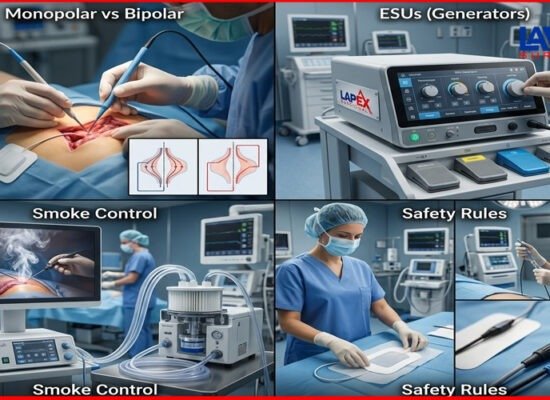
In a bipolar system, the electric current is released and returned through the two precisely aligned tips of the forceps. Unlike monopolar systems, where current must travel from an active electrode through the patient’s entire body to reach a grounding pad, the bipolar current path is restricted solely to the tissue grasped between the tines.
Thermal Control and Safety
Because the current is confined, heat generation is concentrated exactly where the surgeon intends. This significantly reduces the risk of:
- Stray Current Injuries: Unintended current pathways that can damage distant organs.
- Capacitive Coupling: The accidental induction of current into other metal instruments, such as a laparoscope.
- Lateral Thermal Spread: The “bleeding” of heat into surrounding healthy tissue, which is particularly dangerous when operating near sensitive nerves or major vessels.
2. Bipolar vs. Monopolar: The Technical Advantage
While monopolar tools are prized for their ability to cut through large tissue masses, bipolar forceps offer superior safety and performance in specialized environments.
Operation in Wet Fields
A common frustration in surgery is the failure of electrosurgery in the presence of blood or saline. Bipolar energy operates efficiently in fluid environments. In fact, bipolar current can work under water, whereas monopolar current often causes surrounding liquids to boil or disperse energy before it reaches the bleeding vessel.
Safety for Implanted Devices and Pacemakers
Because current does not flow through the patient’s body, bipolar forceps are significantly safer for patients with metal implants, cardiac pacemakers, or implanted cardioverter-defibrillators (ICDs). This eliminates the risk of the electrosurgical unit (ESU) causing a short circuit or “misfire” of the life-saving device.
Table 1: Technical Comparison—Bipolar vs. Monopolar Electrosurgery
| Feature | Monopolar Electrosurgery | Bipolar Electrosurgery |
| Current Flow | Through the patient to the grounding pad | Confined between instrument tips |
| Grounding Pad | Required | Not Required |
| Thermal Spread | Significant (200 Degree C + in fulguration) | Minimal (Concentrated at tips) |
| Wet Field Use | Inefficient (Fluid boiling) | High Efficacy |
| Primary Use | Large-scale cutting/coagulation | Precise, localized hemostasis |
| Patient Risk | Potential for site burns | Minimal risk of stray burns |
3. Material Science and Non-Stick Technologies
One of the greatest challenges in electrosurgical hemostasis is “charring.” As tissue desiccates, it can adhere to the forceps tips. When the surgeon removes the instrument, the adhered tissue (eschar) can be avulsed, leading to frustrating re-bleeding.
Silver, Gold, and Titanium Tips
To combat sticking, premium manufacturers like Lapex Surgical utilize specialized materials:
- Solid Sterling Silver: Silver has the highest thermal conductivity of any metal. It dissipates heat across the tips so rapidly that tissue is less likely to reach the “sticking point”. To ensure durability, Lapex often uses silver alloys reinforced with copper for added strength.
- Gold-Plating: Gold is chemically inert and offers superior wetting tension. Research shows that gold-plated tips adhere to significantly less protein coagulum compared to stainless steel or titanium.
- Titanium: Prized for being lightweight and non-magnetic, titanium is ideal for MRI-compatible surgical environments. While it has lower thermal conductivity than silver, it is highly resistant to corrosion and offers an excellent tactile feel.
Advanced Non-Stick Coatings
Modern instruments may also feature proprietary ceramic or polymer-based non-stick coatings. These coatings reduce friction and facilitate easy cleaning during long procedures, ensuring the surgeon doesn’t have to repeatedly pause to scrape the tips with a sponge.
4. Anatomy of High-Performance Bipolar Forceps
A precision instrument is more than just two pieces of metal. It is a masterpiece of engineering.
High-Grade Insulation
The tines of the forceps must be perfectly insulated to prevent current leakage. Lapex Surgical invests in advanced biocompatible insulation materials that can withstand hundreds of steam sterilization cycles (134°C) without cracking or degrading. Insulation failure is a critical safety risk, as it can lead to accidental thermal burns on the patient’s skin or internal organs.
Ergonomic Handles and Tactile Feedback
Laparoscopic procedures often require surgeons to maintain static postures for hours.
- Axial (In-line) Handles: These are ideal for fine rotation and manipulation, common in neurosurgery and suturing.
- Pistol Grip Handles: Preferred for tasks requiring high force, such as heavy grasping or vessel sealing, to reduce wrist strain and the risk of thenar neuropathy.
Integrated Irrigation
Specialized “saline-linked” bipolar models feature integrated irrigation channels. These channels deliver a constant mist of saline directly to the tips, which:
- Reduces the temperature of the tips.
- Minimizes charring and eschar adhesion.
- Maintains a clean, visible operative field.
5. Advanced Vessel Sealing and Protein Denaturation
Modern bipolar devices have evolved beyond simple coagulation into sophisticated vessel-sealing platforms.
The Fusion Process: Collagen and Elastin
Unlike traditional cautery, which merely creates a “plug” of charred blood, advanced bipolar systems use a combination of high pressure and radiofrequency energy to denature the collagen and elastin within the vessel walls.
- Grasp: The vessel is compressed between the jaws.
- Energy Delivery: The system monitors tissue impedance in real-time.
- Cross-Linking: As the proteins cool, they re-form and cross-link, creating a permanent, translucent seal.
Performance Benchmarks
These advanced seals can withstand supra-physiologic burst pressures—often more than 300 mmHg—making them as secure as traditional surgical clips or ligatures for vessels up to 7mm in diameter.
6. Critical Specialty Applications
The requirements for hemostasis vary significantly across surgical disciplines:
- Neurosurgery: In the brain and spinal cord, even a 1mm lateral thermal spread can be catastrophic. Micro-bipolar forceps with tips as fine as 0.2mm are essential for tumor resection and aneurysm repair.
- Ophthalmology: Eye surgery requires extreme precision in confined spaces. Bipolar units allow for controlled hemostasis while protecting delicate ocular structures from heat.
- Laparoscopy: Multifunctional bipolar graspers/dissectors (like the Maryland dissector) reduce “instrument traffic” by allowing the surgeon to dissect, grasp, and coagulate using a single tool, thereby shortening operative time.
7. Maintenance and Lifecycle: The ROI of Quality
Building a surgical suite is a significant investment. Understanding the lifecycle of your instruments is critical for maintaining safety and profitability.
Insulation Testing and Inspection
To ensure patient safety, instruments must be inspected regularly:
- Visual Check: Look for nicks, scratches, or “burnt” tissue on the tips.
- Electrical Testing: Use insulation testers to find microscopic cracks that the human eye might miss.
- Modular Cleaning: High-quality Lapex hand instruments are often “3-piece modular,” allowing them to be fully disassembled so that internal lumens can be thoroughly flushed.
The Reusable vs. Disposable Debate
While disposable instruments offer guaranteed sterility for high-infection risk cases, high-quality reusables offer a far superior Return on Investment. Studies show that reusable instruments are 9 times more cost-effective than disposables over their lifetime. A surgical department shifting to high-quality reusables can save an estimated €80,000 annually.
8. The Physics of High-Frequency Current
For the medical professional, understanding the underlying physics is essential for predictable surgical outcomes.
Frequency and the Faraday Effect
Electrosurgical units convert standard wall-outlet current (60Hz) into radio-frequency (RF) current exceeding 300,000Hz (300 kHz). At these high frequencies, the current passes through the human body without causing the painful muscle contractions or nerve stimulation known as the Faraday effect.
The Thermal Equation
The thermal effect on tissue is determined by current density, tissue impedance (R), and application time (T).
Thermal Effect = (I/A)2 x R x T
Where I is the current, and A is the surface area of the electrode.
By using fine-tipped bipolar forceps, surgeons increase the current density at the specific bleeding point, achieving rapid hemostasis with lower total power settings—often as low as 5% of the power required for monopolar surgery.
Frequently Asked Questions (FAQ)
Q1: Can I use bipolar forceps on a patient with a pacemaker?
Yes. Bipolar electrosurgery is the preferred method for patients with implanted electronic devices because the current is localized between the forceps tips and does not flow through the patient’s heart or the device.
Q2: Why do my bipolar forceps sometimes cause tissue sticking?
Sticking is usually caused by excessive heat or the buildup of carbonized tissue (eschar) on the tips of the electrodes. Using non-stick silver alloy tips or integrated irrigation can significantly reduce this problem.
Q3: How many times can a reusable Lapex bipolar forcep be sterilized?
With proper care, high-quality German-grade steel instruments from Lapex Surgical can withstand hundreds of autoclave cycles. Regular insulation testing is recommended every 10-20 cycles.
Q4: Is there a difference between bipolar “coagulation” and “cutting” modes?
Traditional bipolar forceps are primarily for coagulation. However, advanced systems now offer “blended” modes and specialized tips that can perform both tasks safely.
Q5: What is “scissoring” in bipolar instruments?
Scissoring occurs when the tines of the forceps become misaligned, preventing the tips from meeting flatly. Lapex Surgical’s potting and insulation processes are designed to prevent this mechanical failure, ensuring a consistent grasp.
Comparison of Specialty Hemostasis Requirements
| Specialty | Key Priority | Ideal Instrument Tip |
| Neurosurgery | Zero lateral spread | 0.2 mm Micro-fine, Non-stick |
| Laparoscopy | Multifunctionality | Maryland Dissector, 5 mm |
| Ophthalmology | Confined space access | Angled Jewelers Forceps |
| General Surgery | Large vessel sealing | 10 mm Atraumatic, Serrated |
Precision in the operating room is a symphony of skill and instrumentation. Bipolar forceps, through their localized energy delivery and advanced material science, provide surgeons with the ultimate tool for safe, efficient hemostasis. At Lapex Surgical, we are proud to carry the legacy of Sialkot’s world-class craftsmanship into the future of electrosurgery. By combining generational expertise with modern metallurgical purity, we ensure that every instrument we produce meets the most rigorous international standards—because when it comes to patient safety, precision is the only option.
👉 Partner with Lapex Surgical. Invest in artisanal precision. Protect your patients. 🩺