Table of Contents
ToggleThe Insulated Advantage: Why Electrosurgical Instrument Insulation is Non-Negotiable
In the world of modern surgery, electrosurgical instruments are indispensable tools. They provide surgeons with an incredible ability to perform precise cutting and meticulous coagulation, all with a single instrument. The power they wield, however, comes with a critical safety consideration: the electrical current that makes them so effective must be meticulously controlled. This is where insulation steps in—an often-overlooked but absolutely vital component that serves as the silent guardian of patient safety.
Flawless insulation is not a luxury; it is a fundamental requirement for any high-quality electrosurgical instrument. It prevents unintended electrical current spread, which can lead to serious patient harm. At Lapex Surgical, we understand that the integrity of our instruments’ insulation is as important as the sharpness of their tips or the ergonomics of their handles. From our roots in Sialkot, Pakistan, a city renowned for its surgical instrument craftsmanship, we have integrated a steadfast commitment to superior insulation into our very manufacturing ethos.
This article will delve into the critical role of insulation, explore the different types and manufacturing processes, identify common causes of insulation failure, and provide a clear guide on how to inspect and maintain these life-saving components. We’ll conclude by outlining the rigorous standards we uphold at Lapex Surgical, ensuring that every instrument we produce offers the insulated advantage that surgeons and patients deserve.
1. The Role of Insulation: Preventing Unintended Current Spread
To understand the importance of insulation, you must first grasp the principle of electrosurgery. Electrosurgical instruments operate by using high-frequency electrical current to generate heat in tissue. This heat can be used to either cut tissue cleanly (cutting mode) or stop bleeding (coagulation mode).
In a monopolar electrosurgical system, the current flows from the active electrode (e.g., the tip of an electrosurgical pencil), through the patient’s body, and to a return electrode (a grounding pad) placed on the patient’s skin. The insulation on the instrument’s shaft is what keeps this current contained, ensuring it only flows through the intended path—the instrument’s tip.
Without proper insulation, the current could escape the instrument’s shaft and flow to unintended areas, causing a variety of devastating complications:
Direct Coupling: An active, uninsulated electrode touches another metal instrument, transferring current and causing an unintended burn at the secondary instrument’s point of contact with tissue.
Capacitive Coupling: Current can be transferred from an insulated instrument to another metal object nearby without direct contact. This is particularly a risk in laparoscopic surgery with insulated instruments passing through metal cannulas. A break in insulation can exacerbate this effect.
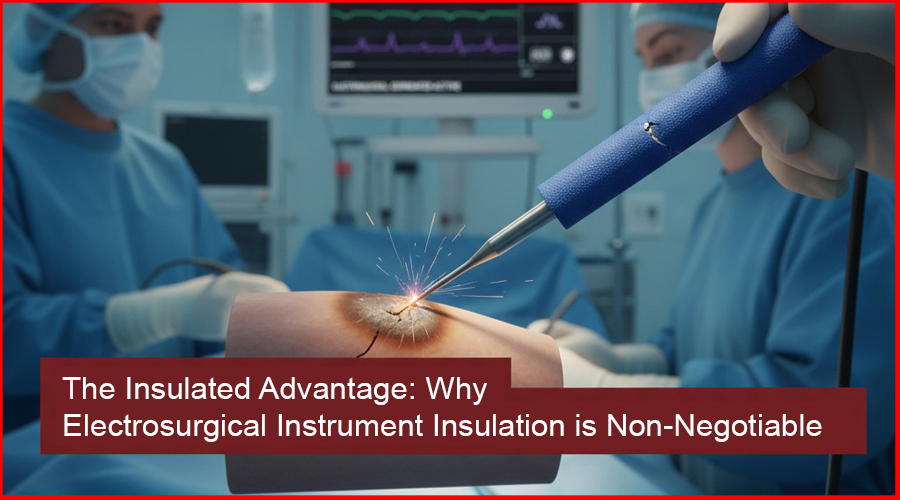
Insulation Failure: If the insulation on the instrument shaft has a small crack, pinhole, or tear, current can leak and cause a severe burn at the site of the defect, often in an area of the body that the surgeon cannot see. This is arguably the most insidious and dangerous form of electrosurgical injury.
The insulation, therefore, is not merely a coating; it is a crucial safety barrier that localizes the high-frequency current, protecting surrounding tissue from harm and ensuring the surgeon’s intended tissue effect is achieved precisely.
2. Types of Insulation: Materials and Manufacturing Processes
The effectiveness of an instrument’s insulation depends on two key factors: the material used and the process by which it is applied. Lapex Surgical invests in both to ensure a superior, long-lasting product.
Common Insulation Materials
Silicone: This is a popular choice for reusable electrosurgical instruments due to its excellent dielectric properties (ability to resist electrical current), flexibility, and durability. It can withstand repeated sterilization cycles, including autoclaving, without significant degradation.
PTFE (Teflon): PTFE is known for its low friction, high thermal resistance, and excellent dielectric properties, making it a suitable coating for certain instruments.
Nylon and Other Polymers: Various other high-performance polymers are used for insulation, each with specific properties regarding durability, thermal resistance, and flexibility.
The Lapex Surgical Manufacturing Process
At Lapex Surgical, the insulation process is a science unto itself, built upon our deep-seated expertise in surgical instrument manufacturing.
Surface Preparation: The metal shaft of the instrument is meticulously cleaned and prepared. Any residual oils or microscopic particles are removed to ensure a perfect bond between the insulation and the metal.
Application: The insulation material is applied evenly along the instrument’s shaft. For a complete and uniform coating, we use a process that ensures there are no pinholes or thin spots where current could leak.
Curing and Hardening: The applied insulation is then cured at a specific temperature to achieve its final hardness and durability. This step is critical for ensuring the insulation can withstand the rigors of surgical use and repeated sterilization.
Final Inspection & Testing: This is the most critical step. Every insulated instrument is subjected to an electrical integrity test. This test involves applying a specific voltage across the insulation. A flawless instrument will show no current flow, indicating a complete and perfect barrier. Any instrument that fails this test is immediately discarded, a testament to our non-negotiable commitment to quality.
This meticulous process ensures that Lapex Surgical’s electrosurgical instruments are not just well-designed but are also safe from the ground up, providing a reliable barrier against electrical current spread.
3. Insulation Failure: Causes and Devastating Consequences
Despite the best manufacturing practices, insulation on reusable instruments can and will fail over time. Recognizing the causes of failure and understanding the consequences is paramount for surgical teams.
Causes of Failure
Mechanical Damage: This is the most common cause. A small nick from a scalpel, a crack from an instrument being dropped, or a scratch from rough handling in a tray can create a pathway for current.
Wear and Tear: Repeated use, particularly in tight surgical spaces, causes cumulative wear on the insulation.
Sterilization Degradation: While our insulation is designed to withstand autoclaving, repeated exposure to high temperatures over a long period can eventually lead to material degradation, cracking, and thinning.
Improper Cleaning: Rough cleaning, using abrasive materials, or failing to remove stubborn debris can damage the insulation, leading to failure.
Manufacturing Defects: Though rare in high-quality instruments from Lapex Surgical, microscopic pinholes or inconsistencies from the manufacturing process can be present, which is why our electrical integrity testing is so critical.
Consequences of Failure
The consequences of insulation failure can be catastrophic. An uninsulated portion of an instrument can act as an active electrode, causing a burn where the surgeon doesn’t expect it. In laparoscopic surgery, this can lead to:
Unseen Burns: A pinhole in the insulation on a laparoscopic instrument can cause a burn to the bowel, bladder, or another organ. Since the incision is tiny and the burn is often far from the camera’s view, it can go unnoticed during the procedure.
Delayed Complications: An unnotified burn can lead to necrosis (tissue death) and perforation of an organ days after the surgery, resulting in a severe infection, a second, emergency surgery, and a prolonged recovery for the patient.
The risk is silent and severe. This is why a routine inspection protocol is non-negotiable.
4. Inspection Protocols: How to Routinely Check Insulation Integrity
The responsibility of maintaining insulation integrity extends from the manufacturer to the surgical team. Every time a reusable electrosurgical instrument is processed for sterilization, it should be visually and functionally inspected.
The Visual Inspection Protocol
This is a simple, yet powerful, first line of defense. The surgical technician or nurse should:
Clean Instrument Thoroughly: Ensure the instrument is completely free of tissue, blood, or debris.
Inspect under Magnification: Use a lighted magnifier or a special inspection device to meticulously examine the entire length of the insulated shaft.
Look for Specific Defects: Look for any of the following signs of damage:
Cracks or Crazing: Small hairline cracks in the insulation.
Punctures or Pinholes: Tiny holes or nicks that expose the underlying metal.
Flaking or Peeling: Areas where the insulation is separating from the instrument.
Discoloration: Severe discoloration can be a sign of thermal damage.
The Functional Inspection
For a more comprehensive check, some institutions use an insulation tester. This small device applies a safe, controlled voltage to the instrument and a sensor that runs along the shaft. If the insulation is breached, the device will emit an audible or visual alert, pinpointing the exact location of the defect.
Summary of Inspection Protocol
Step | Action | Why It Matters |
|---|---|---|
Cleaning | Thoroughly remove all organic debris. | A clean surface allows for a clear visual inspection. |
Visual Check | Meticulously examine the entire shaft with magnification for any damage. | The first and most accessible way to detect visible flaws. |
Functional Test | Use an insulation tester to confirm the electrical integrity. | Detects microscopic, invisible flaws that could lead to severe burns. |
5. Repair vs. Replacement: Making the Right Call
When insulation is damaged, the question is always: should we repair it or replace the instrument? The answer is simple and non-negotiable: electrosurgical instruments with compromised insulation should never be repaired; they must be removed from use and replaced.
While some mechanical instruments can be repaired (e.g., sharpening scissors or replacing a spring), the integrity of an insulated instrument is binary—it’s either perfect or it’s not. A “repaired” spot of insulation can create a weak point, leading to a much higher risk of failure. Given the catastrophic potential of a burn, the cost of a new instrument is negligible compared to the cost of a patient injury, legal action, and damage to a hospital’s reputation.
Lapex Surgical’s instruments are built for durability and to withstand repeated sterilization. However, like any tool, they have a lifespan. We strongly advise that any instrument with confirmed insulation damage be immediately removed from circulation and replaced with a new, tested instrument.
6. Lapex Surgical Standards: Our Commitment to Superior Insulation
At Lapex Surgical, our commitment to superior insulation is more than just a procedural step; it is a core value. We believe that true quality is an invisible force, one that can be trusted without question in the operating room.
A Heritage of Quality
Our deep-seated heritage in Sialkot, Pakistan, is not just about forging steel; it’s about a culture of uncompromising quality control. This is a city where every craftsman understands that a flawless finish is a matter of professional pride, and in the case of surgical instruments, a matter of life and death.
Our Four-Pillar Assurance
Premium Materials: We start with the best. Our insulation materials are sourced for their superior dielectric properties, durability, and biocompatibility.
Meticulous Application: Our manufacturing processes are precisely controlled to ensure a uniform, pinhole-free coating that adheres perfectly to the instrument’s shaft.
Rigorous Testing: Every single electrosurgical instrument we produce undergoes a mandatory electrical integrity test to confirm the flawless performance of its insulation before it ever leaves our facility. This is our final, non-negotiable quality gate.
Education and Partnership: We see ourselves as partners with the global surgical community. We provide clear guidelines for the inspection and care of our instruments and actively work to educate healthcare professionals on the importance of insulation integrity.
Conclusion
The insulated advantage is a cornerstone of safe and effective electrosurgery. It is a critical layer of protection that localizes a powerful electrical current, preventing unintended burns and safeguarding patient well-being. The integrity of an instrument’s insulation is non-negotiable—a single, unseen flaw can lead to devastating consequences.
For Lapex Surgical, insulation is not just a feature; it is a promise. From our artisans in Sialkot who pour generations of craftsmanship into every instrument, to our rigorous testing protocols, we are committed to providing the surgical community with instruments that offer the utmost confidence. By understanding the role of insulation, recognizing the signs of failure, and adhering to strict inspection and replacement protocols, surgeons and healthcare professionals can work in partnership with Lapex Surgical to ensure that patient safety remains the highest priority in every procedure.
Frequently Asked Questions (FAQ)
Q1: What is the difference between direct coupling and insulation failure?
A1: Direct coupling happens when a bare active electrode touches another metal object, transferring current and causing an unintended burn. Insulation failure is when a break in the insulation itself allows current to leak from the instrument’s shaft, causing an unintended burn at the site of the break.
Q2: Can I repair a tear in my electrosurgical instrument’s insulation?
A2: No. Electrosurgical instruments with compromised insulation should never be repaired. A patched area can be a weak point, leading to a higher risk of failure. It is a fundamental safety protocol to remove such instruments from use and replace them.
Q3: How often should I inspect my electrosurgical instruments?
A3: A full visual and, if possible, functional inspection should be performed on every electrosurgical instrument after each use and before sterilization. A small amount of time spent on inspection can prevent a major patient complication.
Q4: How does Lapex Surgical’s Sialkot heritage help with insulation quality?
A4: Our heritage provides us with a skilled workforce that understands meticulous craftsmanship. The precision required for flawless surface preparation and the uniform application of insulation is a direct result of these inherited skills, which are essential for creating a durable and reliable safety barrier.
Q5: What certifications does Lapex Surgical have to ensure product quality and safety?
A5: We operate under a rigorous Quality Management System that is certified to ISO 13485:2016 and our products bear the CE Mark (MDR 2017/745), among others. These certifications validate our commitment to the highest international standards of quality and regulatory compliance.
Q6: Are disposable electrosurgical instruments safer from an insulation perspective?
A6: Disposable instruments, being used only once, eliminate the risk of insulation degradation from repeated use and sterilization. However, manufacturing quality is still paramount. Lapex Surgical applies the same rigorous quality control and electrical integrity testing to our disposable instruments as we do to our reusable ones, ensuring safety regardless of the product type.