Table of Contents
ToggleLaparoscopic Maryland Forceps: Choosing the Right Grasp for Every Surgical Challenge
Precision and adaptability are paramount in the dynamic world of minimally invasive surgery. The laparoscopic Maryland forceps, often considered the laparoscopic instrumentarium’s workhorse, embody these qualities. Its unique design allows for grasping and blunt dissection, making it an indispensable tool across various surgical procedures. However, the true art lies not just in possessing this versatile instrument but in mastering the “right grasp” for every surgical challenge. This comprehensive article delves into the nuances of laparoscopic Maryland forceps, offering practical insights and detailed guidance to empower surgeons in optimizing their instrument selection and achieving superior outcomes.
The Anatomy of Versatility: Understanding the Maryland Forceps
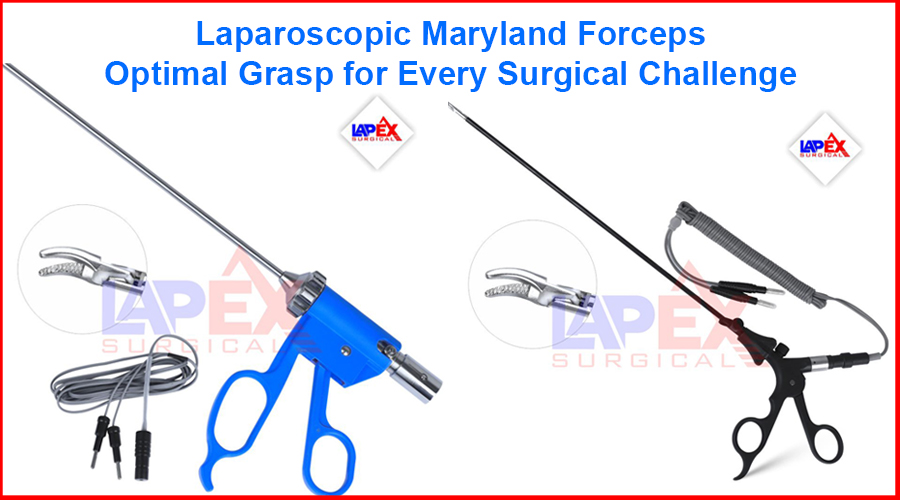
The Maryland forceps derives its name from its characteristic curved jaws, resembling the shape of Maryland’s coastline. This distinct curvature, combined with fine serrations on the inner surface of the jaws, provides a delicate yet secure grip on tissues. Unlike traditional grasping forceps with their more aggressive teeth, the Maryland’s design minimizes tissue trauma, making it ideal for manipulating delicate structures, dissecting planes, and even providing counter-traction during cutting.
Key Features and Benefits:
- Curved Jaws: Facilitates access to difficult-to-reach areas and provides an optimal angle for tissue manipulation.
- Fine Serrations: Offers a secure, non-traumatic grip on various tissue types, from delicate peritoneum to fibrous adhesions.
- Blunt Tip: Allows for gentle blunt dissection, separating tissue planes with minimal risk of injury.
- Fenestrated Jaws (optional): Some Maryland forceps feature fenestrated jaws, which reduce tissue slippage, especially with fluid-laden or friable tissues.
- Shaft Length and Diameter: Available in various lengths (e.g., 33cm, 45cm) and diameters (e.g., 5mm, 10mm) to accommodate different surgical fields and port sizes.
- Rotation Mechanism: Most modern Maryland forceps allow for 360-degree rotation of the jaws, providing precise control and maneuverability.
- Monopolar Cautery Compatibility (optional): Many Maryland forceps are designed for monopolar cautery, allowing for simultaneous dissection and coagulation, streamlining procedures.
The “Right Grasp”: More Than Just Holding On
The concept of the “right grasp” extends beyond simply holding tissue. It encompasses a nuanced understanding of tissue characteristics, the surgical objective, and the optimal application of the Maryland forceps’ unique design. A skilled surgeon leverages Maryland’s versatility to achieve:
- Precise Dissection: Gently separating tissue planes without tearing or avulsing.
- Secure Retraction: Providing stable counter-traction to expose the surgical field.
- Delicate Manipulation: Handling fragile structures like nerves, vessels, and bowel with minimal trauma.
- Efficient Hemostasis: Utilizing the cautery function for precise coagulation.
- Controlled Transection: Assisting in the clear visualization and stabilization of tissue for cutting instruments.
Choosing the Right Grasp: A Practical Guide for Every Surgical Challenge
The selection of the appropriate grasp is a critical decision that influences surgical efficiency, patient safety, and ultimately, the success of the procedure. Here’s a detailed breakdown of considerations and techniques for various surgical scenarios:
1. Tissue Dissection: Unraveling the Layers
The Maryland forceps excels at blunt dissection, separating tissue planes by gently pushing and sweeping motions.
- Delicate Peritoneum/Areolar Tissue:
- Grasp: A very light, broad grasp, almost like a “pinch” rather than a firm hold. The curved tip should be used to sweep and separate.
- Technique: Gentle, sweeping motions, leveraging the blunt tip to define planes. Visualize the underlying structures to avoid inadvertent injury.
- Why it works: Minimizes tearing and allows for precise identification of avascular planes.
- Fibrous Adhesions:
- Grasp: A slightly firmer, yet controlled, grasp on the adhesion. The curved tip can be used to hook and gently pull.
- Technique: A combination of gentle pulling and spreading, leveraging the curved jaw to apply traction. If very dense, consider combining with sharp dissection using scissors while the Maryland provides counter-traction.
- Why it works: Provides sufficient traction to stretch and break down adhesions without excessive force.
- Dissection Around Nerves and Vessels:
- Grasp: An extremely delicate, almost “hovering” grasp. The tip should be used for blunt pushing and separation, never for direct grasping of the nerve or vessel.
- Technique: Meticulous, slow, and deliberate movements, constantly assessing for potential injury. The Maryland acts as a “finger” to gently push away surrounding tissue.
- Why it works: Minimizes the risk of nerve or vessel injury by avoiding direct compression or traction.
2. Tissue Retraction: Unveiling the Surgical Field
Effective retraction is crucial for clear visualization and safe execution of surgical steps. The Maryland forceps can serve as an excellent retractor for various tissues.
- Bowel Retraction:
- Grasp: A broad, gentle grasp across a segment of bowel, avoiding direct compression or crushing.
- Technique: Use the broad surface of the curved jaws to gently push and hold the bowel away from the surgical field. Avoid applying excessive pressure that could compromise the blood supply.
- Why it works: Distributes pressure evenly, minimizing the risk of serosal tears or ischemic injury.
- Organ Retraction (e.g., Liver, Spleen):
- Grasp: A very broad, light grasp, ideally on a non-critical edge or capsule.
- Technique: Gentle, sustained pressure to move the organ out of the way. Often, another instrument (e.g., fan retractor) is used in conjunction with the Maryland for more stable retraction.
- Why it works: Provides temporary displacement without causing parenchymal damage.
- Peritoneal Fold Retraction:
- Grasp: A delicate grasp on the edge of the peritoneal fold.
- Technique: Gentle pulling and stretching to expose underlying structures or create a working space.
- Why it works: Creates tension in the tissue, facilitating easier dissection or access.
3. Tissue Manipulation: Precision in Placement and Stabilization
The Maryland forceps is invaluable for precise tissue manipulation, assisting in various intraoperative tasks.
- Suturing Assistance:
- Grasp: A firm, yet controlled grasp on the tissue edge to be sutured, providing counter-traction for needle passage.
- Technique: Stabilize the tissue firmly to allow for accurate needle placement. The curved tip can also be used to guide the needle through the tissue.
- Why it works: Ensures precise needle placement and reduces tissue tearing during suturing.
- Clip Application:
- Grasp: A secure grasp on the vessel or duct to be clipped, holding it taut and stable.
- Technique: Position the vessel/duct optimally for clip application, ensuring clear visualization of the structure.
- Why it works: Stabilizes the target for precise clip placement, minimizing slippage.
- Specimen Retrieval:
- Grasp: A secure, but non-crushing grasp on the resected specimen, especially for smaller specimens.
- Technique: Gently manipulate the specimen into the retrieval bag or through the port.
- Why it works: Allows for safe and controlled retrieval of tissue without fragmentation.
4. Hemostasis and Cautery: Beyond Mechanical Grasping
Many Maryland forceps are monopolar compatible, allowing for simultaneous grasping and coagulation. This dual functionality offers significant advantages.
- Spot Coagulation:
- Grasp: A very light, almost hovering grasp on the bleeding point.
- Technique: Activate the cautery current briefly while the tip is in contact with the bleeding vessel.
- Why it works: Provides precise and localized hemostasis, minimizing collateral tissue damage.
- Dissection with Coagulation:
- Grasp: A gentle grasp on the tissue to be dissected, often with a slight tension.
- Technique: Apply controlled cautery current as the tissue is gently separated, simultaneously dissecting and coagulating small vessels.
- Why it works: Streamlines the dissection process, reducing blood loss and improving visualization.
Factors Influencing Maryland Forceps Selection
Beyond the general principles of grasping, several practical factors influence the choice of a specific Maryland forceps:
- Shaft Length:
- 33cm: Standard length for most abdominal and pelvic procedures.
- 45cm: Ideal for obese patients, deeper surgical fields, or when operating from a greater distance.
- Shaft Diameter:
- 5mm: Most common and versatile.
- 3mm (Mini-Maryland): Used for highly delicate procedures, pediatric surgery, or when minimizing port size is crucial. Offers enhanced precision but reduced grasping power.
- 10mm: Less common for Maryland forceps, typically reserved for larger grasping instruments or tissue extraction.
- Insulation: Ensure the shaft is adequately insulated, especially if using monopolar cautery, to prevent accidental burns to surrounding tissues or organs.
- Ergonomics of the Handle: A comfortable and well-balanced handle reduces surgeon fatigue and enhances control.
- Disposable vs. Reusable:
- Disposable: Convenient, sterile, and eliminates reprocessing concerns. It may be more costly in the long run.
- Reusable: Cost-effective over time, but requires meticulous cleaning, sterilization, and regular inspection for wear and tear.
- Specialized Designs: Some Maryland forceps have subtle variations in jaw angle or serration patterns for specific applications (e.g., bariatric Maryland for deeper fields, or a more angled tip for specific anatomical access).
Maintenance and Care: Ensuring Longevity and Performance
Proper care and maintenance are crucial for the longevity and optimal performance of reusable Maryland forceps.
- Thorough Cleaning: Immediately after use, clean instruments to prevent blood and tissue from drying, which can make cleaning difficult. Use appropriate cleaning solutions and brushes.
- Inspection: Regularly inspect the jaws for damage, wear, or misalignment. Check the insulation for any breaks or cracks, especially if using monopolar cautery.
- Sterilization: Follow validated sterilization protocols (e.g., steam sterilization) to ensure complete sterility.
- Lubrication: Lubricate moving parts as recommended by the manufacturer to maintain smooth articulation.
- Storage: Store instruments in a way that prevents damage to delicate tips and jaws.
Challenges and Troubleshooting
Despite its versatility, using the Maryland forceps can present challenges:
- Tissue Slippage:
- Cause: Insufficient grasp, overly friable tissue, or excessive fluid.
- Solution: Re-adjust grasp, consider a fenestrated Maryland, or use a more dedicated grasping instrument.
- Tissue Trauma:
- Cause: Excessive force, inappropriate grasp for delicate tissue.
- Solution: Lighten the grasp, use gentler movements, and understand the tissue’s inherent fragility.
- Limited Reach/Visualization:
- Cause: Incorrect shaft length, suboptimal port placement.
- Solution: Consider a longer shaft, Maryland, adjust port placement, or utilize alternative instruments with different angles.
- Instrument Dysfunction (Reusable):
- Cause: Wear and tear, improper cleaning, or damage.
- Solution: Regular inspection, proper maintenance, and timely replacement of damaged instruments.
The Future of Laparoscopic Graspers
While the traditional Maryland forceps remains a cornerstone, advancements in surgical technology continue to refine and diversify grasping instruments:
- Robotic Maryland Graspers: Robotic platforms offer enhanced dexterity, tremor filtration, and often a wider range of motion, translating into even greater precision with Maryland-style graspers.
- Articulating Maryland Forceps: Some newer designs feature articulating tips, allowing for greater maneuverability within confined spaces.
- Integrated Sensors: Future instruments may incorporate haptic feedback or tissue recognition sensors to provide surgeons with real-time information about tissue tension and characteristics.
- Single-Use with Enhanced Features: Disposable Maryland forceps are evolving to offer more advanced features, bridging the gap between single-use convenience and advanced functionality.
Conclusion
The laparoscopic Maryland forceps is far more than just a simple grasping instrument; it is a testament to ingenious surgical design, offering unparalleled versatility for dissection, retraction, manipulation, and coagulation. Mastering the “right grasp” for every surgical challenge is a fundamental skill that distinguishes a proficient laparoscopic surgeon. By deeply understanding the instrument’s anatomy, its myriad applications, and the subtle art of tissue interaction, surgeons can unlock the full potential of the Maryland forceps, enhancing surgical precision, optimizing patient outcomes, and confidently navigating the complexities of minimally invasive surgery. Continued attention to instrument selection, meticulous technique, and diligent maintenance will ensure that the laparoscopic Maryland forceps remains an indispensable tool in the operating room for years to come.
For more information, feel free to contact the Lapex Surgical support team.