Comparing Single-Port vs. Multi-Port Laparoscopic Access Tools
Single-port laparoscopy (SPL) offers superior cosmesis and reduced parietal trauma, making it ideal for elective, straightforward procedures in well-selected patients. Multi-port laparoscopy (MPL) remains the gold standard for complex, high-stakes surgeries where triangulation, instrument freedom, and visual clarity are non-negotiable. The right choice depends on the procedure complexity, patient anatomy, available instrumentation, and the surgical team’s training — not on trend alone.
A Surgical Crossroads Worth Understanding
In the modern operating room, the portal through which a surgeon enters the abdomen is far more than a technical detail — it shapes everything from patient recovery time to surgical precision, cosmetic outcome, and procedural cost. As minimally invasive surgery continues to evolve at a breathtaking speed, two approaches have emerged as the dominant paradigms: single-port laparoscopic access and multi-port laparoscopic access.
For surgeons, OR managers, hospital procurement teams, and healthcare professionals making instrument decisions, understanding the mechanical, clinical, and economic distinctions between these two systems is not optional — it is foundational.
At Lapex Surgical, headquartered in Sialkot, Pakistan — one of the world’s foremost hubs for precision surgical instrument manufacturing — we engineer laparoscopic tools designed for both access philosophies. This article draws on decades of manufacturing expertise to deliver a thorough, evidence-aligned comparison that goes beyond marketing language and gets to the science, ergonomics, and real-world outcomes that matter.
What Is Laparoscopic Access? A Quick Primer
Laparoscopic surgery — also called minimally invasive surgery (MIS) or keyhole surgery — involves inserting a camera (laparoscope) and instruments into the body through small incisions rather than one large open cut. The size, number, and placement of these entry points are collectively referred to as “laparoscopic access.”
Access tools typically include:
- Trocars — hollow tubes inserted through the abdominal wall to maintain access ports
- Cannulas — the sheath through which instruments pass
- Optical ports — trocars with built-in visualization during insertion
- Hasson cannulas — blunt-tipped, open-entry access systems
- SILS (Single-Incision Laparoscopic Surgery) ports — specialized multi-lumen single-site platforms
The distinction between single-port and multi-port access defines the number of incisions, the type of platform used, the degree of instrument freedom, and ultimately, the patient’s postoperative experience.
Single-Port Laparoscopic Access: The Concept and the Instrument
What It Is
Single-port laparoscopy (SPL) — alternatively called single-incision laparoscopic surgery (SILS), single-access surgery (SAS), or transumbilical laparoscopic surgery (TULS) — is performed through one incision, typically at the umbilicus. A specialized multi-lumen port accommodates the camera and one or more working instruments simultaneously through a single fascial entry point.
Key Instruments in SPL Systems
| Instrument Type | Function | Design Consideration |
|---|---|---|
| Multi-lumen SILS port | Houses all instruments through one incision | Must allow simultaneous passage of 2–3 instruments + camera |
| Articulating/bent instruments | Compensate for lack of triangulation | Pre-curved shafts, flexible tips |
| Roticulator graspers | Allow internal angulation | Rotatable working end, rigid outer shaft |
| Curved cannulas | Offset instrument axes | Available in 5mm and 12mm diameters |
| Wound protector/retractor | Protects incision, holds the port | Silicone, latex-free options |
How the Single-Port Approach Works
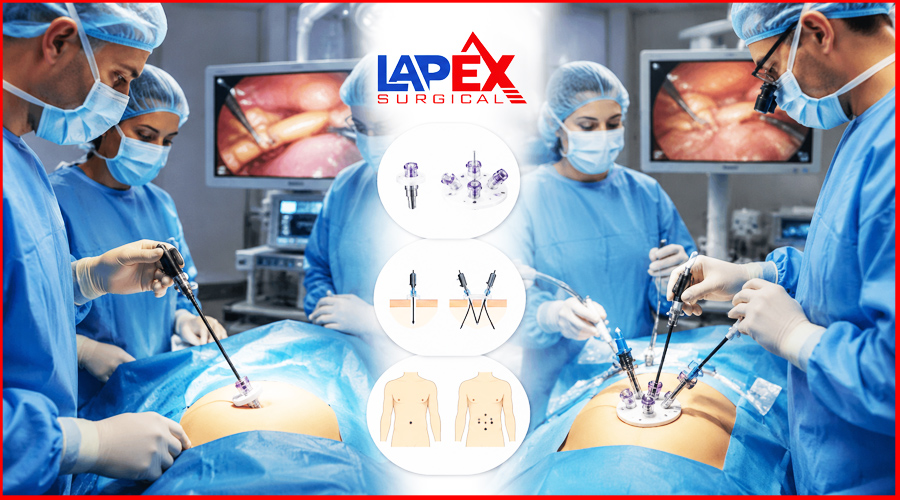
The surgeon makes one incision (typically 2–3 cm at the umbilicus), inserts the multi-lumen port, and then introduces the camera and all working instruments through the same opening. All instruments originate from the same axial point, creating what is known as “sword fighting” — a physical crowding of instrument handles outside the body that requires technique adaptation.
To overcome the loss of triangulation (the geometric separation of instruments that gives multi-port surgery its precision), specialized bent, articulating, and roticulating instruments are used to recreate internal working angles.
Multi-Port Laparoscopic Access: The Established Benchmark
What It Is
Multi-port laparoscopy (MPL) is the conventional laparoscopic model, using three to five separate incisions (typically 5–12 mm each) placed strategically across the abdomen. Each port accommodates one instrument or the camera, creating a geometric working triangle that gives the surgeon independent control of all tools.
Key Instruments in MPL Systems
| Instrument Type | Function | Design Consideration |
|---|---|---|
| Standard trocars (5mm, 10mm, 12mm) | Entry and access maintenance | Bladed or bladeless tip, reusable or disposable |
| Straight laparoscopic graspers | Tissue manipulation | Various jaw configurations for atraumatic or gripping use |
| Laparoscopic scissors | Dissection and cutting | Hook, curved, or straight blade options |
| Clip appliers | Vessel and duct ligation | Titanium or polymer clip mechanisms |
| Linear staplers | Bowel, vessel anastomosis | 30–60mm cartridge lengths |
| Irrigation/suction cannulas | Field management | Single-lumen or combined channels |
| Electrosurgical instruments | Coagulation and cutting | Monopolar hooks, bipolar forceps |
How the Multi-Port Approach Works
Ports are placed at anatomically calculated positions — often following the “baseball diamond” or “triangle” configuration — to ensure the camera and working instruments form optimal angles relative to the target tissue. This triangulation is the cornerstone of multi-port ergonomics: it gives each instrument independent access, minimizes tool collision, and allows the assistant to provide meaningful counter-traction.
Head-to-Head Comparison: Single-Port vs. Multi-Port
1. Incision Count and Cosmesis
This is where single-port access shines brightest.
Single-Port: One incision, hidden within or adjacent to the umbilicus — nature’s own scar. Patients who have undergone umbilical SILS cholecystectomy, for example, often report being unable to locate their incision weeks post-operatively. This matters deeply in elective procedures where body image and scar sensitivity are patient priorities.
Multi-Port: Three to five incisions distributed across the abdomen. Though individually small (5–12mm), they are visible and may scar, particularly in patients prone to keloid formation. For patients with darker skin tones or high scar sensitivity, multiple port sites represent a meaningful cosmetic burden.
Winner: Single-Port — by a significant margin for cosmetically conscious patients.
2. Triangulation and Instrument Freedom
This is where multi-port access asserts its dominance.
Multi-Port: Triangulation — the spatial separation of working instruments relative to the target — is the fundamental geometric advantage of multi-port surgery. When instruments enter the body from different points, they can approach the target tissue from multiple vectors. This allows:
- Precise countertraction
- Optimal dissection angles
- Clear separation of instrument handles outside the body
- Easy integration of a second assistant’s tools
Single-Port: All instruments converge from one axial origin. This creates “in-line vision” (the camera axis and instrument axes are parallel), which diminishes depth perception and fine control. Surgeons describe an adjustment period of 20–50 cases before achieving SPL proficiency equivalent to their multi-port baseline. Specialized articulating instruments help, but they introduce additional mechanical complexity, increased resistance, and tactile feedback loss.
Winner: Multi-Port — definitively, for complex procedures requiring nuanced dissection.
3. Operative Time
| Procedure | SPL Average Time | MPL Average Time | Difference |
|---|---|---|---|
| Laparoscopic Cholecystectomy | 52–78 min | 40–55 min | SPL: ~15–25 min longer |
| Appendectomy | 45–65 min | 35–50 min | SPL: ~10–20 min longer |
| Sleeve Gastrectomy | 80–110 min | 65–90 min | SPL: ~15–25 min longer |
| Colectomy | 150–200 min | 120–160 min | SPL: ~30–40 min longer |
| Adrenalectomy | 90–130 min | 70–110 min | SPL: ~20 min longer |
Note: Times decrease significantly with surgeon experience in SPL. Expert SPL surgeons approach MPL operative times.
Winner: Multi-Port — shorter operative times, particularly during the SPL learning curve.
4. Patient Pain and Recovery
Single-Port: Theoretically, one incision means less parietal trauma (injury to the abdominal wall muscles and fascia). Multiple studies have reported modestly reduced postoperative pain scores in SPL patients at 24 and 48 hours compared to three-port equivalents. Hospital stays are often comparable or slightly reduced.
Multi-Port: Multiple port sites create multiple points of fascial trauma. Each trocar puncture involves muscle splitting or cutting. Larger 10–12mm ports require fascial closure, adding a layer of postoperative discomfort. However, multi-port pain is well-managed and considered clinically acceptable across virtually all patient populations.
Winner: Single-Port — modest but measurable advantage in early postoperative pain.
5. Complication Rates
Single-Port: SPL carries a modestly elevated risk of:
- Port-site hernia — the single large fascial defect (20–30mm for SILS ports) is biomechanically weaker than three small individual defects
- Vascular injury during port placement — larger incision near the umbilical vessels
- Conversion to multi-port — required in 3–12% of SPL cases due to intraoperative difficulty
Multi-Port: MPL’s complication profile is extensively documented and well-understood. Risks include:
- Individual port-site hernias at 10–12mm sites (smaller risk per site)
- Injury during blind trocar insertion (mitigated by optical trocars)
- Subcutaneous emphysema at multiple sites
Winner: Multi-Port — more predictable, better-characterized complication profile across large patient volumes.
6. Surgeon Ergonomics and Learning Curve
| Factor | Single-Port | Multi-Port |
|---|---|---|
| Handle crowding (external) | Significant (“sword fighting”) | Minimal |
| Instrument reach | Limited by single-axis entry | Excellent, multiple vectors |
| Fulcrum effect | Exaggerated | Standard |
| Depth perception | Reduced (in-line vision) | Normal stereoscopic view |
| Learning curve | 20–50 cases | 15–30 cases |
| Assistant utility | Limited | Full |
| Surgeon fatigue | Higher | Lower |
Winner: Multi-Port — significantly better ergonomics and a gentler learning curve.
7. Instrument Design Demands
Single-port surgery demands a completely different instrument philosophy. Where multi-port tools can be straight, rigid, and simple, SPL instruments must compensate mechanically for what geometry no longer provides.
SPL-Specific Instrument Requirements:
- Pre-bent or articulating shafts — typically 35–45° angulation to recreate internal triangulation
- Roticulating ends — allow the working jaw to pivot independently of the shaft
- Reduced diameter — often 5mm to reduce crowding within the single port
- Longer working lengths — to allow handle separation outside the body
- Low-profile handles — minimize external collision
At Lapex Surgical, our laparoscopic instrument design team in Sialkot engineers dedicated SPL instrument sets with these mechanical requirements built into every component — from the heat-treated stainless steel shafts to the precision-milled jaw assemblies.
8. Cost Considerations
| Cost Factor | Single-Port | Multi-Port |
|---|---|---|
| Port/access system cost | Higher (specialized SILS port) | Lower (standard trocars) |
| Instrument set cost | Higher (articulating tools) | Lower (standard instruments) |
| Operative time cost | Higher (longer procedures) | Lower |
| Hospital stay cost | Comparable or slightly lower | Slightly higher |
| Reusability potential | Moderate | High |
| Training/credentialing cost | Higher | Lower |
Winner: Multi-Port — lower total procedural cost in most healthcare settings.
Procedures: Where Each Approach Excels
Best Suited for Single-Port Access
- Laparoscopic cholecystectomy (in select patients)
- Laparoscopic appendectomy
- Simple ovarian cystectomy
- Laparoscopic sterilization
- Laparoscopic sleeve gastrectomy (experienced teams)
- Adrenalectomy
- Splenectomy (selected cases)
Best Suited for Multi-Port Access
- Laparoscopic colorectal resections
- Laparoscopic Whipple/pancreatic procedures
- Complex gynecologic oncology
- Laparoscopic hernia repair (inguinal, hiatal, ventral)
- Laparoscopic fundoplication (Nissen, Toupet)
- Bariatric bypass procedures
- Laparoscopic nephrectomy
- Complex adhesiolysis
- Any emergency laparoscopy
The Role of Electrosurgical Instruments in Both Access Systems
Electrosurgical capability is essential in both SPL and MPL, but the constraints differ importantly.
In multi-port surgery, electrosurgical instruments — monopolar hooks, curved scissors, bipolar forceps, and advanced energy devices — can be introduced through dedicated ports with full freedom of movement. There is no geometric penalty for using a full-sized, ergonomically optimized electrosurgical handle.
In single-port surgery, electrosurgical instruments must contend with shaft angulation and space restrictions. Lapex Surgical manufactures insulated, bent-shaft monopolar dissectors and bipolar graspers specifically designed for SILS compatibility — maintaining full electrosurgical functionality while conforming to the spatial demands of single-incision access.
Key electrosurgical considerations across both platforms:
- Insulation integrity — critical in both; stray current is a real risk when instruments are in proximity (especially in SPL)
- Active electrode management — requires vigilance when multiple instruments share a narrow working corridor
- Generator compatibility — instruments must be matched to available electrosurgical units
- Arcing and coupling risks — elevated in SPL due to instrument proximity
Plastic Surgery Applications: Laparoscopic Access in Aesthetic and Reconstructive Procedures
Minimally invasive access tools have increasingly found application beyond traditional abdominal surgery. In plastic and reconstructive surgery, laparoscopic techniques are used for:
- Endoscopic brow lift — using small scalp ports
- Endoscopic abdominoplasty — for fascial plication via laparoscopic ports
- Latissimus dorsi harvest — endoscopically assisted flap harvest for breast reconstruction
- Thoracoscopic rib harvest — costal cartilage access for rhinoplasty or chest wall reconstruction
- Fibula free flap harvest assistance — vascular visualization
In these applications, single-port access is frequently preferred because the target is superficial, the anatomical plane is well-defined, and cosmesis of the entry point is itself part of the surgical goal. Multi-port access is reserved for deeper dissections or when additional retraction assistance is required.
Innovations Shaping the Future of Laparoscopic Access
Robotic-Assisted Single-Port Surgery
The da Vinci SP Surgical System has introduced robotic single-port surgery, using a single 25mm port through which articulating robotic arms deploy independently. This addresses SPL’s greatest limitation — loss of triangulation — by recreating internal instrument geometry robotically. However, cost remains a prohibitive factor for most healthcare systems.
Magnetic Anchoring and Guidance Systems (MAGS)
MAGS technology allows instruments to be introduced through a single port and then magnetically repositioned internally, eliminating external handle crowding. This remains investigational but represents a promising convergence of single-port access with multi-point internal instrument placement.
Natural Orifice Transluminal Endoscopic Surgery (NOTES)
NOTES eliminates abdominal wall incisions, accessing the peritoneum through the stomach, vagina, or rectum. While not yet mainstream, it represents the logical extreme of the single-port minimalism philosophy.
Smart Trocars and Pressure-Sensing Cannulas
Next-generation trocars incorporate pressure sensors, optical guidance systems, and even haptic feedback to make port placement safer and more reproducible — applicable to both SPL and MPL platforms.
Lapex Surgical: Engineering Instruments for Every Access Philosophy
Based in Sialkot, Pakistan — the city that supplies an estimated 60% of the world’s surgical instruments — Lapex Surgical designs and manufactures precision surgical, electrosurgical, plastic surgery, and laparoscopic instruments for global markets.
Our laparoscopic instrument range covers both access philosophies comprehensively:
For Multi-Port Laparoscopy:
- Reusable and disposable trocars (5mm, 10mm, 12mm) with bladed and bladeless options
- Hasson cannulas with radially dilating sleeves
- Complete grasper sets: atraumatic, toothed, fenestrated, and bowel graspers
- Monopolar hook electrodes, curved scissors, and straight dissectors
- Titanium clip appliers (5mm and 10mm)
- Suction-irrigation cannulas with Luer-lock compatibility
For Single-Port Laparoscopy:
- Pre-bent 5mm graspers and dissectors (35° and 45° angulation)
- Rotating laparoscopic scissors
- SPL-compatible bipolar graspers with reduced-profile handles
- Multi-lumen SILS port systems with wound retractor integration
- Curved cannulas for offset instrument placement
Every instrument leaves our Sialkot facility having undergone dimensional inspection, surface finish analysis, and functional testing — meeting ISO 13485 quality management standards.
Frequently Asked Questions (FAQ)
Q1: Is single-port laparoscopy safe for high-risk or obese patients?
A: Generally, no — at least not as a first choice. Obese patients (BMI >35) present challenges for SPL because the greater abdominal wall thickness limits instrument reach and maneuverability through a single port. Multi-port access is preferred in this population because additional ports can be placed to compensate for the larger working distances. High-risk patients also benefit from the shorter operative times and more predictable intraoperative control that MPL offers.
Q2: Can a surgeon transition from a multi-port to a single-port technique without specific training?
A: Not safely without dedicated practice. SPL requires unlearning fundamental ergonomic reflexes established during MPL training. The reversed fulcrum effect, in-line vision, and handle crowding create a new sensorimotor environment. Most surgical training programs recommend a structured proctored transition of at least 15–20 supervised cases before performing SPL independently.
Q3: What is “sword fighting” in single-port laparoscopy?
A: “Sword fighting” refers to the external collision and crowding of instrument handles outside the body during single-port surgery. Because all instruments emerge from the same incision, their handles converge in a small external space, causing them to physically interfere with each other — resembling a sword fight. This is managed through instrument design (low-profile handles, longer working lengths) and technique (using opposing instrument angles, alternating movements).
Q4: Which access system is more cost-effective for a high-volume surgical center?
A: For most high-volume centers, multi-port laparoscopy with reusable instruments offers the best cost-per-procedure profile. Reusable trocars, graspers, and scissors from manufacturers like Lapex Surgical can be resterilized through hundreds of cycles, amortizing the initial instrument cost dramatically. Single-port systems, with their specialized articulating instruments and SILS port costs, carry higher per-procedure costs that are difficult to offset even with marginally shorter hospital stays.
Q5: Are single-port incisions truly “scarless”?
A: Not truly, but practically close in many cases. The umbilical incision used in SILS heals within the natural contours and skin folds of the navel, making the resulting scar nearly invisible at conversational distance. However, it is not literally “scarless” — tissue is incised and must heal. For procedures where patients request minimal scarring (elective cholecystectomy in young women, for example), SILS offers a clinically meaningful cosmetic advantage.
Q6: How do instrument material and finishing affect performance in laparoscopic access tools?
A: Significantly. High-grade surgical stainless steel (typically 304 or 316L) ensures corrosion resistance through repeated autoclave sterilization cycles. Instrument finishing — whether hand-polished, electro-polished, or satin-finished — affects both glide resistance within trocars and the reflectivity of the instrument shaft under camera illumination. Lapex Surgical’s laparoscopic instruments undergo multi-step finishing to achieve surface consistency that supports both sterilization longevity and in-procedure visibility.
Q7: What is the port-site hernia risk comparison between SPL and MPL?
A: SPL carries a modestly higher absolute risk of port-site hernia because the single fascial defect is significantly larger (20–30mm for most SILS ports) compared to the 5–12mm individual defects of MPL. Larger fascial defects require more meticulous closure and are biomechanically more prone to failure, particularly in patients with connective tissue weakness, obesity, or significant postoperative coughing/straining.
Q8: Can single-port techniques be used in emergency laparoscopy?
A: Rarely recommended. Emergency laparoscopy — for trauma, perforated viscus, or bowel obstruction — demands rapid access, broad visualization, and maximum instrument freedom. Single-port access adds unnecessary complexity in scenarios where speed and reliability are paramount. Multi-port access should be the default for all urgent and emergent laparoscopic indications.
Q9: What makes Sialkot a credible manufacturing location for laparoscopic instruments?
A: Sialkot has been a global center of surgical instrument manufacturing for over a century, with a concentrated cluster of skilled craftsmen, metallurgical expertise, and export infrastructure that serves hospitals and surgical distributors across Europe, North America, and Asia. The region’s manufacturers, including Lapex Surgical, increasingly operate under ISO 13485 quality management systems and meet CE marking requirements for European market access. The combination of skilled labor, material expertise, and manufacturing scale makes Sialkot instruments competitive in both quality and price against European and North American alternatives.
Decision Framework: Choosing the Right Access System
When selecting between single-port and multi-port access for a given case or program, consider the following structured framework:
Patient Factors
- BMI — SPL for BMI <30 ideally; MPL preferred above BMI 35
- Previous abdominal surgery — adhesions favor MPL for broader access
- Cosmetic priority — high priority supports SPL in elective cases
- Risk tolerance — higher-risk patients benefit from MPL’s shorter operative times
Procedure Factors
- Complexity — simple, well-defined anatomy supports SPL; complex dissection demands MPL
- Expected bleeding — vascular cases benefit from MPL’s superior hemostatic instrument access
- Conversion likelihood — SPL has higher conversion rates; MPL offers smoother escalation
Team Factors
- Surgeon SPL experience — do not perform SPL without adequate training volume
- Instrument availability — SPL without appropriate articulating tools is unsafe
- OR team familiarity — scrub nurses and OR staff need SPL-specific instrument knowledge
Institutional Factors
- Cost structure — disposable SPL systems are expensive; reusable MPL instruments lower per-case costs
- Volume — SPL expertise requires consistent case volume to maintain proficiency
- Training program — credentialing and proctoring programs must be in place
Summary Comparison Table
| Parameter | Single-Port | Multi-Port |
|---|---|---|
| Incisions | 1 (2–3 cm) | 3–5 (5–12 mm each) |
| Cosmesis | Excellent | Good |
| Triangulation | Limited | Excellent |
| Operative time | Longer | Shorter |
| Learning curve | Steeper | Gentler |
| Surgeon ergonomics | Challenging | Comfortable |
| Instrument complexity | High | Standard |
| Instrument cost | Higher | Lower (reusable) |
| Postoperative pain | Modestly lower | Well-controlled |
| Port-site hernia risk | Higher (larger defect) | Lower (smaller defects) |
| Emergency applicability | Not recommended | First choice |
| Complex procedure suitability | Limited | Excellent |
| Robotic integration | Available (SP systems) | Mature (multi-arm) |
| Best patient profile | Low BMI, elective, cosmesis-priority | All comers |
The Right Tool for the Right Operation
The comparison between single-port and multi-port laparoscopic access tools is not a competition with a universal winner — it is a clinical calculus that must be solved fresh for each patient, procedure, and surgical team.
Multi-port laparoscopy remains the backbone of minimally invasive surgery globally. Its established safety profile, superior triangulation, ergonomic advantage, shorter operative times, and lower instrument cost make it the default choice for the vast majority of laparoscopic procedures. It is the platform on which surgical excellence is built.
Single-port laparoscopy offers genuine, meaningful advantages in carefully selected patients and procedures — primarily in cosmesis and the philosophical elegance of a single point of entry. As instrument design continues to evolve and robotic SPL systems mature, their procedural reach will expand. But it demands more of surgeons, more of instruments, and more of OR teams — and should be adopted with eyes open to those demands.
At Lapex Surgical, we build instruments for both worlds — engineered with the precision that Sialkot has perfected over generations, and designed for the clinical realities that surgeons face every day. Whether you are building a single-port program from the ground up or optimizing your multi-port instrument set for higher volumes, our team is equipped to support your clinical and procurement needs.
Lapex Surgical — Surgical, Electrosurgical, Plastic Surgery & Laparoscopic Instruments. Manufactured in Sialkot, Pakistan. Trusted Worldwide.