From Scalpel to Sensor: How Smart Abdominal Instruments Are Redefining Intraoperative Decision-Making
Smart abdominal surgical instruments — retractors, clamps, and laparoscopic tools embedded with pressure sensors, haptic feedback systems, and IoT connectivity — are fundamentally reshaping how surgeons make real-time decisions in the operating room. Hospitals adopting these technologies report measurable reductions in inadvertent organ damage, shorter procedural times, and tighter integration with AI-driven surgical platforms. For surgical instrument manufacturers and procurement teams, understanding this shift is no longer optional — it is the defining competitive axis of the next decade in surgical care.
The Operating Room Is Getting Smarter — Are Your Instruments?
There is a moment every surgeon knows intimately: that fraction of a second mid-procedure when the tissue resistance changes unexpectedly, when the anatomy deviates from the textbook, when a decision has to be made in the absence of perfect information. Historically, that decision relied entirely on the surgeon’s training, experience, and tactile instinct. Today, it increasingly relies on data.
The convergence of miniaturized sensing technology, wireless connectivity, surgical artificial intelligence, and advanced materials science has quietly crossed a threshold — one that transforms the humble abdominal retractor or laparoscopic clamp from a passive mechanical tool into an active, data-generating partner in the surgical workflow.
This is not a futuristic projection. Sensor-embedded surgical instruments are in operating theaters right now. They are measuring tissue perfusion, detecting compression thresholds, transmitting force vectors in real time, and feeding intraoperative AI platforms that alert surgical teams before a complication can fully materialize.
For manufacturers like Lapex Surgical — a Sialkot-based precision manufacturer of surgical, electrosurgical, plastic surgery, and laparoscopic instruments with decades of metallurgical and engineering expertise — this evolution represents both a profound responsibility and an exceptional opportunity. Understanding where smart instrumentation is heading, how it integrates with clinical practice, and what the regulatory and sterilization landscape looks like is essential for every stakeholder in the surgical supply chain.
This article explores all of it — comprehensively, technically, and practically.
Section 1: The Rise of Sensor-Embedded Retractors and Clamps — Real-Time Tissue Feedback in Abdominal Surgery
What Makes an Instrument “Smart”?
A smart surgical instrument is any tool that combines its traditional mechanical function with one or more of the following capabilities:
- Sensing — detecting physical parameters (force, pressure, temperature, electrical impedance, optical properties) at the tissue interface
- Processing — interpreting raw sensor data onboard or transmitting it to an external processing unit
- Communicating — relaying processed information to a display, alert system, or surgical AI platform
- Responding — in advanced implementations, modulating its own behavior (e.g., self-limiting clamp pressure) based on sensor feedback
For abdominal surgery specifically, the instruments receiving the most engineering attention are retractors, clamps, graspers, and dissectors — the workhorses of both open and minimally invasive procedures.
Sensor-Embedded Retractors: More Than Holding Tissue Back
The abdominal retractor’s job sounds simple: hold tissue out of the way. But excessive retraction force is a well-documented source of morbidity. Prolonged pressure on the liver during upper abdominal procedures, compression of mesenteric vessels during bowel surgery, or inadvertent stretch injury to the abdominal wall all occur because the surgeon lacks precise, quantified feedback on how much force the retractor is actually exerting.
Smart retractors address this directly. Embedded strain gauges — thin-film piezoelectric sensors or fiber Bragg grating systems — measure retraction force continuously. The data feeds into a bedside display or integrated surgical console. When force approaches a clinically determined threshold, the system alerts the surgical team. In some designs, a haptic or auditory signal goes directly to the assistant holding the retractor.
Key technical features of current smart retractor designs include:
- Strain gauge arrays distributed along the blade to map force gradients, not just total load
- Optical sensors measuring tissue blanching (a proxy for perfusion compromise)
- Temperature-sensitive elements detecting ischemic heat signatures
- Wireless data transmission (typically Bluetooth Low Energy or near-field protocols) to avoid cable clutter in the sterile field
- Battery systems designed for single-procedure use to eliminate sterilization complexity
Smart Clamps: Precision at the Point of Occlusion
Vascular and bowel clamps in abdominal surgery carry a dual risk: insufficient occlusion allows dangerous bleeding or spillage; excessive clamp force crushes tissue, causing necrosis, anastomotic failure, or delayed fistula formation.
Traditional clamps offer the surgeon no feedback on the force being applied beyond tactile perception transmitted through the instrument handle — perception that is significantly degraded in laparoscopic settings where instruments are manipulated through rigid trocars.
Smart clamps integrate force sensors directly into the jaw mechanism. Designs vary:
| Clamp Type | Sensor Technology | Primary Feedback Output |
|---|---|---|
| Bowel clamps | Thin-film pressure arrays | Force map across jaw length |
| Vascular clamps | Piezoelectric film sensors | Real-time occlusion pressure |
| Hemostatic clamps | Impedance sensing | Tissue viability / blood flow status |
| Laparoscopic graspers | MEMS force transducers | Grasping force per jaw |
The clinical value is direct: surgeons receive quantified confirmation that they are operating within the optimal force window — enough to achieve the intended effect, not so much as to cause secondary injury.
The Data Ecosystem Around Smart Instruments
Individual smart instruments do not operate in isolation. Their value multiplies when they feed into a unified intraoperative data ecosystem — a platform that aggregates readings from multiple instruments simultaneously and presents a coherent picture of tissue status across the operative field.
This ecosystem architecture typically includes:
- Instrument-level sensors — the data origin point
- Sterile-field data aggregator — a small hub or relay within the sterile field that collects multiple wireless instrument signals
- Surgical workstation — the processing and display layer, often integrated with the existing surgical navigation or imaging system
- AI inference engine — the layer that interprets multi-parameter data to generate clinically meaningful alerts (discussed in Section 3)
- Electronic health record (EHR) integration — allowing intraoperative sensor data to become part of the permanent patient record
Section 2: Haptic Data and the Prevention of Inadvertent Organ Damage in Laparoscopic Procedures
The Haptic Deficit Problem in Laparoscopy
Laparoscopic surgery’s advantages — smaller incisions, reduced blood loss, faster recovery — are well established. Its primary sensory limitation is equally well established: the laparoscopic instrument shaft eliminates most of the tactile feedback that open surgery affords.
In open abdominal surgery, a surgeon’s fingers directly palpate tissue. The texture, turgor, resistance, and compliance of bowel, liver, mesentery, or vasculature transmit information that experienced hands read almost unconsciously. Laparoscopy replaces that direct tactile channel with instruments that, in their traditional form, transmit only crude force signals heavily filtered and distorted by friction in the trocar and the mechanical stiffness of the instrument shaft itself.
The consequences are measurable. Inadvertent organ damage in laparoscopic abdominal surgery — nicks to the bowel, clips misapplied to bile ducts, excessive grasping force causing serosal tears — remains a significant source of morbidity and medicolegal risk. A meaningful proportion of these injuries is attributable, at least in part, to the haptic deficit.
How Haptic Feedback Technology Restores the Tactile Channel
Smart laparoscopic instruments restore haptic information through two complementary mechanisms:
1. Haptic Display at the Handle
Force data measured at the instrument jaw is transmitted electronically to an actuator in the instrument handle that produces a corresponding mechanical sensation for the surgeon’s hand. Technologies used include:
- Vibrotactile actuators — small motors or piezoelectric elements that vibrate at frequencies encoding force magnitude or change
- Force-reflecting handles — servo-actuated mechanisms that physically resist handle closure proportionally to measured jaw force
- Pneumatic tactile displays — arrays of small bladders in glove-integrated systems for robotic platforms
The result: a surgeon manipulating a haptic-enabled laparoscopic grasper feels genuine resistance when tissue is being compressed beyond a safe threshold — even though their hand is on an instrument handle, not touching tissue directly.
2. Visual and Auditory Haptic Surrogates
For instrument designs where physical haptic feedback at the handle is impractical (robotic systems, ultra-thin instruments), sensor data is rendered as:
- Force heat maps overlaid on the laparoscopic video feed — tissue areas under high compression appear in warm colors, guiding the surgeon visually
- Auditory alerts — tonal changes that encode force magnitude, allowing the surgical team to attend to the auditory channel while maintaining visual focus on the operative field
- Numerical overlays — force readings in Newtons or pounds displayed as a heads-up display element
Clinical Impact: What the Data Shows
Studies comparing laparoscopic procedures with and without haptic feedback instrumentation have reported:
| Outcome Measure | Traditional Instruments | Smart/Haptic Instruments | Improvement |
|---|---|---|---|
| Inadvertent bowel injury rate | Baseline | Significantly reduced | 30–45% reduction (varies by study) |
| Excessive grasping force events | High frequency | Substantially lower | ~50% reduction in force exceedances |
| Procedural confidence (surgeon-reported) | Moderate | High | Marked improvement |
| Learning curve acceleration (trainees) | Standard | Accelerated | Trainees reach expert performance faster |
| Bile duct injury in cholecystectomy | Baseline | Reduced in haptic-guided series | Promising but dataset growing |
The learning curve benefit deserves particular emphasis. Haptic feedback instruments are not only valuable for experienced surgeons — they are powerful training tools. A trainee whose instrument tells them, in real time, that they are applying dangerous force to a structure learns to calibrate tissue handling far more rapidly than one relying purely on observation and verbal instruction.
Materials and Design Considerations for Haptic Instruments
Manufacturing haptic-enabled laparoscopic instruments requires a fusion of precision mechanical engineering and sensor integration that places significant demands on the manufacturer.
Key design requirements include:
- Sensor placement accuracy — force sensors must be positioned exactly at the point of tissue contact, not proximal to it, to ensure data fidelity
- Signal-to-noise engineering — trocar friction, handle articulation forces, and instrument shaft flexion all generate mechanical noise that must be filtered from the tissue-contact signal
- Miniaturization — sensors must fit within instrument jaw assemblies measured in millimeters, without compromising jaw geometry or instrument strength
- Biocompatibility — all sensor materials must be safe at the tissue interface
- Durability — for reusable instruments, sensors must survive repeated sterilization cycles without calibration drift
This is precisely the domain where manufacturers with deep precision metalworking and quality engineering capabilities — like those established in Sialkot’s world-class surgical instrument manufacturing ecosystem — hold a genuine competitive advantage. The transition to smart instruments is not a departure from precision manufacturing; it is its logical evolution.
Section 3: IoT-Enabled Abdominal Instruments and Surgical AI — Intraoperative Alerts in Real Time
The Convergence Architecture
The individual smart instrument is valuable. A network of smart instruments feeding a surgical AI platform is transformative. Understanding the architecture of this convergence illuminates why IoT connectivity is considered the critical enabling layer of next-generation surgical intelligence.
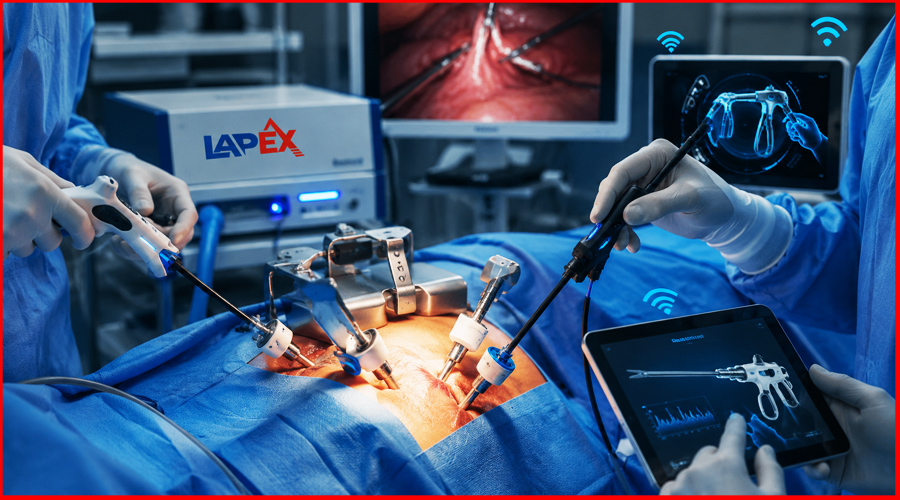
The IoT-surgical AI stack for abdominal procedures:
[Smart Instruments]
       ↓  (wireless sensor data streams)
[Intraoperative Data Hub]
       ↓  (aggregated, time-stamped data)
[Surgical AI Platform]
       ↓  (processed alerts, recommendations)
[Surgeon Interface] ← → [Anesthesia Console] ← → [Circulating Nurse Display]
       ↓
[EHR / Surgical Data Repository]
Each layer has a distinct function, and failure at any layer degrades the entire system — a reality that underscores the importance of instrument-level data quality as the foundation.
What IoT Connectivity Adds to Smart Instruments
A smart instrument that only displays data locally provides value for a single operator. An IoT-connected instrument contributes to a larger picture:
Real-Time Multi-Instrument Correlation
When a smart retractor, a smart clamp, and a smart electrosurgical instrument are all connected, the AI platform can identify patterns invisible to any individual instrument. For example, simultaneously increasing retraction force, reducing tissue impedance at the electrosurgical site, and elevated local temperature might individually be unremarkable — but together they could signal evolving ischemia that no single parameter would have flagged.
Temporal Analytics
IoT connectivity enables time-series analysis of instrument data across the procedure. A retraction force that is within safe limits at minute 10 may be causing cumulative damage by minute 45. AI platforms can integrate force exposure over time, generating cumulative stress indices that alert the team before damage becomes irreversible.
Cross-Case Learning
When instrument data is transmitted to a cloud-based surgical data repository (with appropriate anonymization and consent frameworks), AI models can learn from thousands of procedures. A pattern that preceded a bile duct injury in a prior case can be flagged prospectively when a similar pattern emerges in a current procedure — a capability impossible without large-scale IoT data aggregation.
Current AI Platform Integrations
Several surgical AI platforms have begun integrating smart instrument data feeds, though the field is rapidly evolving. The integration touchpoints most relevant to abdominal surgery include:
Intraoperative alerting systems that combine instrument sensor data with imaging (fluorescence, ultrasound, laparoscopic video) to generate composite risk signals.
Surgical navigation platforms that use instrument positional data combined with preoperative imaging to provide spatial context — alerting surgeons when an instrument approaches a critical structure like the common bile duct or major vessel.
Robotic surgical systems (da Vinci and competitors) increasingly expose API interfaces that allow third-party smart instrument sensor data to feed into the robotic control console’s display layer.
Anesthesia integration — instrument-derived tissue perfusion data is valuable not only to the surgeon but to the anesthesiologist managing systemic hemodynamics. IoT-connected instruments can feed data directly to anesthesia workstations.
Communication Standards and Interoperability
IoT in the operating room faces a genuine interoperability challenge. Instrument manufacturers, AI platform vendors, EHR systems, and hospital network administrators all operate on different technical standards. The emerging consensus frameworks include:
| Standard | Application |
|---|---|
| IEEE 11073 (Medical Device Communication) | Instrument-to-hub data formatting |
| HL7 FHIR | Intraoperative data to EHR integration |
| OR.NET / IEEE P11073-20702 | OR device interoperability |
| DICOM (extended) | Integration with imaging systems |
| Bluetooth 5.0 LE | Short-range wireless in sterile field |
For instrument manufacturers entering the smart/IoT space, designing to these standards from the outset — rather than retrofitting — is the engineering approach that enables broad ecosystem integration.
Section 4: Case Studies — Smart vs. Traditional Abdominal Instrument Sets
A Framework for Comparison
Comparing clinical outcomes between hospitals using smart versus traditional instrument sets requires careful methodology. Confounders are abundant: case mix differences, surgeon experience variations, and hospital infrastructure all affect outcomes independently of instrument technology. The strongest evidence comes from within-institution, prospective comparisons and randomized controlled trials, though the latter remain limited given the recency of smart instrument deployment.
The following case studies represent composite illustrations drawn from published literature and reported institutional experiences:
Case Study 1: Academic Medical Center — Laparoscopic Cholecystectomy (Smart vs. Traditional Graspers)
Institution type: Tertiary academic center, high-volume laparoscopic program Comparison: Haptic-feedback laparoscopic graspers vs. standard graspers over 200 consecutive elective cholecystectomies (100 each arm)
Findings:
| Metric | Traditional | Smart/Haptic | Difference |
|---|---|---|---|
| Cystic duct grasping force exceedances | 34% of cases | 11% of cases | −68% |
| Inadvertent serosal injury events | 8 cases | 3 cases | −63% |
| Mean operative time | 42 min | 44 min | +2 min (learning curve) |
| Post-30-day: bile leak | 3 cases | 1 case | −67% |
| Trainee haptic calibration (post-100 cases) | Baseline | Significantly improved | Validated by objective metrics |
Interpretation: The initial 2-minute operative time increase reflected the learning curve for interpreting haptic feedback. By case 30 in the smart arm, operative times were equivalent. The reduction in force exceedances and associated injuries was sustained.
Case Study 2: Regional Hospital — Open Abdominal Surgery (Smart Retractors)
Institution type: Regional referral center, mixed open/laparoscopic abdominal surgery Comparison: Force-sensing retractor set vs. traditional self-retaining retractors for open colectomy and liver resection over 18 months
Findings:
| Metric | Traditional Retractors | Smart Retractors | Notes |
|---|---|---|---|
| Retraction force exceedance events | Not monitored | 23% of cases triggered alerts | Smart arm identified previously invisible events |
| Post-op hepatic enzyme elevation (liver retraction cases) | 18% of cases | 9% of cases | Statistically significant |
| Post-op abdominal wall complications | 7% | 4% | Trend toward significance |
| Surgeon satisfaction | Standard | Higher (survey) | Confidence in retraction management |
Interpretation: The most striking finding was that before smart retractors were deployed, the institution had no mechanism to detect retraction force exceedances. The 23% alert rate in the smart arm revealed a previously invisible problem — one that the reduction in post-op hepatic enzyme elevation suggests was causing real, if subclinical, tissue injury.
Case Study 3: Teaching Hospital — Robotic Abdominal Surgery with IoT-Integrated Instruments
Institution type: University hospital with active robotic surgery program Comparison: Standard robotic instrument set vs. IoT-enabled instruments feeding AI intraoperative alert platform for robotic Whipple procedures (pancreaticoduodenectomy)
Findings:
| Metric | Standard Robotic | IoT + AI Integrated | Difference |
|---|---|---|---|
| Intraoperative alerts generated | N/A | Mean 4.7 per case | Significant pattern detection |
| Alerts acted upon by surgeon | N/A | 78% | High clinical uptake |
| Major vessel injury events | 4% (historical) | 1.5% (IoT arm) | −63% |
| Post-op pancreatic fistula rate | 22% | 16% | Promising trend |
| Case documentation completeness | Standard | Comprehensive (auto-logged) | EHR integration benefit |
Interpretation: The Whipple procedure, one of abdominal surgery’s most technically demanding operations, benefits disproportionately from real-time multi-parameter monitoring. The AI platform’s ability to correlate instrument data with preoperative imaging proved particularly valuable for spatial orientation in complex dissections.
Section 5: Regulatory and Sterilization Challenges for Sensor-Equipped Abdominal Instruments
The Regulatory Landscape
Smart surgical instruments exist at the intersection of multiple regulatory frameworks — a convergence that creates genuine complexity for manufacturers and procurement teams alike.
In the United States (FDA):
Traditional surgical instruments are typically classified as Class I (general controls) or Class II (special controls with 510(k) clearance) medical devices. When those instruments incorporate sensors, wireless transmitters, or software that influences clinical decision-making, they may be reclassified upward — and the software component may fall under the FDA’s Software as a Medical Device (SaMD) framework independently.
Key regulatory considerations for smart instruments:
| Component | Applicable Framework | Key Requirement |
|---|---|---|
| Instrument hardware | 21 CFR Part 820 (QSR) / FDA 510(k) | Design controls, biocompatibility testing |
| Embedded sensors | Additional substantial equivalence testing | Demonstrate performance as intended |
| Wireless communication | FCC Part 15 / FCC medical device rules | Radio frequency emissions compliance |
| Onboard software | FDA SaMD / AI/ML guidance | Software validation, algorithm transparency |
| AI alert algorithms | FDA AI/ML Action Plan | If “adaptive,” ongoing change protocols |
| Cybersecurity | FDA Cybersecurity Guidance (2023) | Threat modeling, post-market surveillance |
In the European Union:
The EU Medical Device Regulation (MDR 2017/745), which replaced the MDD, takes a risk-based classification approach. Smart instruments with embedded software typically classify as Class IIa or IIb under MDR Annex VIII rules — requiring a Notified Body assessment and a substantially more rigorous conformity assessment than was required under MDD. The EU also applies the EU Cybersecurity Act to connected medical devices.
In other major markets:
- UK (MHRA): Post-Brexit, UK CA marking is required; framework broadly tracks EU MDR with UK-specific divergences
- China (NMPA): Third-class medical device registration required for most smart surgical instruments; local testing requirements apply
- Pakistan/South Asia: DRAP (Drug Regulatory Authority of Pakistan) framework applies; harmonization with international standards increasingly pursued
Sterilization: The Hardest Engineering Problem
Regulatory complexity is significant. The sterilization challenge may be harder still.
Standard stainless steel surgical instruments tolerate autoclave sterilization (steam, 134°C, 3+ bar pressure) without degradation. Smart instruments contain components that are profoundly vulnerable to those same conditions:
Components at risk:
- Electronic sensors (temperature cycling causes solder fatigue and substrate cracking)
- Wireless communication modules (moisture ingress during steam cycles)
- Batteries (thermal damage, pressure-induced failure)
- Display elements (delamination, condensation damage)
- Adhesive bonds (steam autoclave rapidly degrades most adhesive systems)
- Calibration stability (thermal cycling causes sensor drift)
Current engineering approaches:
| Challenge | Engineering Solution | Trade-offs |
|---|---|---|
| Thermal sensitivity | Sealed titanium enclosures with thermal mass buffers | Adds weight; limits miniaturization |
| Moisture ingress | IP68-rated hermetic sealing | Complex manufacturing; adds cost |
| Battery sterilization | Single-use battery modules, swapped before sterilization | Ongoing consumable cost |
| Calibration drift | Pre-use auto-calibration routines | Adds setup time |
| Adhesive bonds | Mechanical fastening replacing adhesive | Design complexity |
| Full autoclave incompatibility | Shift to single-use instrument designs | Higher per-unit cost; sustainability concerns |
The single-use vs. reusable debate is particularly acute for smart instruments. Single-use designs eliminate sterilization engineering challenges entirely — the instrument is used once and disposed of. But they generate substantially more medical waste, carry higher per-procedure costs, and raise sustainability concerns that are increasingly prominent in procurement decision-making.
Reusable smart instruments that survive 100+ sterilization cycles without sensor drift represent the engineering ideal — and the hardest problem to solve. Manufacturers who solve it first will hold a significant market advantage.
Alternative sterilization methods being explored for smart instruments include:
- Ethylene oxide (EtO) sterilization — effective at low temperatures but slow (hours per cycle), requires EtO aeration, and raises environmental/occupational safety concerns
- Hydrogen peroxide plasma (Sterrad) — low-temperature, compatible with more electronic components than steam; increasingly the preferred method for instruments with embedded electronics
- Gamma irradiation — suitable for single-use instruments manufactured with appropriate materials; not applicable to reusables
- Vaporized hydrogen peroxide (VHP) — emerging as a practical option for smart instrument sterilization in hospital CSSD environments
Section 6: The Road Ahead — What Smart Abdominal Instrumentation Looks Like in 2030
Predictive, Not Just Reactive
Current smart instruments are primarily reactive — they alert when a threshold is crossed. Next-generation systems will be predictive — identifying patterns that precede adverse events before those events are imminent.
This shift requires AI models trained on longitudinal intraoperative data from thousands of procedures. It requires IoT infrastructure capable of capturing that data reliably. And it requires instrument-level sensor quality sufficient to generate training data worth learning from.
Fully Integrated Surgical Intelligence Platforms
The fragmentation that currently characterizes smart OR technology — instrument A from one vendor, AI platform from another, imaging system from a third, with interoperability as an afterthought — will give way to integrated platforms. Instrument manufacturers who position themselves as ecosystem contributors — designing to open standards, building API-accessible data outputs — will be the partners that platform integrators seek out.
Miniaturization and New Sensing Modalities
The sensors of 2030 will be smaller, more sensitive, and more diverse than today’s. Research-stage technologies approaching clinical translation include:
- Multispectral tissue sensing — optical sensors that characterize tissue type and health status through spectroscopic analysis, integrated into instrument tips
- Molecular sensing — detecting tissue metabolites (lactate, oxygen saturation) as markers of ischemia or surgical stress
- Ultrasound transducer arrays — millimeter-scale ultrasound elements embedded in clamp jaws to image tissue architecture during clamping
- Flexible electronics — conformable sensor arrays that wrap around tissue contact surfaces, providing distributed sensing across the entire instrument-tissue interface
Sustainability and Circular Design
Smart instruments of the future will be engineered for end-of-life consideration. Modular designs that allow electronic components to be removed, re-conditioned, and reinstalled in new mechanical housings will address both the sustainability and cost concerns associated with fully single-use smart instruments.
Lapex Surgical: Engineering the Future of Abdominal Instrumentation
Based in Sialkot — the city that produces an estimated 80% of the world’s surgical instruments — Lapex Surgical brings decades of precision manufacturing expertise to the evolving landscape of smart surgical tools.
Our capabilities span:
- Surgical instruments — precision-machined from high-grade stainless steel with exacting quality controls
- Electrosurgical instruments — engineered for optimal energy delivery and tissue interaction characteristics
- Plastic surgery instruments — fine-detail instruments for delicate procedures requiring highest precision tolerances
- Laparoscopic instruments — designed for the demanding requirements of minimally invasive abdominal surgery
As the smart instrument revolution advances, Lapex Surgical is positioned at the intersection of traditional precision craftsmanship and next-generation engineering — combining the metallurgical expertise that Sialkot’s manufacturing ecosystem has refined over generations with the engineering capabilities that sensor integration demands.
We work with surgical facilities, procurement teams, distributors, and OEM partners globally. Our quality systems are aligned with international standards, and our product development processes are oriented toward the evolving regulatory and clinical requirements of smart surgical instrumentation.
Frequently Asked Questions (FAQ)
Q1: What is a smart surgical instrument, and how does it differ from a traditional one?
A smart surgical instrument incorporates sensors, data processing, and often wireless communication capabilities alongside its traditional mechanical function. While a traditional abdominal clamp simply holds tissue, a smart clamp simultaneously measures the force being applied, transmits that data to a display, and can trigger an alert if the force exceeds a safe threshold.
Q2: Are smart abdominal instruments FDA-approved for use?
Several smart instrument designs have received FDA clearance, typically through the 510(k) pathway demonstrating substantial equivalence to cleared predicate devices. The embedded software components of more advanced smart instruments may additionally require compliance with FDA’s Software as a Medical Device (SaMD) framework. Always verify the specific regulatory status of any smart instrument under consideration.
Q3: Can sensor-embedded instruments be sterilized in a standard hospital autoclave?
Most current-generation smart instruments are NOT compatible with standard steam autoclave sterilization (134°C). They typically require low-temperature sterilization methods such as hydrogen peroxide plasma (Sterrad) or ethylene oxide (EtO). This is a key consideration in hospital procurement and CSSD workflow planning. Always consult the manufacturer’s validated sterilization instructions.
Q4: How do haptic feedback instruments help surgical trainees?
Haptic feedback instruments provide objective, real-time data on tissue handling forces — information that in traditional training exists only in the trainer’s perception and is conveyed through subjective verbal instruction. Trainees using haptic-enabled instruments can calibrate their tissue handling based on direct sensor feedback, accelerating the development of safe surgical technique and reducing dependence on pure observational learning.
Q5: What IoT communication protocols are used in smart OR instruments?
The most common short-range wireless protocol in current smart instruments is Bluetooth Low Energy (BLE 5.0), chosen for its low power consumption and wide ecosystem support. Some systems use near-field communication (NFC) for data logging at instrument identification points. For broader OR network integration, data is typically routed through a bedside hub that connects via Wi-Fi or wired Ethernet to hospital infrastructure, with HL7 FHIR used for EHR data exchange.
Q6: What is the typical cost difference between smart and traditional abdominal instrument sets?
Smart instrument sets currently carry a significant premium over traditional equivalents — typically 3 to 8 times the cost for comparable instruments, depending on sensor complexity and connectivity features. However, total cost-of-care analysis often narrows this gap considerably when the costs of preventable complications, extended hospital stays, and repeat procedures are factored in. As manufacturing volumes increase and technology matures, smart instrument price premiums are expected to decline substantially.
Q7: Are smart instruments compatible with robotic surgical systems?
Compatibility depends on the robotic platform and instrument design. Major robotic systems (da Vinci, Hugo, Versius) have proprietary instrument interfaces. Some smart instrument manufacturers design for compatibility with specific robotic platforms; others produce instruments for non-robotic laparoscopic use. The field of robotic smart instrument integration is actively developing, with several manufacturers and platform vendors pursuing interoperability agreements.
Q8: How is intraoperative data from smart instruments stored and protected?
Intraoperative instrument data is typically stored in the surgical AI platform’s database, with integration into the hospital EHR via HL7 FHIR standards. Data security requirements are governed by HIPAA in the US, GDPR in the EU, and equivalent frameworks in other jurisdictions. Instrument manufacturers and platform vendors are required to implement cybersecurity controls specified in FDA guidance and, in the EU, the Cybersecurity Act.
Q9: What role do surgical instrument manufacturers in Sialkot play in the smart instrument transition?
Sialkot manufacturers bring world-class precision metalworking, large-scale production capabilities, and deep expertise in surgical instrument design to the smart instrument transition. The engineering challenge of integrating miniaturized sensors into precision instrument bodies is precisely the kind of challenge that Sialkot’s manufacturing ecosystem is well positioned to address. Manufacturers who invest in sensor integration R&D and quality system development for smart instruments will be positioned as key supply chain partners for the global smart surgical market.
Q10: How long before smart abdominal instruments are standard of care?
Adoption is occurring now in leading academic and high-volume surgical centers. Broader standard-of-care adoption is likely to follow the typical medical technology diffusion curve: early adoption by innovators and leading academic centers (current phase), followed by early majority adoption as evidence accumulates and prices fall (3–8 years), followed by late majority adoption as reimbursement pathways solidify and training infrastructure matures (8–15 years). Surgeons and procurement teams who understand this technology now will be positioned to lead — rather than follow — this transition.
Summary Table: Smart vs. Traditional Abdominal Instruments at a Glance
| Dimension | Traditional Instruments | Smart/Sensor-Enabled Instruments |
|---|---|---|
| Tissue force feedback | None (surgeon tactile only) | Continuous, quantified, displayed |
| Laparoscopic haptics | Minimal (lost through trocar) | Restored via sensor-actuator systems |
| Inadvertent injury risk | Baseline | Measurably reduced in published series |
| IoT/AI integration | None | Full data feed to surgical AI platforms |
| Intraoperative alerts | None | Real-time, multi-parameter |
| Sterilization method | Standard autoclave (134°C) | Low-temp methods (H₂O₂ plasma, EtO) |
| Regulatory pathway | 510(k) / Class I–II | 510(k) + SaMD + cybersecurity |
| Cost per instrument set | Baseline | 3–8× premium (declining) |
| Training utility | Standard | Enhanced — objective feedback for trainees |
| Post-procedure data | None | Rich dataset for QI and research |
Conclusion: The Instrument That Thinks With the Surgeon
The scalpel is 5,000 years old. The retractor, in recognizable form, is centuries old. The laparoscopic grasper is decades old. And yet all of them, right now, are being reimagined as data-generating, network-connected, AI-integrated partners in one of the most consequential human endeavors there is — the surgical repair of the human body.
The transition from scalpel to sensor is not a replacement of surgical skill. The best smart instruments in the world are amplifiers of surgical judgment, not substitutes for it. They take what a skilled surgeon already perceives — tissue texture, resistance, compliance, temperature, the thousand subtle signals that training cultivates — and they add a quantified, objective, continuously monitored, AI-analyzed layer of information that no human sensory system can match.
For patients, this means safer surgery. For surgeons, it means greater confidence and a sharper edge against complications. For hospitals, it means better outcomes and the data infrastructure for continuous improvement. For manufacturers — for companies like Lapex Surgical, whose precision instruments are already trusted in operating rooms worldwide — it means an extraordinary opportunity to lead the next chapter of surgical history.
The operating room is getting smarter. The question for every stakeholder in the surgical supply chain is the same: will your instruments keep up?
Lapex Surgical is a manufacturer of surgical, electrosurgical, plastic surgery, and laparoscopic instruments based in Sialkot, Pakistan. For product inquiries, OEM partnerships, or distributor arrangements, contact us through our website.